
 Login
Login 

Rostering & Scheduling
Rostering Software Australia: How to Choose the Right Platform for Field Teams
By Duane Butler · 22 June 2026 · Updated 16 September 2026

Rostering software in Australia spans everything from drag-and-drop shift builders made for cafés to full workforce management platforms built for multi-site construction and FIFO mining. For trades, construction and mining services businesses, picking the wrong category of tool creates more problems than it solves.
The labels vary (staff rostering software, employee rostering software, roster software, rostering applications, employee scheduling software), but the buying decision is the same. This guide covers what workforce rostering software should do for Australian field businesses, what separates field-built platforms from generic scheduling tools, and how to think through the evaluation. If you’d rather start by looking at a field-built platform, the Humanz rostering software page is the short version of everything below.
What workforce rostering software actually needs to do
Before comparing platforms, be clear about the problem. Rostering a café with ten casual staff and one location is solved. There are dozens of adequate tools. Rostering a mechanical contracting business with 80 workers across four remote sites, a mix of direct employees and subcontractors, FIFO swings and strict WHS obligations is a different job entirely.
It’s also a job the labour market won’t rescue. Master Builders Australia counted 28,290 construction apprentices exiting their training early, without a qualification, during 2025, so the trades workforce isn’t getting deeper any time soon. The platform question is really a utilisation question. How much more work can the crew you already employ safely carry?
For Australian field businesses, workforce rostering software needs to handle:
- Multi-site visibility. All sites, crews and shifts in a single view, without flicking between separate rosters.
- Dynamic scheduling. Last-minute changes, callout shifts and crew swaps with an audit trail in real time with instant notification, plus automated staff rostering to build the baseline roster for you.
- Mixed workforce types. Direct employees and subcontractors rostered from the same platform, each with their own compliance profile.
- Compliance integration. Fatigue monitoring, licence currency and qualification checks embedded in the scheduling workflow before shifts are confirmed.
- FIFO and extended roster patterns. Swing rosters, rotating nights and back-to-back patterns that don’t fit a weekly template.
- Shift confirmation tracking. Knowing whether workers have seen and accepted shifts before the day of work.
- Mobile access. Coordinators and workers both need to manage and respond to rosters from their phones.
If a platform doesn’t handle all of these, it’s not built for the field.
Most of the confusion in this market comes from three quite different kinds of product being sold under one word. Comparing categories is more useful than comparing feature lists, because the category decides what the tool will never do well.
| What field work needs | Cafe and retail shift tools | HR and payroll suites | Field-built platforms |
|---|---|---|---|
| Multi-site live view | Built around one location | Reporting after the fact | The default view |
| Employees and subbies together | Employees only | Contractors sit elsewhere | One roster, both |
| Fatigue limits at booking | Not modelled | A policy document, not a gate | Blocks the booking |
| Licence and ticket currency | Not tracked | Filed in HR records | Checked when rostering |
| FIFO swings and travel | Weekly patterns only | Leave and absence focus | Handled natively |
| Shift confirmation | Usually present | Rarely | Seen and unseen per shift |
None of the three is bad at its own job. A cafe tool run by a cafe is a good tool, and our comparison of small-team rostering apps covers that end of the market fairly. The mistake is buying one category and expecting the behaviour of another, which is what happens when the only comparison anyone does is a feature list.
Staff rostering across four kinds of worker
On a field crew, staff rostering covers four kinds of people on the same job, each with rules the others don’t have. A tool built for one of them, usually permanent employees at one location, treats the other three as exceptions, and exceptions are where the phone calls come from.
| Worker type | What the roster has to know | Where it goes wrong in a generic tool |
|---|---|---|
| Permanent employees | Award hours, RDOs and approved leave already blocked out | Leave lives in a separate system, so the roster books over it |
| Casuals | Availability that changes weekly, and the regular pattern that builds up over months | Availability is a text message, and nobody can see the pattern forming |
| Labour hire | Your site rules and fatigue policy apply while the agency stays the employer | The worker isn’t in the system at all, so their hours across your sites are invisible |
| Subcontractors | The entity, its insurance and ticket currency, and whether the booking is with a business or a person | Booked by phone, tracked in a spreadsheet, never checked against expiry dates |
The labour hire row carries legal weight of its own, covered in the host employer’s obligations, state by state, and the subcontractor row starts with paperwork a roster can hold, set out in what to collect from subbies and how to check it. The rostering point is simpler than either: all four have to sit on one screen, each with its own compliance profile, or the coordinator is running four rosters and calling it one.
That is the line a field-built platform draws. In Humanz, employees, labour hire and subcontractors sit in the same roster, each with their own compliance profile, in one view of who’s available, qualified and compliant, so the shortlist for a shift has already been filtered by the rules that apply to each person on it.
Moving from spreadsheets to electronic rostering
Electronic rostering means building, publishing and changing the roster in software that reaches every worker’s phone, instead of a spreadsheet, a whiteboard or a printed sheet by the door. Plenty of field businesses run the roster in Excel long after it stops coping, because the spreadsheet got them this far and everyone knows where the tabs are. What the spreadsheet can’t do is message a worker when their shift moves, check a ticket before a name goes in a cell, or show two coordinators the same version at the same time. Electronic rostering fixes those three things on day one. Everything else is a bonus.
The migration is smaller than it looks. Five steps:
- Audit what you roster today. Sites, crews, shift times, swing patterns, and every unwritten rule living in the coordinator’s head. This is the step people skip and regret.
- Turn the patterns into templates. Your recurring rosters (the 2/1 swing, the weekday day shift, the standing night crew) become templates you apply rather than rebuild.
- Load workers and rules. Employees, subbies, tickets, inductions, fatigue limits. The system can only gate on what it knows.
- Publish to phones. Workers see shifts in the app and confirm them, and the ring-around stops being the publishing method.
- Measure. Fill rates, unfilled shifts, confirmation lag. The first month’s numbers become the baseline you improve against.
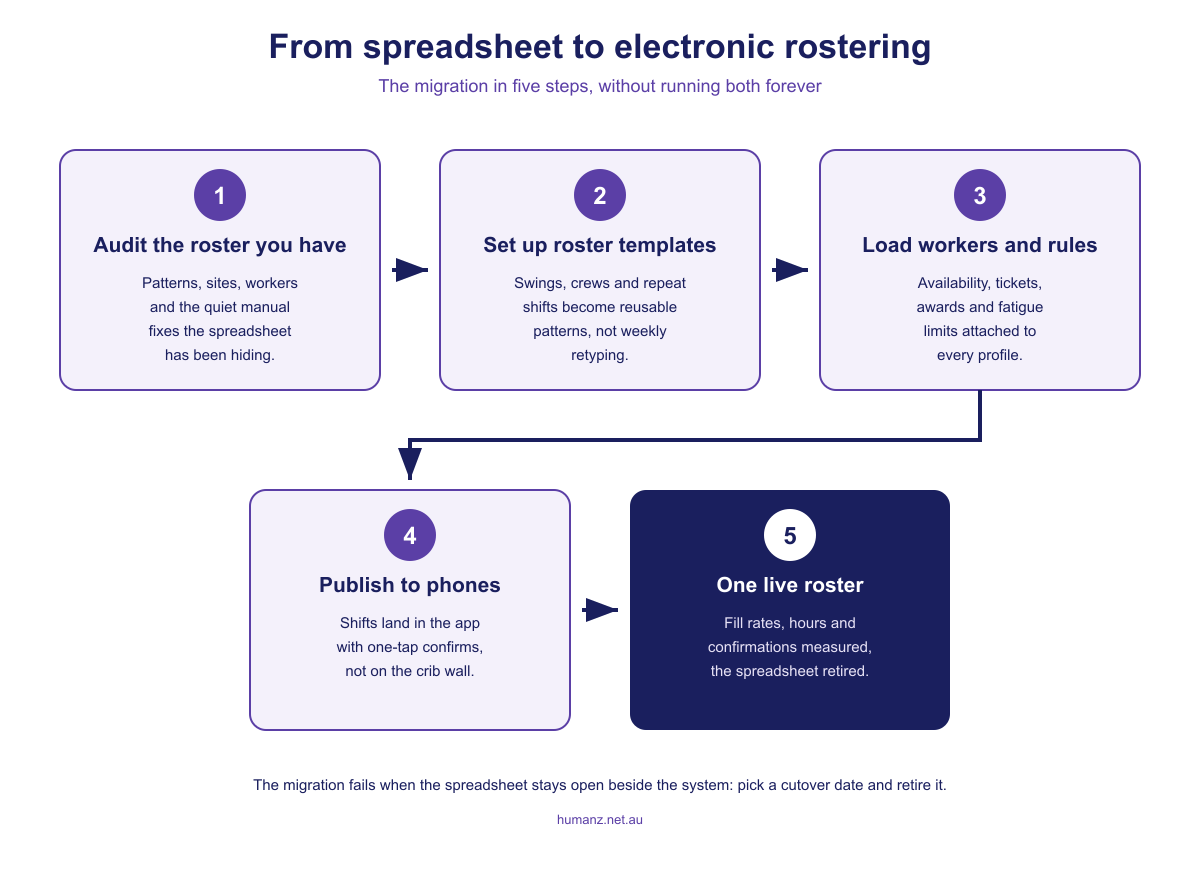
Keep the thinking, not the file. That spreadsheet encodes years of decisions about crew mixes and coverage, and all of it maps straight into templates. Then set a cutover date and honour it. The usual failure is running both in parallel “for safety”, indefinitely, at which point the spreadsheet stays the real roster and the online roster system becomes a copy nobody trusts. Two pay cycles side by side is prudence. Six months is a second job.
The compliance dimension of Australian rostering
Australian businesses operate under a compliance framework that generic rostering tools, particularly those built for international markets, often don’t account for.
Fair Work obligations
Modern awards set the minimum entitlements for employees in covered industries: minimum rest periods between shifts, maximum ordinary hours, overtime entitlements and penalty rates. The Fair Work Commission’s award finder is the definitive reference for which award applies to your workers and what it requires. A rostering system that doesn’t flag when a roster breaches these obligations is a liability, and not a theoretical one. The Fair Work Ombudsman secured a record $23.7 million in court penalties in 2024-25 and filed 73 new litigations, and roster decisions that quietly breach an award are exactly where that trouble starts.
For shift workers, the entitlements get complex. Fair Work Act compliance for shift workers covers the obligations Australian employers need to build into rostering decisions, and the Fair Work Ombudsman’s pay and conditions calculator is a practical way to check specific scenarios.
WHS fatigue obligations
Under work health and safety law, employers must manage foreseeable risks, including fatigue from excessive or poorly structured shift patterns. Safe Work Australia says businesses must eliminate or minimise the risk of fatigue so far as is reasonably practicable, and its model Code of Practice on managing that risk, published in September 2025, had been approved in Tasmania, New South Wales and the Northern Territory by March 2026.
Rostering software with fatigue monitoring built in (alerts when a roster pushes a worker past safe hour thresholds) turns that obligation from a manual checking exercise into an automated safeguard. Fatigue management software inside the scheduling workflow is the modern standard, and purpose-built fatigue management is what stops the check becoming someone’s Friday afternoon job. The impairment behind the rules is measurable: the Road Safety Commission of Western Australia puts being awake for 17 to 19 hours on par with a 0.05 blood alcohol reading. That’s the reality behind the regulation.
For transport operations, the National Heavy Vehicle Regulator sets prescriptive work and rest hour requirements. Mining businesses in WA work to the Work Health and Safety (Mines) Regulations 2022 and WorkSafe WA’s working hours code of practice, covered in fatigue and rosters under the WA mines regulations.
Licence and qualification requirements
Construction, mining and trades businesses must verify that workers hold current, valid qualifications for the work they’re assigned. The national training register at Training.gov.au is the reference point. A rostering system that tracks licence expiry and flags non-compliant workers at the scheduling stage takes human memory out of the loop.
The requirement runs deeper than licences. Most major sites now demand a current verification of competency per plant type before an operator touches the machine, whatever tickets they hold, and VOCs are the credential most likely to be site-specific and shortest-lived. A roster that can’t see VOC status books operators the gate will refuse. One that can makes the whole question disappear into the booking screen, which is where it belongs.
Manufacturing and engineering shift coverage
Manufacturing rostering has its own shape. The roster serves the production line, so shift patterns wrap around production runs and planned maintenance windows rather than customer demand. Coverage is about trades as much as headcount. A shift with 12 people and no electrician still stops the line. Engineering rostering carries the same problem into workshops and maintenance crews, where every shift needs the right mix of fitters, boilermakers and sparkies, not just enough bodies. And because continuous production usually means rotating shifts, the fatigue obligations above bite harder, not softer. A worker rotating from nights to days is exactly who that guidance is written for. Our guide to manufacturing rostering software covers the sector in full.
What separates good from average rostering software
Multi-site rostering with real-time visibility
The biggest operational difference for field businesses is being able to see every site at once. A coordinator in a construction or mining services business might be across five or ten active sites on any given day. Switching between spreadsheet tabs, or ringing around to build a picture, creates bottlenecks and leaves gaps.
Real-time multi-site rostering means one view of all workers, sites and shifts. Changes land across the system immediately and go straight to the workers affected.
Shift confirmation and seen/unseen tracking
Publishing a roster to 40 workers is not the same as having 40 workers confirmed. Shift confirmation tracking shows whether each worker has seen and acknowledged their shift, so gaps get filled before the day rather than on it. The difference announces itself at 5am, when a no-show nobody predicted leaves a hole in the crew.
Subcontractor scheduling in the same view
Most rostering tools are built for direct employees. Subcontractors get managed on the side, in a phone book, a spreadsheet or a different system. For businesses where subbies make up a large share of the working crew, that fragmented view is operationally dangerous.
Workforce rostering software for trades and construction should manage subcontractors in the same scheduling interface as direct employees. Managing subcontractors without the spreadsheet chaos covers why the link between scheduling and subcontractor management matters so much.
The shift carries its own requirements
A subtler thing to look for in a demo. On a field-built platform, the shift itself knows what it needs. Open a job and the card shows the positions to fill, the trade or asset category each position demands, the resources counted against it, and the job’s own chat thread, all in one place.
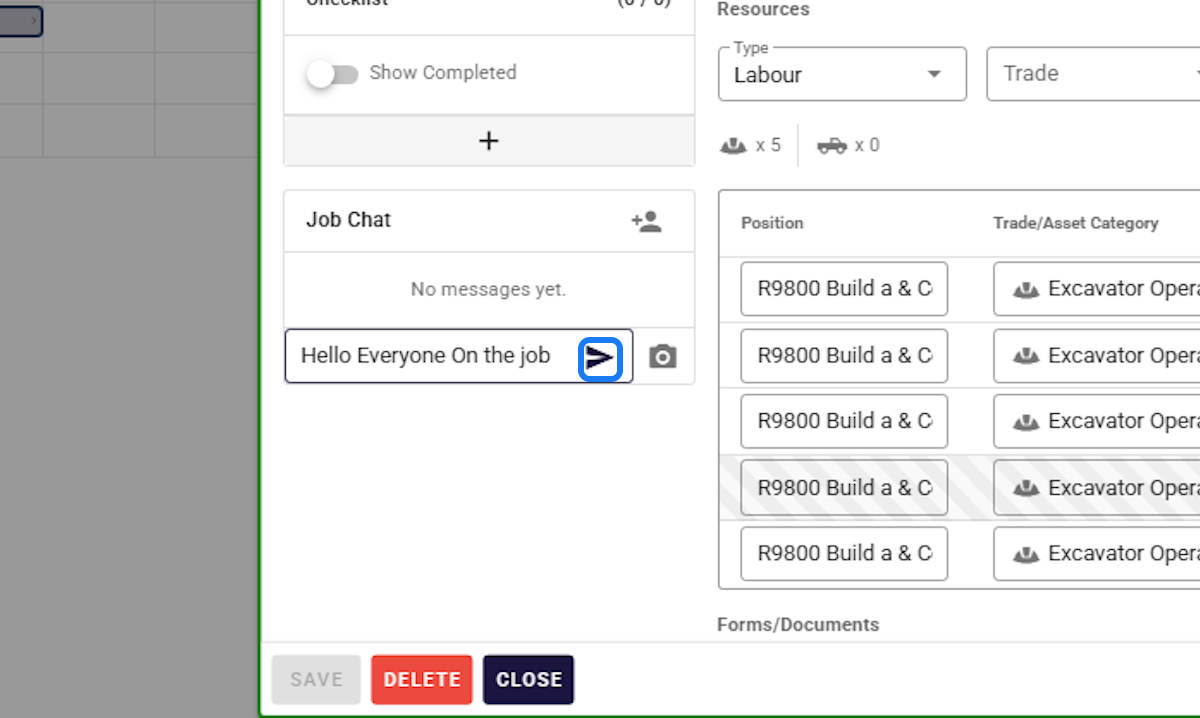
That structure is what makes everything else possible. If the shift knows it needs an excavator operator with a current site induction, the platform can filter candidates to workers who qualify, and the conversation about the job happens against the job rather than in a separate group chat someone has to remember to search. On generic tools the shift is just a time block with a name on it, and all of that context lives in people’s heads.
Compliance gates embedded in scheduling
The difference between a rostering tool and a workforce management platform is often compliance integration. A pure rostering tool lets you build a schedule. A WFM platform stops you building a non-compliant one, flagging fatigue breaches, expired licences and missing inductions before you confirm a shift. If you’re weighing the whole platform rather than the roster alone, our workforce management software buyer’s guide covers the wider category.
Automated compliance and qualification expiry alerts working inside the scheduling step are where purpose-built field platforms separate themselves from adapted general tools.
FIFO and non-standard roster support
Standard rostering software is built for weekly patterns. FIFO runs on swings: two weeks on, one off, crews rotating, travel days tacked onto either end. Managing FIFO flights and accommodation within the rostering workflow is a genuine operational requirement for remote businesses, not an optional extra. For the complete swing picture, see our FIFO rostering software guide.
The Australian Resources and Energy Employers Association, formerly AMMA, publishes on resources-sector workforce matters, and the complexity of running extended rosters across remote sites is well documented across the industry.
Reporting and workforce analytics
A roster is also a data asset. Scheduler power tools like filters, team views and reason codes for unallocated shifts turn it into an operational reporting layer. Over time the data shows where overtime creeps in and where deployment could be smarter.
AIPM publishes resources on workforce planning in project environments. The scheduling data your WFM system accumulates is the raw material for those planning decisions.
The rostering software checklist for field crews
Feature lists all look the same, so the useful version of a checklist says why each item matters on a crew and how to test it in a demo rather than take the vendor’s word for it.
| Capability | Why it matters on a field crew | How to test it in a demo |
|---|---|---|
| Multi-site live view | A coordinator across five sites can’t run five tabs | Open every site at once and move a worker between two |
| Employees and subbies on one roster | Half the crew may be subbies, and they need their own compliance profile | Book a subbie beside an employee and check the profiles differ |
| Fatigue rules checked at booking | A policy PDF is checked after the incident, a gate is checked before the booking | Roster someone onto a 15th consecutive shift and see whether it stops you and names the breach before you confirm |
| Ticket and induction currency at booking | Expiry dates matter on the shift date, not today’s | Book a worker whose high risk work licence expired yesterday |
| Swing and rotation templates | A 2/1 with offset panels can’t be built from a weekly grid | Apply a 2/1 to a crew and offset three panels |
| Shift confirmation, seen and unseen | Publishing 40 shifts isn’t 40 confirmed workers | Publish a roster, then find who hasn’t opened it |
| Open shifts to a pool | The 5am sick call needs the qualified pool, not one favourite | Clear a sick worker’s shifts and push one to everyone eligible |
| Change history | Somebody will ask who moved Thursday’s start, weeks later | Move a shift, then find who changed it and who was told |
| Timesheets from the roster | Re-keying hours is where pay disputes start | Open Tuesday’s timesheet and check it’s prefilled |
| A mobile app that works offline | Underground, in a shed, on a remote site, the signal drops | Turn off data on the phone and submit a prestart |
| Payroll hand-off | An export is a snapshot, an integration stays in step | Ask what happens when an hour is corrected after export |
| Reporting | Fill rates and unallocated shifts are the roster’s own scoreboard | Ask for last month’s unfilled shifts by site |
Anything that fails three or more rows isn’t a field platform, whatever the brochure says.
How to demo rostering software: bring your own week
Vendors demo on tidy data, so bring your own. Send the vendor four things a day ahead: last month’s messiest roster week as it lives in your spreadsheet, three real workers with the names changed (a subbie, a casual and an employee on a swing), your fatigue limits, and one site with a client induction requirement. Then run the tests in the checklist’s third column in table order, about an hour all up, and score each 0 for no, 1 for a workaround, 2 for yes. A field platform scores 18 or better out of 24.
Finish with the audit question, which no table cell covers: who was on Site B on the 14th, and were they inducted? Answered from the screen, or from a support ticket next week? The point of running your own week is that the score is yours to defend when the invoice arrives, not the vendor’s.
The operational cost of poor rostering
No-shows, last-minute crew scrambles and compliance breaches all carry direct costs. Take a construction crew of 15 at an average day rate of $600. A single preventable no-show costs $600 in lost productivity before you count the effort of finding a replacement, the drag on the rest of the crew, and any hit to the project schedule. The free cost calculator runs those numbers for your own crew size and day rates.
Multiply that across a business running several sites and the labour costs of inadequate rostering tools quickly overtake the cost of a purpose-built platform. The broader context on what no-shows cost and how better rostering prevents them makes it concrete.
Chamber of Commerce and Industry WA and Business Chamber Queensland have both highlighted labour productivity as a key challenge for Australian field industries, and the Productivity Commission’s February 2025 housing construction research put hard numbers under the concern. Dwellings completed per hour worked have fallen roughly 53% since 1995, while labour productivity across the broader economy rose 49% over the same stretch. Roster management is a direct input into that outcome, and one of the few productivity levers a field business fully controls.
How Humanz approaches workforce rostering
Humanz is an Australian-built workforce management platform with rostering at its core. The scheduler is purpose-built rostering software for Australian field industries, not a hospitality tool wearing hi-vis.
Key rostering capabilities:
- Multi-site dashboard. All sites, workers and shifts in a single live view.
- Live availability. See who’s available, qualified and compliant before making a booking.
- Subcontractor scheduling. Book subbies onto jobs from the same interface as direct employees.
- Shift confirmation tracking. Seen/unseen status for every worker on every shift, with reminders a tap away.
- Fatigue monitoring. Alerts fire at the point of scheduling, before a non-compliant roster is confirmed.
- Licence and qualification checks. Workers with expired tickets are flagged before being rostered.
- FIFO and swing roster support. Extended and non-standard patterns handled natively.
- Instant mobile notifications. Workers get shift details, changes and alerts through the Humanz app.
- Job-linked communication. Briefings and schedule updates sent against specific jobs and sites.
- Workforce analytics. Compliance dashboards, shift fill rates and unallocated work tracking.
Humanz is used by construction companies, mechanical contractors, mining services operators, drilling companies and trades businesses across Australia.
See the scheduler with your roster in it →
Frequently asked questions
What separates field-built rostering software from generic scheduling tools?
The category, not the feature list. Cafe and retail shift tools are built around one location with employees only, HR suites treat compliance as records rather than gates, and field-built platforms make the multi-site live view the default, roster employees and subbies together, and check fatigue and licence currency at booking time. FIFO swings and travel are handled natively rather than bent out of a weekly grid. None of the three is bad at its own job, but buying one category and expecting the behaviour of another is where it goes wrong.
What is staff rostering software?
Staff rostering software is the tool a business uses to plan who works which shifts, publish the roster to workers and handle the changes that follow. On a field crew it has to roster four kinds of worker at once, permanent employees, casuals, labour hire and subcontractors, each with its own availability rules and compliance profile, on one screen. It replaces the spreadsheet, the whiteboard and the group chat with one roster that reaches every worker’s phone.
How do you move from a spreadsheet roster to rostering software?
Five steps: audit what you roster today including the unwritten rules, turn your recurring patterns into templates, load workers and compliance rules, publish to phones, and measure fill rates and confirmation lag from the first month. Keep the thinking rather than the file, because the spreadsheet encodes years of crew and coverage decisions that map straight into templates. Then set a cutover date and honour it. Two pay cycles in parallel is prudence, six months is a second job.
Can workforce rostering software handle both permanent and casual employees?
Yes. Good rostering software handles every employment type (permanent full-time, part-time, casual, labour hire) with the right availability patterns and entitlements for each. Humanz handles all of these, plus subcontractors, in one platform.
How does rostering software handle last-minute changes?
Coordinators make the change from desktop or mobile and instant notifications go to the workers affected. Live availability data means a replacement for a no-show can be found and contacted within minutes, not through a chain of phone calls.
Is it possible to use templates for repeating roster patterns?
Yes. Humanz lets you build roster templates for repeating patterns (weekly rotations, FIFO swings, standard crew configurations) and apply them to new periods without rebuilding from scratch. A good template captures the pattern, the crew mix and the compliance rules together, so applying it produces a roster that is already checked.
Can workers view their rosters on their phones?
Yes. In Humanz, workers see their full roster through the mobile app, including upcoming shifts, recent changes and details like site address and job brief. Shift confirmation is submitted through the app too.
How does rostering software help with overtime management?
By tracking cumulative hours across the pay period and flagging when an extra shift would tip a worker into overtime. That makes the cost visible before the decision is made, which matters under award conditions that apply overtime rates past certain daily or weekly hours.
What’s the difference between a roster and a timesheet in the system?
The roster is the planned schedule, the shifts workers are assigned to. The timesheet records the time they worked. In Humanz, timesheets are generated automatically from roster data and adjusted for actual attendance, closing the gap between what was planned and what gets paid.
How does the platform handle workers in different states?
Humanz holds each client’s sites in whichever states they sit, and each site keeps its own shift times, requirements and fatigue policy, so a business operating across several states runs them all in one platform. Award interpretation and pay rates stay with payroll, which Humanz feeds with approved hours.
Related articles
Ready to see Humanz on your own roster?
Free 30-minute walkthrough, we'll use your real crews, sites and shift patterns.