
 Login
Login 

Compliance, Fatigue & Safety
Verification of Competency (VOC): What It Is and How to Manage It
By Christian Tietzel · 24 August 2026 · Updated 28 September 2026

A verification of competency (VOC) is a practical assessment confirming that a worker can operate a specific machine, or perform a specific task, to the required standard right now. It is not a licence and it is not training. Australian mining, civil and construction sites routinely ask for one per plant type, whatever tickets the operator already holds.
A forklift ticket earned in 2014 says one thing. It says that in 2014, on a forklift somebody else chose, this person satisfied an assessor. It says nothing about whether they can safely operate the 16-tonne telehandler parked outside your crib room this morning. That gap is what a VOC exists to close, and businesses that treat it as an afterthought find out at the gate, when a rostered operator becomes a very expensive passenger.
This guide covers what a VOC actually is, when you need one, who can run one, what the record should contain, and how to manage the whole thing so it stops living in a spreadsheet nobody trusts.
What is a verification of competency (VOC)?
A verification of competency is a structured practical assessment. A competent assessor watches a worker operate the plant or perform the task, measures what they see against the relevant national unit of competency or an equivalent standard, and records the outcome. Pass or gap. Current or not.
VOC vs licence vs training
Two things a VOC is not. It isn’t a licence. Licences, like a high risk work licence for a crane class, are issued by state WHS regulators and carry legal weight on their own. And it isn’t training. A VOC doesn’t teach anybody anything. It verifies that earlier training stuck, on the equipment that matters, in conditions that resemble the actual work.
Side by side, a training course, a high risk work licence and a VOC compare like this.
| Training course | High risk work licence | VOC | |
|---|---|---|---|
| What it is | Teaching and assessment against a national unit of competency | A licence for a legislated class of high risk work | A practical assessment of current competency on specific plant or a specific task |
| Who issues it | A registered training organisation | The state or territory WHS regulator | The assessor, as a record, RTO-linked where the site standard requires it |
| Does it teach anything? | Yes | No. It follows training and assessment through an RTO | No. It verifies that earlier training stuck |
| Expiry | Depends on the course | Five years, then renewal | None in legislation. The review date on the record, commonly one to two years |
| Carries between sites? | Yes, as nationally recognised training | Yes, recognised in every state and territory | Often not. Many sites verify to their own standard |
The licence column follows the WA Government’s wording. Its high risk work licensing guide has the licence valid for 5 years and recognised in all states and territories of Australia.
The distinction drives how the obligations stack. Under WHS law, a business must ensure workers are competent for the work they’re given, not merely credentialed. Safe Work Australia’s guidance on managing health and safety frames competency as part of the primary duty of care. And the stakes of that duty aren’t spread evenly. Safe Work Australia’s Key Work Health and Safety Statistics for 2025 put machinery operators and drivers at 32% of all worker deaths in 2024, with a fatality rate of 6.7 per 100,000 workers against 1.3 for the workforce as a whole. The workers a VOC covers are, by occupation, the likeliest in the country to be killed at work. The ticket gets a worker considered. The VOC gets them on the machine.
When is a VOC required?
There’s no single national rule that says “VOC required here”. The demand comes from three directions, and in practice they overlap.
Site and principal contractor rules. Most tier-one miners and many principal contractors require a current VOC per plant type before anyone operates on their site, whatever tickets the operator holds. The requirement usually sits in the site’s mobile plant standard or contractor management procedure, and it commonly repeats per site. A VOC accepted at one operation often means nothing 40km up the road.
Risk triggers. A sensible business runs a VOC when an operator is new, when they’re moving onto an unfamiliar make or model, when they’re returning after a long break, after an incident or near miss, and on a periodic cycle, commonly every one to two years for high-consequence plant. Shutdowns and turnarounds concentrate all of those triggers into a fortnight, which is why VOC backlogs surface right before a window opens.
The equipment itself. Some plant needs a high risk work licence by law. Plenty of high-consequence equipment doesn’t. Excavators, loaders, dump trucks, telehandlers under 3 tonnes, skid steers. For that gear, the load-shifting units and a VOC are how a business demonstrates competency, because there’s no licence to point at. That’s precisely why sites lean on VOCs so heavily. There’s a reason the lean is so hard. In Safe Work Australia’s 2024 fatality figures, vehicle incidents were the leading cause of worker deaths at 42% (a category broad enough to sweep in road crashes as well as site plant), with falls from height a distant second at 13%. The machine is the thing most likely to kill someone, licensed or not.
If you run blended crews, the requirement extends past your own payroll. Subbies and labour hire operating plant on your site need the same verification, and the host’s duty doesn’t outsource itself just because the operator arrived through an agency.
Who can conduct a VOC assessment?
The assessor question causes more argument than any other part of this. The honest answer has two tiers.
For a VOC that references a national unit of competency and needs to stand up to external scrutiny, use an assessor working through a registered training organisation, holding the current assessor qualifications (the TAE assessor skill set or equivalent) plus the relevant unit and real currency on the plant. Many businesses bring in specialist VOC providers exactly for this, and most tier-one sites specify it.
For internal assurance between formal cycles, a documented in-house check by a demonstrably competent senior operator has real value. It just isn’t the same artefact, and pretending otherwise is how businesses end up re-doing every VOC after an audit. If a client’s standard says RTO-linked assessment, an in-house form won’t satisfy it, however good the assessor was.
Whoever assesses, independence matters. The person signing off shouldn’t be the person whose crew is short an operator this swing. That pressure is real, and it’s exactly what the paperwork exists to resist.
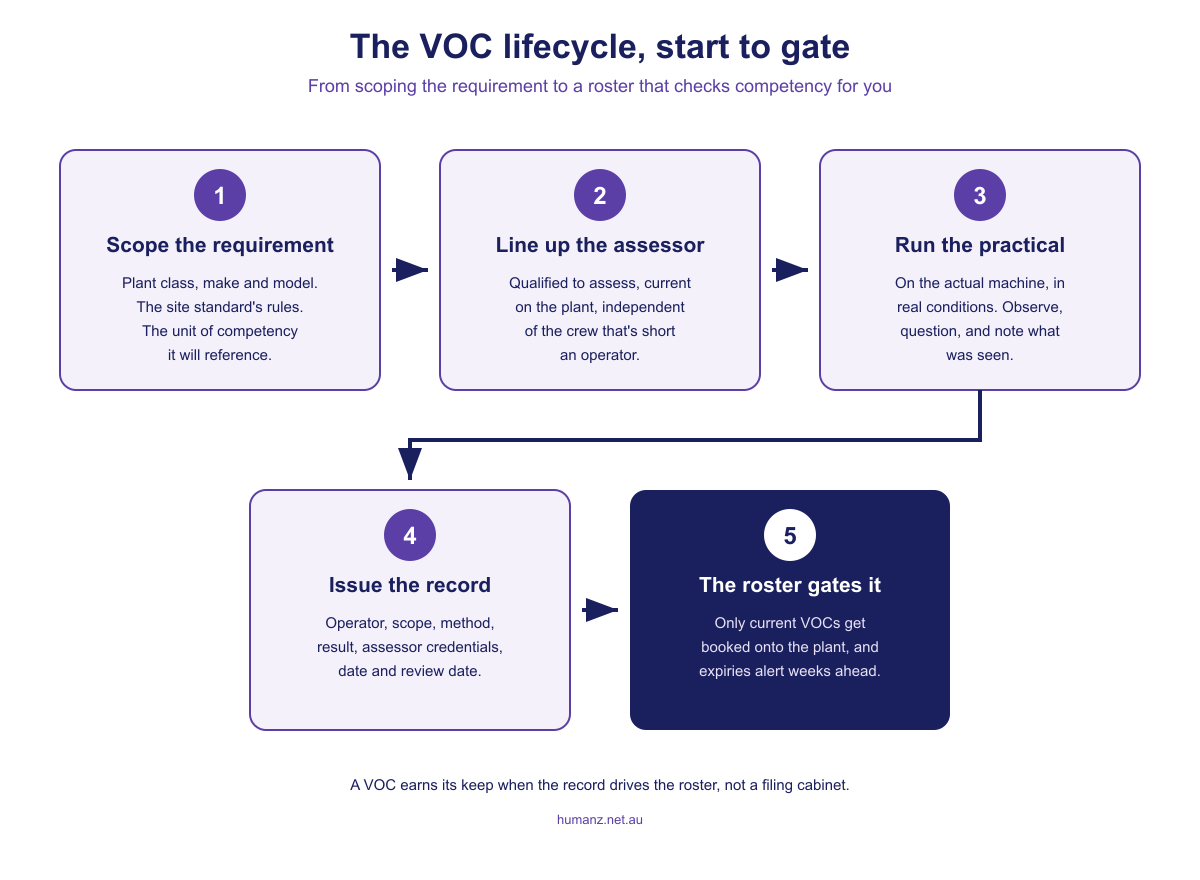
What a VOC record or template has to capture
A VOC that lives as “yeah, Macca checked him out on the digger” is worth nothing. The record is the product. A defensible one captures:
- Who. The operator’s name and the assessor’s name, with the assessor’s qualifications and currency stated
- What. The task or plant assessed, down to make and model, not just “excavator”
- Against what. The unit of competency or standard the assessment referenced
- How. The method used. Practical observation, questioning, or both, and the conditions on the day
- The outcome. Competent, or the specific gaps found and what happens next
- When. Assessment date and a review date, because a VOC without an expiry quietly becomes permanent
Anyone searching for a verification of competency template is really looking for that list. The format matters far less than the fields. A one-page form that captures all seven beats a glossy booklet that captures five.
How long a VOC takes, what it costs and how long it lasts
Three questions arrive together whenever a VOC gets scheduled, so here are the straight answers.
How long does it take? Plan on an hour or two per plant type. The usual shape is a short theory or questioning component, then practical observation of the operator working through representative tasks on the machine itself. Complex plant stretches that. A crane with multiple configurations takes longer to assess honestly than a skid steer, and an operator being verified across three plant types has lost most of a shift, not a smoko.
What does it cost? Nobody can quote a single figure, because the bill is mostly time. The drivers are the assessor’s hours, with an external RTO-linked assessor costing more than a competent in-house one and travel to a remote site adding more again, plus the machine standing idle while the assessment runs and the operator off productive work for the duration. The quiet variable is notice. An assessor booked three weeks out charges a normal rate. One needed by Thursday, at a site four hours from anywhere, prices accordingly.
How long does it last? As long as your policy or your client’s site standard says it does. No legislation sets an expiry, so the review date on the record is the only clock that exists, and most businesses set it at one or two years for plant that can hurt someone. Expect to re-verify sooner than the date when circumstances change: a new site with its own standard, a different make or model, an incident, or a long stretch out of the seat.
As for what goes on the form, that’s the list in the section above. Plant type down to make and model, the tasks observed, the standard assessed against, the assessor and the basis of their competence, the method, the outcome, and both dates. One page holds all of it.
Every one of those cost drivers shrinks with notice. A review date visible weeks ahead means an orderly re-VOC on a quiet day. The same assessment booked in a panic costs the same assessor hour plus everything around it.
The subbie wrinkle
Blended crews add a question the tidy version of this process skips, and in some sectors it’s the main question. WorkSafe WA’s safety performance report for 2023-24 has contractors working 56% of all hours in WA mining, ahead of company employees on 44%. So on a WA mine site, when the operator is a subcontractor or labour hire worker, whose VOC is it? That’s not the edge case. That’s most of the workforce.
The contractual answer varies. Some agencies VOC their own people and hand over the records. Some host businesses insist on running their own assessments regardless, because their site standard says so or because they’ve been burned by a courtesy pass before. Both models work. The one that fails is the middle ground, where each party assumes the other checked.
If you’re the host, three rules keep it clean. Treat an incoming VOC as a claim, not a fact, and sight the actual record with its scope and dates before relying on it. Hold subbie VOCs to the same review cycle as your own operators, in the same system, because an agency’s spreadsheet doesn’t alert your coordinator; the VOC is one line in the wider subcontractor file, and it decays like the rest of it. And where your client’s standard requires site-specific verification, budget for it in the mobilisation timeline rather than discovering it the morning plant is due to move. A VOC assessor at short notice is either unavailable or expensive, and sometimes both.
Where VOC management falls over
Almost nobody fails at running the assessment. Businesses fail at everything around it.
The pattern is familiar. VOCs live in a spreadsheet, or a filing cabinet, or a site administrator’s memory. Each one has a different review date. Operators move between sites with different requirements. A crane VOC expires mid-swing and nobody notices until the client’s auditor does. The roster, meanwhile, knows none of this. It happily books an operator onto plant their VOC no longer covers, and the error is discovered at the gate, or worse, after something goes wrong.
The failure isn’t laziness. It’s that expiry tracking across dozens of operators, multiple plant classes and several sites is genuinely hard to do by hand. Our guide to qualification and induction tracking covers the broader credential problem, and VOCs are its sharpest case because they’re the credential most likely to be site-specific and shortest-lived.
Connect the VOC to the roster and the problem mostly disappears
The fix is structural rather than administrative. Store every VOC against the worker with its scope and review date, then let rostering software enforce it at booking time. An operator without a current VOC for the loader simply isn’t bookable onto the loader shift. Expiring VOCs surface weeks ahead, while there’s still time to schedule an assessor rather than stand down a crew.
That flips the economics of the whole exercise. The VOC stops being paperwork that trails the work and becomes a gate that shapes it. Coordinators stop memorising who’s current on what. And when a client asks for evidence, the answer is a report, not a weekend of reconstruction.
In Humanz, that’s how it works day to day. VOCs sit alongside tickets, inductions and medicals on the worker profile, bookings check them automatically, and expiry alerts go to the people who can act. The same gate covers employees, labour hire and subcontractors, which matters because the machine doesn’t care whose payroll the operator is on.
Before an audit ever tests the system, four failure modes are worth checking for in your own records, because they account for most findings.
- A VOC recorded against “excavator” with no make, model or size class, which an auditor reads as scope unknown
- Assessor qualifications asserted but not evidenced, so the whole assessment inherits doubt
- Review dates missing entirely, leaving every VOC technically current forever
- Records held per site rather than per worker, so nobody can see one operator’s full picture
Every one of those is cheap to fix at capture time and expensive to fix retrospectively across a workforce.
The one-line summary for the whiteboard. A ticket says they passed a course once. A VOC says they can operate this machine, and your roster should refuse to guess about either.
Frequently asked questions
What is a verification of competency?
A verification of competency, or VOC, is a practical assessment confirming that a worker can operate specific plant or perform a specific task to the required standard. An assessor observes the worker on the equipment, measures performance against the relevant unit of competency or standard, and records the outcome with a date and scope.
What does VOC mean in training?
VOC stands for verification of competency. Despite the phrase VOC training, a VOC is an assessment, not a course: it checks that earlier training has stuck on the plant or task in front of the worker. Training providers often run the assessment, and refresher or gap training may follow where the assessor finds a shortfall.
Is a VOC a legal requirement in Australia?
No law names the VOC itself. The legal driver is the WHS duty to ensure workers are competent for the work they perform, and a VOC is the accepted way to demonstrate that for plant operation. In practice most mining and many construction principals mandate VOCs through their site standards, which makes them contractually unavoidable even where legislation doesn’t name them.
What is the difference between a VOC and a high risk work licence?
A high risk work licence is issued by a state WHS regulator for legislated classes of work, such as certain cranes and forklifts, and is valid across Australia. A VOC is not a licence. It’s evidence of current competency on specific equipment, often demanded per site, and it applies equally to plant that needs no licence at all, like excavators and loaders.
Who can conduct a VOC?
For assessments that need to withstand client or regulator scrutiny, an assessor with current assessor qualifications and demonstrated currency on the plant, typically working through or with a registered training organisation. In-house checks by a competent senior operator are useful between formal cycles but usually won’t satisfy a tier-one site standard that specifies independent or RTO-linked assessment.
How long does a VOC last?
There’s no legislated expiry. Most businesses and sites work on one to two years for high-consequence plant, with earlier re-verification after incidents, long absences or a change of equipment type. The review date recorded on the VOC is what counts, and different sites are free to set different cycles.
What should a VOC record include?
The operator’s name, the assessor’s name with their qualifications and currency, the plant assessed down to make and model, the standard or unit of competency referenced, the assessment method, the outcome, and both the assessment date and a review date. The format matters far less than the fields. A one-page form that captures all of them beats a glossy booklet that misses the review date, because a VOC without an expiry quietly becomes permanent.
Is a VOC transferable between sites?
Often not. Many mining and construction principals require verification to their own site standard, so a VOC accepted at one operation can mean nothing at the next one up the road. Treat an incoming VOC as a claim rather than a fact, sight the actual record with its scope and dates, and budget for site-specific re-verification in the mobilisation timeline where the client’s standard demands it.
Related articles
Ready to see Humanz on your own roster?
Free 30-minute walkthrough, we'll use your real crews, sites and shift patterns.