
 Login
Login 

Subcontractors
Certificates of currency: what to collect from subcontractors and how to check them
By Christian Tietzel · 14 September 2026

A certificate of currency is a document from an insurer, broker or state scheme confirming that a named business held a particular policy on the day the certificate was issued. Principals collect them from subcontractors as evidence of public liability cover and, where the subbie employs anyone, workers compensation. Each one proves cover on its issue date, not afterwards.
This guide is for the principal or head contractor on the receiving end of the email, not the business being asked for one. The wider subbie file is covered in the subcontractor onboarding checklist.
What a certificate of currency shows, and what it doesn’t
A certificate is a summary of a policy, not the policy itself. The fields vary with the insurer and the type of cover, but these are the ones to test against your contract.
| Field on the certificate | Check it against |
|---|---|
| Insured name and ABN | The legal entity and ABN on your subcontract, not the trading name on the ute |
| Type of cover | The policies your contract requires |
| Limit of liability | The minimum your head contract or client passes down |
| Period of insurance | Every date you intend to book the subbie |
| Insurer, broker and policy number | The people you’ll contact to confirm it |
| Wages, industry classification and workers covered (NSW workers compensation) | The crew that turns up and the work they do |
The last row is specific to workers compensation. icare’s certificate of currency page says a NSW certificate includes the business name and ABN, employee wages, industry classification and the number of workers covered. South Australia’s equivalent is ReturnToWorkSA’s certificate of registration, which shows the employer name, trading name and employer number. ReturnToWorkSA makes it available from 1 June and says it is valid until 30 June the following year. Treat that date like any other expiry: it tells you when to ask again, not that the registration is still in force today.
What no certificate can tell you
However clean it looks, a certificate can’t see past its issue date. One printed in July won’t tell you the policy was cancelled in September or never renewed. It doesn’t carry the fine print either. Exclusions, conditions and the business activities the insurer agreed to cover live in the policy wording.
It can be current for the wrong business, too, because a trading name, a related company or the owner’s own name can all sit on a valid certificate that doesn’t cover the entity you contracted with. And it can’t tell you if the subbie’s people are your workers, which in several states is a question for your own policy.
A certificate isn’t a safety control either. Insurance pays for the aftermath of an incident, while your WHS duties are about stopping one.
Checking a certificate in five steps
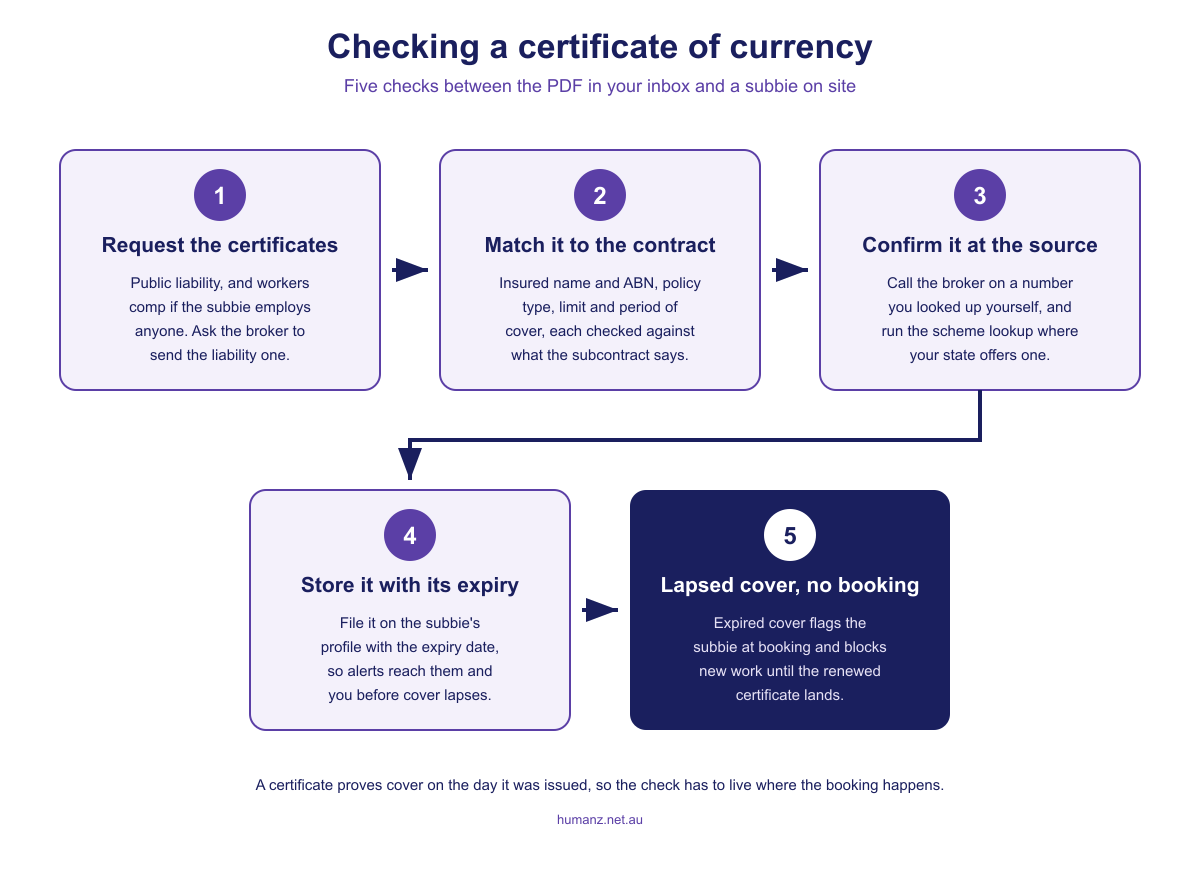
1. Request the certificates from the source
Ask for a current certificate for each policy your contract requires. Where you can, have the broker send the public liability certificate straight to you. Workers compensation certificates are usually downloaded by the subbie from their scheme’s portal (icare and ReturnToWorkSA both issue them that way), so treat those as a claim to test in step three. A certificate forwarded through three inboxes, or photographed on a phone, is the easiest place for an old or altered one to hide.
2. Match it to the contract, line by line
Put the certificate beside the subcontract and work down the table above. The insured has to be the entity you’re contracting with, the cover and limit have to meet your head contract, and the period has to reach the last day you’ll book them. A certificate that expires three weeks into a six-month package isn’t a pass. It’s a date you’ll have to act on.
Here’s a hypothetical. A Newcastle civil contractor engages a kerbing subbie, who emails two certificates on a Friday for a Monday start. The public liability certificate is in the subbie’s trading name, but the subcontract is with a Pty Ltd. The icare workers compensation certificate names the right company and shows two workers covered, while six people are rostered for Monday. Neither document is fake. Both need an answer before the ute arrives. Is the Pty Ltd the insured? And are the other four employees who belong on that policy, labour hire, or subbies of the subbie? In NSW that second question can land a premium bill on the principal, because a subcontractor’s statement doesn’t protect a principal who had reason to believe it was false.
Licences get the same treatment against their own registers, set out in how to check a contractor licence, White Card or high risk work ticket.
3. Confirm it with the insurer, broker or scheme
A PDF is easy to edit. A reply from a broker you contacted yourself is much harder to fake. Find the broker’s or insurer’s number yourself rather than using the one printed on the certificate, then ask if the policy is current for that insured, what the period is, what has changed since issue and if it covers the work you’re engaging them for. Get the answer in writing and file it with the certificate.
NSW, Queensland, Victoria and South Australia all offer an online check. icare’s Employer Lookup searches employers registered with icare by ABN or ACN and is refreshed each Monday, though it doesn’t show wages, industry classification or worker numbers, and a business covered by a specialised insurer or a self-insurer (Coal Mines Insurance in the coal industry, for one) may not appear. WorkCover Queensland checks for a current accident insurance policy by ABN. WorkSafe Victoria will issue a certificate of currency for another business if you have its WorkCover employer number and postcode. ReturnToWorkSA’s employer lookup searches by ABN, ACN or employer number. Public liability has no public lookup that we know of, so there the broker’s reply is the check.
4. Store it with its expiry date
Record the expiry date when you accept the certificate, on the subbie’s record rather than in a shared folder, and make sure the reminder reaches the subbie as well as your office. Keep the confirmation email with it, because an auditor asking if cover was checked wants to see the check.
5. Gate the booking on currency
The last step is a rule rather than a task. A subbie whose cover has lapsed doesn’t get booked until the renewed certificate is in, and the roster flags or blocks the booking so nobody has to remember.
Which subcontractor insurance to ask for
Your head contract and your client set the list. The business.gov.au guide to business insurance sets out the baseline underneath it.
| Policy | Who holds it | What to know |
|---|---|---|
| Public liability | Most subcontracting businesses | Only some states and territories require it by law, and only for certain occupations, so for most subbies the requirement comes from your contract |
| Workers compensation | Any subbie with employees, bar some very small employers | Employers must get it from an authorised insurer. NSW and Victoria exempt some of the smallest, such as those paying $7,500 a year or less in wages with no apprentices or trainees |
| Personal accident, illness or income protection | Sole traders | A sole trader can’t cover themselves under a workers compensation policy, so this is their own cover |
| Professional indemnity | Subbies doing design or advisory work | Mandatory for some professions |
| Product liability | Subbies supplying goods | Can be needed even when the goods come as part of a repair or service |
The workers compensation row is where files come unstuck, because a subbie’s certificate covers the subbie’s employees and says nothing about whether the subbie, or anyone they bring, counts as your worker.
Workers compensation insurance for contractors in five states
Each state runs its own scheme with its own tests, and they reach principals in two ways. A contractor, even a sole trader with an ABN, can count as your worker. And in some states the principal can be liable for a subbie’s unpaid premiums, or for compensation to a subbie’s injured worker. The sums aren’t trivial. Safe Work Australia’s Key Work Health and Safety Statistics Australia 2025 counts 17,600 serious workers’ compensation claims in construction in 2023-24 (preliminary figures), 12% of the national total, each involving at least a week off work. It puts the median compensation paid on a serious construction claim at $20,000, using 2022-23, the latest finalised year.
This summarises each scheme’s guidance as read in September 2026. It isn’t legal or insurance advice. For a crew that only works in one state, confirm with that state’s scheme. For FIFO or cross-border crews, each worker is insured in one state, their state of connection, which starts with where they usually work and where they’re based rather than where a particular job sits.
| State | What the scheme says | What to collect or check |
|---|---|---|
| NSW | A principal contractor is liable for a subbie’s unpaid premiums on the contract work unless it holds a subcontractor’s statement it had no reason to believe was false | Certificate plus statement for any subbie with employees, with wages and worker numbers checked against the crew |
| Victoria | Your worker can include a contractor or subcontractor, including a sole trader | A worker-status decision each time you hire |
| Queensland | Your policy must cover some contractors, and a sole trader may still be a worker | Contractor wages declared on your own policy where they meet the definition |
| WA | Principal and contractor can be jointly and severally liable to a contractor’s injured worker | Certificates from every tier of the chain |
| SA | You may be liable for premiums for labour from suppliers not registered with ReturnToWorkSA | Certificate of registration and an employer lookup |
NSW and the subcontractor’s statement
Section 175B of the Workers Compensation Act 1987 makes a principal contractor liable for a subcontractor’s unpaid workers compensation premiums on the work done under the contract, where the subbie’s employees do that work and it is part of the principal’s business. The liability doesn’t arise for any period covered by a written subcontractor’s statement, in which the subbie declares that all premiums for that work have been paid, attaches a copy of the certificate of currency and says whether it is itself a principal contractor on the work. The statement doesn’t protect a principal who had reason to believe it was false when it was given. And the section doesn’t apply to work at the principal contractor’s principal place of residence, or where the subbie is in receivership, being wound up or bankrupt and the contract payments go to the receiver, liquidator or trustee.
In NSW the certificate and the statement travel as a pair. If the certificate’s wages and worker numbers can’t account for the crew on site, you may have reason to believe the statement is false, and then it doesn’t protect you. SIRA also says an ABN by itself is not a definite indicator of a person’s status, and that someone hired as a contractor, and treated as one for tax, can still be a worker for workers compensation purposes, in which case they belong on your own policy.
When a contractor is your worker in Victoria and Queensland
WorkSafe Victoria says your worker can include a contractor or subcontractor you hire, whether that person is a sole trader, a partner, or working through a company or a trust. It expects a worker-status decision each time you hire a contractor, and warns you may be liable if a contractor is injured while performing work for you.
WorkCover Queensland says an accident insurance policy must cover anyone who meets the definition of a worker, which usually includes some contractors, and that a sole trader may still be a worker. Their wages go on your declaration at renewal. Sole traders, partners, company directors and trustees can’t cover themselves under their own accident insurance policy, and WorkCover Queensland offers them separate, optional workplace personal injury insurance from $1,650 a year including GST and stamp duty.
Liability down the chain in WA
WorkCover WA takes the most direct line. If a contractor’s worker is injured, the principal and the contractor are both taken to be employers of that worker and are jointly and severally liable for the compensation. A principal is only liable if the work being done when the worker was injured was directly a part or process in the principal’s trade or business, and the injury arises in respect of premises where the principal has undertaken to do the work, or that are otherwise under its control or management. The liability runs right down the contractual chain, which is why a head contractor wants current workers compensation certificates from every tier, including subbies it never signed.
Due diligence on labour suppliers in SA
ReturnToWorkSA says a business using workers it doesn’t directly engage, such as labour hire or contract labour, must do due diligence to make sure those businesses are adequately registered for work injury insurance, and warns you may be liable for premiums for labour from unregistered suppliers. Where the labour comes through an agency, the host-side licensing checks are in labour hire host employer obligations.
We haven’t covered Tasmania, the ACT or the Northern Territory, so check with WorkSafe Tasmania, WorkSafe ACT or NT WorkSafe for workers connected to those jurisdictions.
Make the expiry date a booking gate, not a reminder
The failure that’s easiest to miss isn’t a forgery. It’s a lapse. The policy renews, the new certificate sits in the subbie’s inbox, and your file still holds last year’s. Once you’re booking more than a handful of subbies, an office calendar reminder doesn’t close that gap, because the reminder fires in one place and the booking happens somewhere else.
So put the expiry date where the booking decision is made. In Humanz, insurances, licences and tickets sit on the subcontractor’s profile with the documents stored against it. Automated expiry alerts go to the subbie and your coordinators before anything lapses, a non-compliant subbie is flagged at booking, and expired credentials block new bookings until they’re renewed. The subbie uploads the renewed certificate from their phone, so chasing it doesn’t fall entirely on your office, and the compliance reporting is ready when a tier-1 client asks. That’s how our subcontractor management software handles certificates, and tracking qualifications, inductions and credentials covers the same gates for licences and tickets.
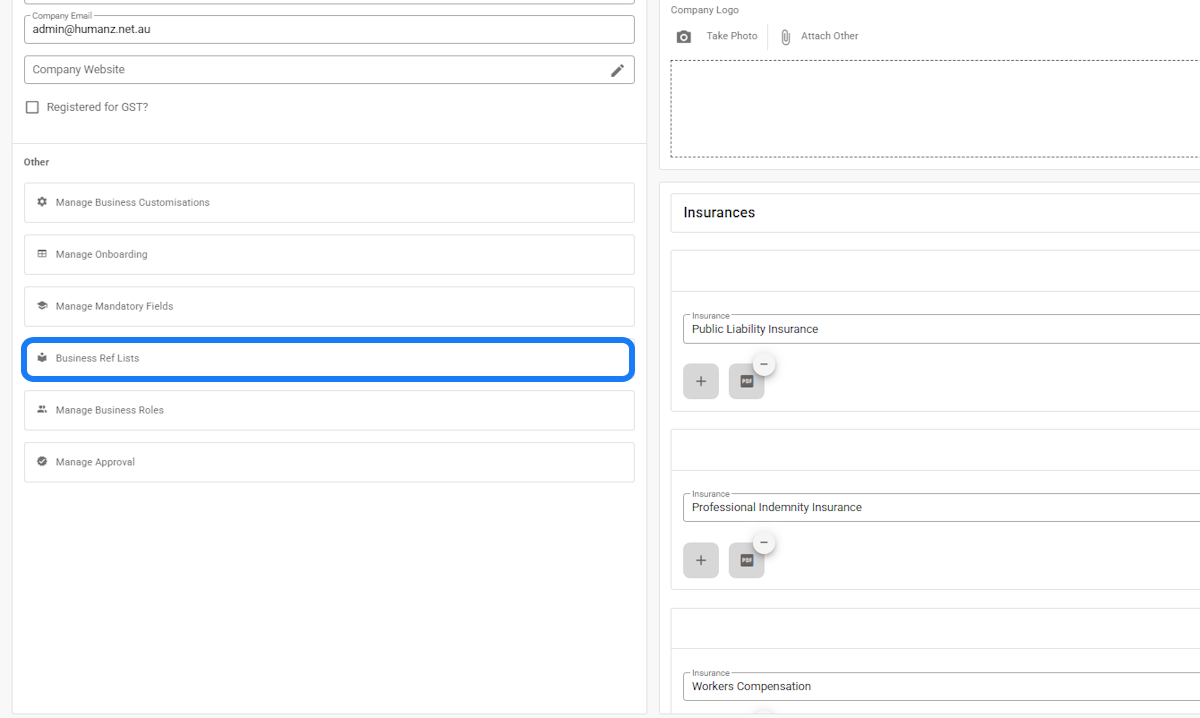
What software won’t do is ring the broker. Step three stays a person’s job, and the confirmation email is the thing worth attaching to the profile.
To see how profiles, expiry alerts and booking gates work against your own subbie list, walk through it with our team.
Frequently asked questions
What is a certificate of currency?
A certificate of currency is a document from an insurer, broker or state scheme confirming that a named business held a particular policy on the date it was issued. It summarises the policy rather than replacing it. Principals ask subcontractors for one before work starts as evidence of the cover their contract requires.
What does a public liability certificate of currency show?
It shows who is insured, the type of cover, the limit of liability, the period of insurance and the insurer or broker, usually with a policy number. Check the insured name and ABN against your subcontract, the limit against your contract’s minimum and the period against your booking dates. It won’t show exclusions or conditions, so ask the broker to confirm in writing that the policy covers the work.
Do subcontractors need workers compensation insurance?
Yes, a subcontractor that employs workers generally must insure them, though NSW and Victoria exempt some very small employers, such as those paying $7,500 a year or less in wages with no apprentices or trainees. A sole trader can’t cover themselves under a workers compensation policy, so SIRA recommends contractors hold their own sickness and accident or income protection insurance. The harder question is whether the subcontractor counts as your worker, which can put them on your own policy. Victoria and Queensland say that can include a sole trader, and NSW says an ABN alone doesn’t settle it, so confirm each engagement with your state scheme.
Does a certificate of currency prove a subcontractor is still insured?
No, it proves the policy was in force on the day the certificate was issued. A policy can be cancelled or left to lapse after that date without the certificate changing. Confirm currency with the insurer or broker before work starts, and again before any booking that runs past the expiry date.
How do I check a certificate of currency is genuine?
Confirm it with the insurer or broker directly, using contact details you’ve looked up yourself rather than the ones printed on the certificate. Ask if the policy is current for that insured, what the period is and what has changed since issue. For workers compensation, icare’s Employer Lookup in NSW, WorkCover Queensland’s cover check and ReturnToWorkSA’s employer lookup all search by ABN, and WorkSafe Victoria will issue a certificate for another business if you have its WorkCover employer number and postcode.
How often should I ask subcontractors for a new certificate of currency?
Before the expiry date on the certificate you hold, so the renewed one is on file before any booking runs past it. NSW workers compensation policies run for 12 months unless a shorter term is requested, and ReturnToWorkSA’s certificate of registration is valid until 30 June the year after it becomes available on 1 June. Ask again whenever a subbie changes entity or takes on more workers, and run the scheme lookup where one exists, because a certificate can’t show a cancellation after it was issued.
What is a subcontractor’s statement in NSW?
It’s a written statement in which a subcontractor declares that all workers compensation premiums for the work done under the contract have been paid, with a copy of the relevant certificate of currency attached. Under section 175B of the Workers Compensation Act 1987, a principal contractor is liable for a subcontractor’s unpaid premiums on that work unless it holds one for the period, but the statement gives no protection if the principal had reason to believe it was false. The section doesn’t apply to work at the principal contractor’s own residence, or where the subcontractor is in receivership, liquidation or bankruptcy and contract payments go to the receiver, liquidator or trustee.
Related articles
Ready to see Humanz on your own roster?
Free 30-minute walkthrough, we'll use your real crews, sites and shift patterns.