
 Login
Login 

Rostering & Scheduling
Shift roster patterns in Australia: every major swing and rotation, with the real trade-offs
By Duane Butler · 6 August 2026 · Updated 16 September 2026

Every roster pattern looks reasonable on a whiteboard. The trouble starts six weeks in, when the night crew is running on fumes and the 3/1 swing you inherited is quietly failing the client’s fatigue standard. The pattern you choose sets four things at once: hours worked, headcount required, how often anyone sees their family, and how much fatigue risk you carry.
This guide covers every shift and swing pattern actually used in Australia: what each is, the numbers behind it, and how to compare them before committing a workforce to one.
What is a rotating roster?
A rotating roster is one where workers move through different shifts, days or weekends over a repeating cycle instead of holding the same slot permanently. Everyone takes a turn at nights, early starts or Saturdays, so the unpopular shifts are shared rather than owned. The alternative is a fixed roster, where the same people always work the same shift.
Several of the patterns below rotate crews between days and nights, and that rotation is where fatigue rules bite. Which direction a crew rotates, and how quickly it turns from nights back to days, decides more than the pattern’s name does, which is why the section on fixed and rotating nights further down matters as much as the comparison table. The 7 day rotating roster used outside FIFO gets its own section too.
What a roster pattern actually is
A roster pattern is a repeating cycle of work and rest, written as days on / days off. 8/6 means eight days of work, six off, repeat. Three terms do most of the work here (all defined in our glossary):
- Cycle: the days before the pattern repeats. 14 for 8/6, 21 for 2/1, 28 for DuPont.
- Swing: the on-site block in FIFO language. “What’s your swing?” means “what’s your pattern?”
- Panel (or crew): a group on the same pattern, offset from the other panels so the site stays covered while each takes its break.
The key mental shift: a pattern describes one worker’s rhythm; coverage comes from stacking offset panels.
One quiet detail: any cycle divisible by 7 locks to the same weekdays permanently. A guaranteed weekend off every break, or never one at all, decided by the start date.
Continuous vs non-continuous coverage
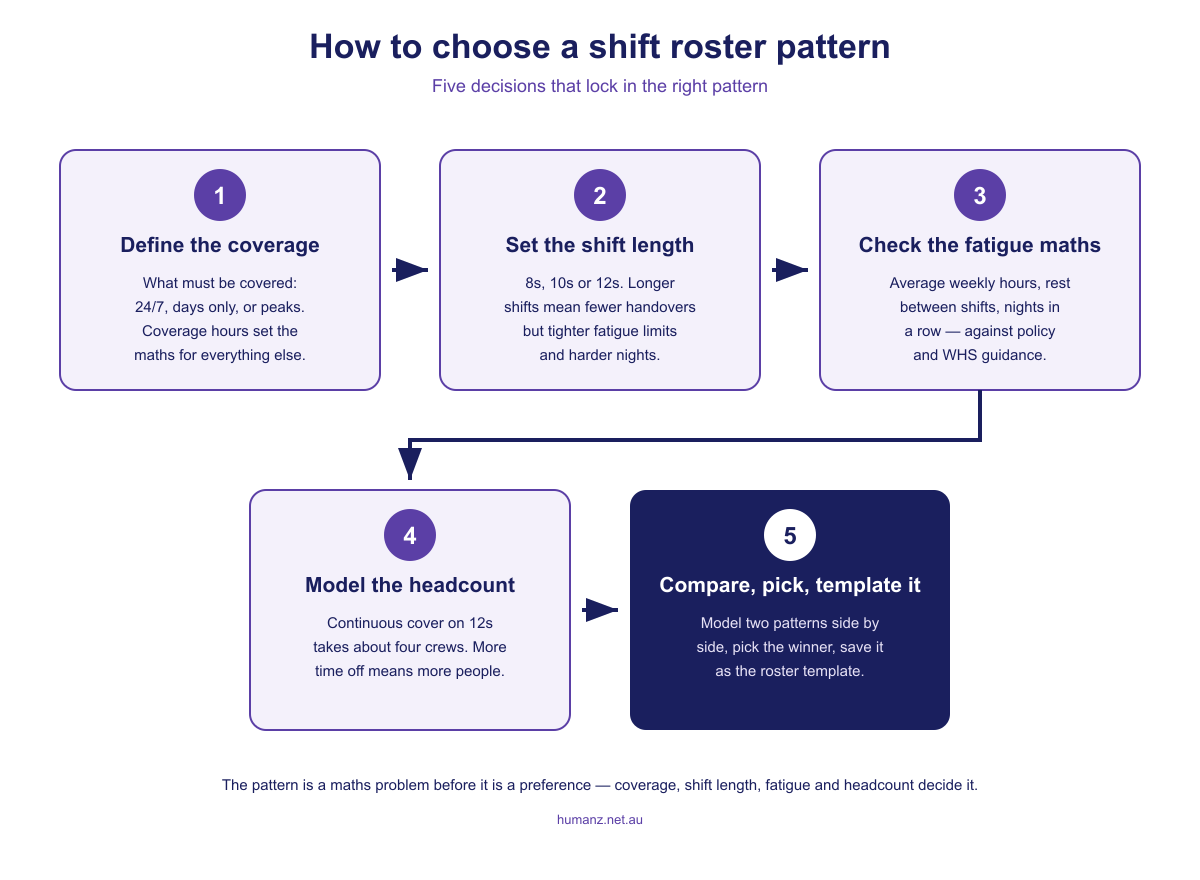
Before comparing patterns, answer one question: does the work stop?
Non-continuous operations work one block of the day: a civil crew on 12-hour day shifts, a workshop running 6am to 6pm. You only need enough panels to cover that block.
Continuous operations run 24/7: a process plant, an underground mine, a control room, an aged care home that never closes its doors. Now you need day and night coverage at once, doubling the seats to fill and dragging night work, rotation direction and circadian load into the decision. If you are sizing a continuous crew from scratch, the 24/7 headcount calculation sets out how many people each covered position actually costs.
This distinction eliminates half the patterns at a stroke: Panama and DuPont exist to solve continuous coverage, and a day-only site running them would be hiring people for shifts that don’t exist.
The patterns, one by one
All figures below assume 12-hour shifts, which is what most of these patterns run in practice.
2/1 and 3/1 swings (14/7 and 21/7)
The 2/1 (two weeks on, one off) is the workhorse of Australian FIFO. A 21-day cycle, 56 average hours a week, about 122 days at home a year, and every break is a full week, long enough to feel like a life. It’s flight-efficient (one round trip per three weeks) and covers a seat with fewer crews than anything gentler.
The 3/1 (three weeks on, one off) pushes to 63 average hours and about 90 days home. It survives on remote exploration and short overseas campaigns, but it’s hard to hire for and sits badly against modern fatigue standards: 21 consecutive 12-hour shifts is the kind of number that makes an auditor reach for a highlighter.
Swings also carry flights, camp rooms and changeover days. That layer is covered in our guide to FIFO rostering software.
8/6
Eight on, six off. A 14-day cycle at 48 average hours, around 156 days home a year. The 8/6 became the compromise pattern of the last decade: meaningfully more home time than 2/1, meaningfully cheaper to staff than even time. The catch is flights: an 8/6 worker flies 26 times a year to a 2/1 worker’s 17, and every travel day nibbles the break. The full breakdown, including the start-day arithmetic that decides whether the crew ever gets a full weekend, is in the 8/6 roster.
Even time: 7/7 and 14/14
Even time means exactly what it says: as many days off as on. Both 7/7 and 14/14 average 42 hours a week and put about 182 days a year at home, which is why even time is the retention pattern: half your roster, half your life.
The two versions trade travel against stretch length. 7/7 means a flight every week, which is fine for DIDO or short hops and brutal for a Perth-to-Pilbara commute where two of the seven days off go to transit and recovery. 14/14 halves the trips but asks for a full fortnight away, which is where partners of FIFO workers develop strong opinions.
Panama (2-2-3)
The Panama runs a 14-day cycle: 2 on, 2 off, 3 on, 2 off, 2 on, 3 off. Every shift is 12 hours, the average is 42 a week, and you work the same days every fortnight, with a three-day weekend every second week, which is the pattern’s whole sales pitch.
Panama is a residential pattern, not a FIFO one; nobody flies to site for a two-day stint. You’ll find it in 24/7 control rooms, utilities and manufacturing and processing plants, covered by four crews (two on days, two on nights). Its strength: nobody ever works more than three shifts in a row. Its weakness: nobody ever gets a proper block off without dipping into annual leave.
DuPont
The DuPont is a 28-day, four-crew rotation mixing day and night blocks: typically four nights, three off, three days, one off, three nights, three off, four days, then the famous seven days off, averaging 42 hours a week across the cycle.
That full week off every month is why people love DuPont. The reason fatigue specialists squint at it is the price: one week in the cycle contains six shifts (a 72-hour week), and the rotation flips between days and nights with as little as 24 hours’ turnaround. It trades peak fatigue for a guaranteed recovery block; whether that works depends on the workforce and the site’s risk profile.
4-panel rotations
“4-panel” describes any continuous roster covered by four offset crews, but in Australian mining it usually means the even-time rotation: 7 days on, 7 off, 7 nights, 7 off, on a 28-day cycle. Two panels are always on site (one on days, one on nights) while two are home. It averages 42 hours, delivers even-time lifestyle, and bakes nights into everyone’s rotation equally, which kills the perpetual-night-crew problem before it starts. Variants run 8/6 timing for a 48-hour average where the operation wants more hours from the same four panels.
The 7 day rotating roster
Outside FIFO, the phrase people search for is the 7 day rotating roster, and it means something simpler than any pattern above. The business operates all seven days, and instead of fixing who owns the weekend, the roster rotates everyone through weekdays and weekends in turn. Three or four crews cycle through the week on a repeating sequence, so the Saturday shifts, and the penalty rates that come with them, get shared rather than owned.
Two details decide whether a 7-day rotation feels fair or feels like chaos. The cycle length has to divide cleanly so each crew’s turn at the weekend comes around on a predictable rhythm, and the rotation direction should run forward through the week rather than jumping around, for the same circadian reasons that apply to nights. Get both right and workers can tell you which weekends they have off in October. Get either wrong and every second conversation with the crew is a swap request, which is its own workload once it’s running through the roster rather than a group chat.
The patterns side by side
| Pattern | Cycle | Avg hrs/week (12-hr shifts) | Days home/year* | Full weekends off/year | Best for |
|---|---|---|---|---|---|
| 2/1 (14/7) | 21 days | 56 | ~120 | ~17 | FIFO production; fewest crews per seat |
| 3/1 (21/7) | 28 days | 63 | ~90 | ~13 | Remote campaigns; increasingly rare |
| 8/6 | 14 days | 48 | ~156 | 0 or 26† | FIFO with retention pressure |
| 7/7 even time | 14 days | 42 | ~182 | ~26 | DIDO and short-commute FIFO |
| 14/14 even time | 28 days | 42 | ~182 | ~26 | Long-haul FIFO, interstate commuters |
| Panama (2-2-3) | 14 days | 42 | ~182 | 26 (all 3-day) | Residential 24/7 plants and control rooms |
| DuPont | 28 days | 42 | ~182 | 13+ | 24/7 sites wanting a full week off per cycle |
| 4-panel (7D-7O-7N-7O) | 28 days | 42 | ~182 | ~26 | 24/7 mining; even time with nights shared |
* Before travel days. † All these cycles divide by 7, so weekdays lock and weekend counts hinge on the start day; 8/6’s six-day break lands a full weekend every cycle or never.
Fixed nights, rotating nights, and which way to rotate
Continuous coverage forces the nights question, and there are only two honest answers.
Fixed crews keep the same people on nights permanently. Some workers genuinely prefer nights for the penalties and the quiet. The cost is a permanent B-team: fixed night crews see less supervision, training and daylight, and their turnover runs hotter.
Rotating crews share the circadian load: everyone does their week of nights and gets it over with. Direction matters. Rotating forward (days towards nights) is easier on the body than backwards, and quick returns (finishing a night block and starting days 24 hours later) are the single most fatiguing transition a roster can contain. DuPont has them by design; plenty of home-grown rosters have them by accident.
Either way, changeover is where a pattern leaks value. A roster with no structured handover window assumes nothing important ever happens at 5:55am.

How to compare two patterns: five numbers
Strip the folklore out of a roster debate by putting five numbers side by side.
- Average weekly hours. Total rostered hours in the cycle ÷ weeks in the cycle. Drives pay, fatigue baseline and headcount at once. 2/1 at 12s is 56; even time is 42; the gap between those numbers is a third of a salary and a third of a workforce.
- Days at home per year, counted after travel. A 7-day break with a travel day each end is a 5-day break. Short cycles multiply travel; this is where 8/6 and 7/7 give back some of what they promise.
- Full weekends off per year. The number families actually feel. Check whether the cycle locks to weekdays and where the start day lands.
- Fatigue exposure. Longest run of consecutive shifts, longest run of nights, and the worst rolling 7-day hour total anywhere in the cycle, not the average, which hides exactly what fatigue rules are written to catch. When we ran that worst-window check across the eight patterns above at 12-hour shifts, six of the eight contain at least one 84-hour rolling week (any pattern with seven or more consecutive shifts does), DuPont peaks at 72 and only Panama stays at 60. Five of the eight average a tidy 42, and the average conceals all of it.
- Headcount required, covered next.
The free swing comparison tool runs the first three for any two patterns side by side, and the swing calendar in the FIFO roster calculator maps a pattern onto real dates so you can see which weekends land where.
How the pattern sets your headcount
The arithmetic is short and unforgiving. Take the hours a seat must be covered per week, divide by the pattern’s average weekly hours, and you have crews per seat.
- 24/7 coverage is 168 hours a week. On even time (42 hrs), that’s exactly 4 crews; on 2/1 (56 hrs), 3. No clever pattern covers 24/7 with two crews; the arithmetic doesn’t negotiate.
- Day-only 12-hour coverage is 84 hours a week. 2/1 covers it with 1.5 crews per seat, 8/6 needs 1.75, even time needs 2.
Then add relief. Annual leave, public holidays, sick leave and training push the real staffing factor well above the raw number, and on a continuous roster it lands near 19%, because shift workers regularly rostered on Sundays and public holidays are often entitled to a fifth week of annual leave. A 24/7 even-time operation genuinely needs about 4.8 heads per seat, not 4. Skipping the relief loading is how sites end up “covering” leave with overtime and quietly demolishing the fatigue case the roster was built on. The 24/7 headcount calculation works through it step by step, and the crew planner does the arithmetic for your actual seat count, relief included.
Pattern changes are therefore commercial decisions, not scheduling ones: moving a 60-person day crew from 2/1 to even time is a hiring project for roughly 20 extra people. On the ABS’s May 2026 average weekly earnings, mining full-time adult ordinary time earnings run $3,224.20 a week, which makes those 20 heads about $3.4 million a year in ordinary-time wages before a single on-cost. Price it before the town hall, not after.
What fatigue limits mean for 12-hour patterns
Under the model WHS laws, fatigue is a hazard employers must manage like any other. Safe Work Australia says businesses must eliminate or minimise the risk of fatigue so far as is reasonably practicable, and its announcement of the model Code of Practice on managing the risk of fatigue at work, published in September 2025 and applying where a state or territory has approved it, names changes to work hours and shift design and sufficient breaks between periods of work among the ways to do it. Comcare treats it as a psychosocial hazard as well as a physical one. The impairment these rules chase is measurable. The Road Safety Commission of Western Australia rates 24 hours awake as equivalent to a 0.10 blood alcohol reading, double the 0.05 that 17 to 19 hours already earns, and a night shift plus a commute plus a broken day’s sleep gets a worker to 24 hours faster than most rosters assume. Most mining clients and major contractors layer their own numeric standards on top, usually set out in a written fatigue management plan, and those are what actually constrain a 12-hour pattern:
- Shift length capped around 12–14 hours including pre-starts and handover; a “12-hour” shift with a 30-minute pre-start and a bus ride is already flirting with the cap
- Minimum rest of 10 hours between shifts, ruling out most quick returns
- Consecutive shifts commonly capped at 14, which is precisely why the 2/1 endures and the 3/1 is dying
- Consecutive nights capped lower again, often around 7
- Rolling hour limits across 7, 14 and 28 days: the check that catches the DuPont-style 72-hour week an annual average conceals
Read those against the table above and the landscape explains itself: 2/1 sits at the ceiling of most standards, 3/1 sits above it, and the 42-hour patterns clear every limit with room to spare. The practical question is where the limits are enforced. In a policy PDF, they get checked after the roster is built, usually by an incident investigation. Rostering software that holds the pattern and the fatigue rules in one system checks every allocation at booking time: the 15th consecutive shift simply refuses to be rostered, which is a much cheaper conversation than the alternative. That is the whole gap between a standard written down and fatigue standards wired into the rostering system.
Common mistakes when choosing a pattern
Copying another site’s roster. The pattern that works down the road was shaped by their commute distance, camp capacity, workforce age profile and client fatigue standard. Import it without the context and you import a solution to somebody else’s problem. Start from your own coverage requirement, forecast as positions and hours per site. The roster templates guide then covers building the chosen pattern as a reusable object.
Ignoring travel days. On paper, 8/6 gives 156 days home and 7/7 gives 182. Add a long commute (a flight each way, 26 times a year) and short-cycle patterns surrender 30–50 of those days to airports and recovery. For long commutes, fewer longer breaks beat frequent short ones, which is exactly the 14/14 argument.
Averaging hours over the wrong window. Under the Fair Work framework, ordinary hours are 38 a week plus reasonable additional hours, and awards and agreements allow averaging over a roster cycle, which is what makes a 56-hour swing lawful. But averaging provisions are an industrial instrument, not a fatigue defence. A pattern can average a tidy 42 while containing a 7-day stretch that breaches every rolling limit the client publishes. Always test the worst window in the cycle, never the mean.
Frequently asked questions
What is a rotating roster?
A rotating roster moves workers through different shifts, days or weekends over a repeating cycle, rather than giving each person a permanent slot. It shares nights, early starts and weekend work around the crew instead of leaving them with the same people. The opposite is a fixed roster. Rotating forward, from days to afternoons to nights, is easier on the body than rotating backwards, and a quick return from nights to days within 24 hours is the most fatiguing transition a roster can contain.
What is a 2/1 roster?
A 2/1 roster is two weeks on site followed by one week off, on a 21-day cycle, also written 14/7. At 12-hour shifts it averages 56 hours a week and gives about 122 days at home per year. It’s Australia’s most common FIFO production roster: flight-efficient, with a break long enough to be worth flying home for.
What does “even time” mean in a roster?
Even time means the days off equal the days on: 7/7, 14/14 or two weeks on, two weeks off. Workers spend half the year at home and average 42 hours a week on 12-hour shifts. It costs more to staff than compressed swings, so it’s used where retention pressure justifies the extra headcount.
What is a Panama roster?
The Panama (also called 2-2-3) is a 14-day cycle of 2 on, 2 off, 3 on, 2 off, 2 on, 3 off, worked in 12-hour shifts by four crews. It averages 42 hours a week, never rosters more than three consecutive shifts, and delivers a three-day weekend every second week. It suits residential 24/7 operations such as processing plants and control rooms rather than FIFO.
What is a DuPont roster?
The DuPont is a 28-day, four-crew rotation mixing day and night blocks, typically four nights, three off, three days, one off, three nights, three off, four days, then seven days off. It averages 42 hours a week across the cycle, and the full week off every month is its whole appeal. The price is one week in the cycle containing six shifts, a 72-hour week, plus day-night flips with as little as 24 hours’ turnaround.
How do you compare two roster patterns fairly?
Put five numbers side by side: average weekly hours, days at home per year counted after travel, full weekends off per year, fatigue exposure and headcount required. For fatigue, test the worst window in the cycle rather than the average, meaning the longest run of consecutive shifts, the longest run of nights and the worst rolling 7-day hour total. The average is what hides exactly the stretch fatigue rules are written to catch.
How many crews do you need for a 24/7 roster?
Divide 168 (the hours in a week) by the pattern’s average weekly hours. Even-time and Panama-style patterns at 42 hours need exactly 4 crews; a 2/1 swing at 56 hours needs 3. Real operations then add a relief allowance for leave, public holidays, sick leave and training, which on a continuous roster runs to about 19% once the fifth week of shift-worker annual leave is counted, so a 24/7 even-time site plans around 4.8 people per seat.
Are 12-hour shifts legal in Australia?
Yes, provided the arrangement meets award or agreement terms and the employer manages fatigue as required under WHS law. Ordinary hours of 38 a week can be averaged over a roster cycle, which is how compressed swings like 2/1 operate lawfully. Most sites also apply numeric fatigue standards (maximum shift length, minimum breaks, caps on consecutive shifts and rolling hours) that constrain how 12-hour patterns are built.
Related articles
Ready to see Humanz on your own roster?
Free 30-minute walkthrough, we'll use your real crews, sites and shift patterns.