
 Login
Login 

Workplace Rules
RDOs explained: how rostered days off accrue in construction and civil
By Heather · 14 September 2026

An RDO, or rostered day off, is a day in the roster period when an employee isn’t required to work. Under the Building and Construction General On-site Award it’s earned, not given. Each 8-hour day includes 0.4 of an hour that accrues towards the RDO, and 19 worked days add up to one 7.6-hour paid day off.
That’s the award version, and plenty of crews work to something else: an enterprise agreement can set its own pattern, and electrical and plumbing contractors have awards of their own.
What does RDO mean?
RDO stands for rostered day off. The Fair Work Ombudsman describes it as a day in a roster period that an employee doesn’t have to work, paid or unpaid depending on how RDOs are set out in the award or registered agreement that applies.
When an RDO is paid, the Ombudsman explains, it’s because the employee has worked extra hours that add up over a set period and are taken as the day off. Nobody is handing out a free Monday. The hours went in a sliver at a time, and the RDO is those hours coming back as one whole day. It’s also not the same as time off in lieu, which runs under its own rules.
Not everyone on a site accrues one. The award covers employers “in the on-site building, engineering and civil construction industry and their employees” in the classifications it lists (clause 4.1), so an independent contractor has no clause 16 count running, and in construction that’s a big slice of the workforce. The ABS Working arrangements release for August 2025 puts independent contractors at 21% of people employed in the industry.
How RDOs accrue under the construction award
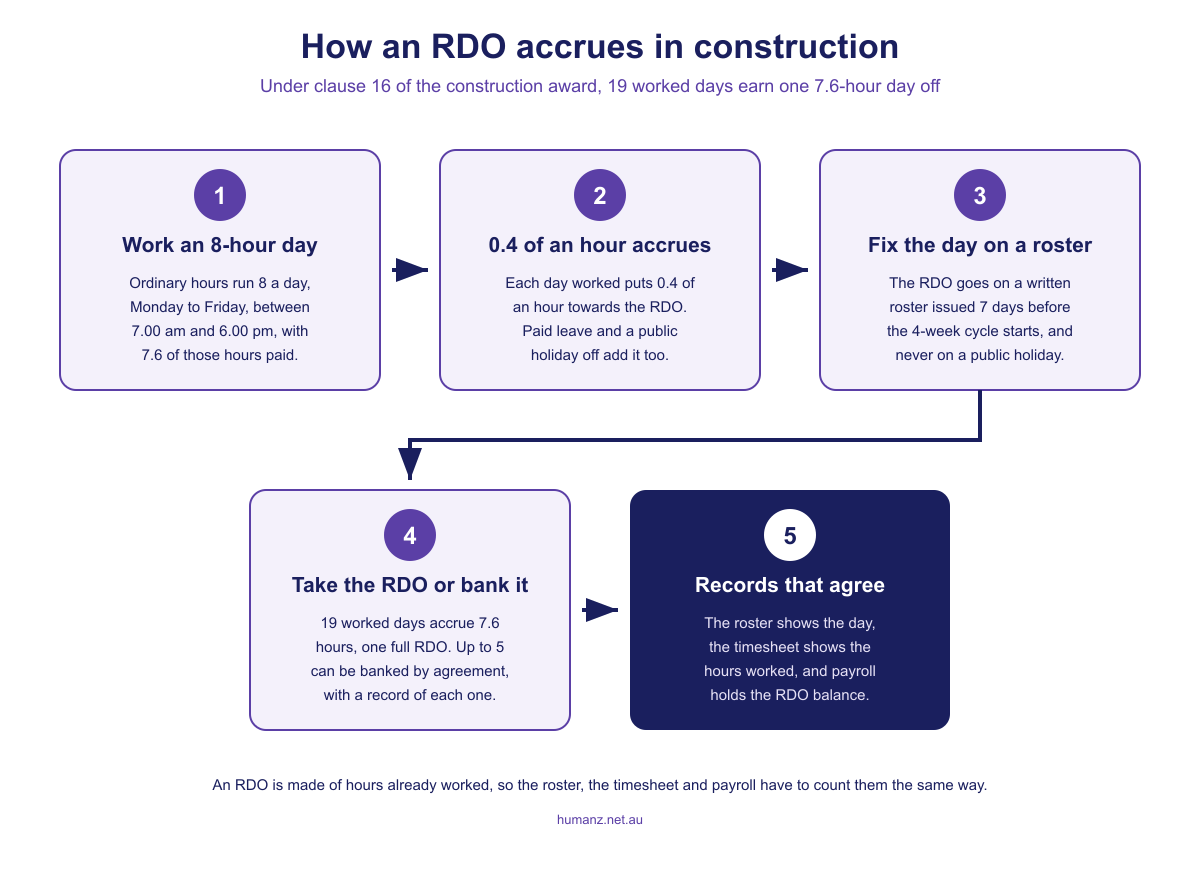
Clause 16 of the Building and Construction General On-site Award 2020 sets the model (MA000020, consolidated by the Fair Work Commission to 1 July 2026). Ordinary hours are 38 a week, averaged over a 20-day, four-week roster cycle so RDOs can accrue and be taken, and they’re worked between 7.00 am and 6.00 pm Monday to Friday (clause 16.1). Shiftwork sits under clause 17. Clause 16.2 splits each 8-hour ordinary day into 7.6 paid hours and 0.4 of an hour that accrues, so 19 days of ordinary hours build one 7.6-hour RDO.
| The 20-day cycle in hours | Figure | Clause or sum |
|---|---|---|
| Ordinary hours in a day | 8 | 16.2 |
| Accrues towards the RDO per day worked | 0.4 of an hour | 16.2 |
| Days of ordinary hours in the cycle | 19, plus the RDO | 16.1 and 16.2 |
| Hours worked across those 19 days | 152 | 19 × 8 |
| Hours accrued across those 19 days | 7.6, one RDO | 19 × 0.4 |
| Average ordinary week over four weeks | 38 | 152 ÷ 4 |
Here’s why the counting matters. Say a concreter’s four-week cycle holds a public holiday they aren’t required to work, two days of annual leave and the RDO, so they work 16 days. Clause 16.3(a) accrues 0.4 of an hour for the public holiday and each paid leave day, making 19 accruing days and a full RDO. A spreadsheet that only ticks worked days comes up 1.2 hours short, and nobody notices until the worker does.
Civil construction shiftworkers accrue a rostered off shift
Civil crews on shiftwork get the same idea under a different name. For the civil construction sector, clause 17.2(d) accrues 24 minutes of each 8-hour shift towards a rostered off shift, taken after each 19 shifts worked and paid for as though worked, and clause 17.2(e) counts paid leave and public holidays as shifts worked for accrual. Twenty-four minutes is 0.4 of an hour, so the maths matches. The mechanics differ, though. The cycle can be two, three or four weeks (clause 17.2©), the employer and employees agree in writing how rostered off shifts are taken or accumulated, up to five (clause 17.2(g)), and clause 17.2(h) covers working one when emergency work requires it. Check clause 17.2 rather than applying the clause 16 steps below, and label it as a rostered off shift so the record shows which clause it came from.
Paid leave, public holidays and part-time hours
The accrual keeps running on paid leave and public holidays, with a few edges worth knowing. The RDO itself doesn’t accrue, and a roster can’t put an RDO on a public holiday (clause 16.4©). Part-timers depend on the arrangement, because clause 16.9 lets a part-timer be paid for actual hours with no accrual, or agree to accrue pro rata. The award permits both, and the trouble starts when nobody wrote down which applies to whom.
| Day in the cycle | Counts towards the next RDO? | Clause |
|---|---|---|
| Ordinary day worked | Yes, 0.4 of an hour | 16.2 |
| Public holiday the employee isn’t required to work | Yes, 0.4 of an hour | 16.3(a) |
| Part-day public holiday | Pro rata for its ordinary hours | 16.3(b) |
| Day of paid leave | Yes, 0.4 of an hour | 16.3(a) |
| The RDO itself | No | 16.2, 16.3(a) |
| Part-timer paid for actual hours worked | No accrual | 16.9(b) |
| Part-timer who has agreed to accrue | Pro rata | 16.9© |
Clause 16.3(a) names paid leave and public holidays. Unpaid leave isn’t on the list.
Taking, banking and working an RDO
How the RDO day is fixed
Clause 16.4(a) allows one RDO day for all employees in the cycle, different days for particular employees, or any other method agreed by the employer and a majority of its employees and recorded in writing. The first two need a written roster fixed by the employer and issued seven days before the cycle starts, and clause 16.4(b) lists ways to issue it, including email or other electronic means.
A shared RDO leaves no gap to fill. Staggered RDOs are another matter. Each one is a hole in a working crew, and it needs to be on the roster well before the morning it bites.
Banking an RDO
An employer and employee can agree to bank an accrued RDO instead (clause 16.5). No more than five can be banked at any time. The employee works the day the RDO was fixed for, the banked day is taken later on an agreed day, and the employer can’t unreasonably refuse the day the employee asks for. The employer must also keep a record of how many RDOs each employee has banked and the date each is taken, which turns a handshake into a record-keeping obligation.
Five banked RDOs can also mean 20 weeks of five 8-hour days without the day off the pattern was built around, which is a fatigue question as much as an award one. The wider limits are in how many hours can legally be worked in a row.
Working on an RDO
Clause 16.6(a) lets an employer require work on a fixed RDO by agreement with the employee, or on at least 48 hours’ notice where the work is needed because of unforeseen delays or other unforeseen or emergency circumstances on the project. The employee keeps the accrued RDO (clause 16.6(b)). How that day is paid is set out in the award and handled by payroll, not the roster.
When a day off every four weeks doesn’t suit the work
Clause 16.8 lets an employer and the majority of employees at an enterprise agree another way of arranging hours where the nature of the operations means an RDO in each four-week cycle is not practicable. Ordinary hours still sit inside the 7.00 am to 6.00 pm Monday-to-Friday spread, with no more than 8 ordinary hours a day, and the agreement goes in writing. It doesn’t stretch to swings or weekend rotations, because the hours stay Monday to Friday. Rotating patterns are their own planning problem, covered in shift roster patterns in Australia.
What happens to RDOs when someone leaves
On termination the employer pays out accrued RDOs not yet taken, banked RDOs, and the hours and minutes accrued towards the next one (clause 16.7). The half-built RDO needs a real number on someone’s last day.
Enterprise agreements and the industry RDO calendars

Plenty of employees aren’t on the award’s pattern at all. Across all industries, public sector included, the ABS Employee Earnings and Hours survey for May 2025 found 34.6% of employees had their pay set by a collective agreement, registered or not, against 22.7% on an award alone. Where a registered enterprise agreement covers the crew, the award doesn’t apply, so the agreement is the document to read.
The calendars show how far agreements move things. The CFMEU’s national RDO page says calendars vary from state to state. CFMEU SA’s 2026 calendar tags industry RDOs separately from EBA 36-hour RDOs, and AWU Victoria publishes separate 36-hour and 38-hour calendars, so plan a 36-hour crew against a 38-hour calendar and the dates won’t line up. Under the award, though, the employer fixes the RDO on a written roster unless the employer and a majority of its employees have agreed another method in writing (clause 16.4(a)(iii)). The roster, not the calendar on the lunchroom wall, is the document that has to be right.
| Publisher | What the page offers |
|---|---|
| CFMEU national RDO page | Links to branch calendars for the ACT, NSW, Qld and NT, SA, Vic and Tas, and WA |
| ETU Victoria | 2026 electrical contracting RDOs (a different award), public holidays, lockdown weekends and school holidays |
| AWU Victoria | Separate RDO calendars for 36-hour and 38-hour weeks |
Master Builders NSW and NECA SA/NT publish calendars too, but only to members.
What the roster should show
For each crew and each cycle, the roster should show the following. The first and third items come from clause 16.4, and the rest keep the record straight.
- Every employee’s RDO date, issued seven days before the cycle
- Staggered RDOs as gaps, with cover planned
- Public holidays kept clear of RDOs
- Any worked RDO, marked as banked, agreed or worked on notice
- The day each banked RDO is taken
A spreadsheet can hold all of that. What it can’t do is reach 30 phones at 4pm on a Monday when a pour slips and Thursday’s RDO becomes a working day on 48 hours’ notice. Rostering software built for field crews pushes the change to every affected phone and tracks who has seen it. The wider Fair Work obligations around a shift roster are in Fair Work compliance for shift workers.
What each timesheet should record
Each timesheet day adds to the next RDO, adds nothing, or changes a banked or retained RDO, so the line should say which.
| What to record | Why it matters | Clause |
|---|---|---|
| Each ordinary day worked | Each one accrues 0.4 of an hour | 16.2 |
| Paid leave days and public holidays not worked | They accrue too, so they can’t be left blank | 16.3(a) |
| The RDO, marked as the RDO | It doesn’t accrue, and it shows the day was given | 16.3(a), 16.4 |
| A fixed RDO worked because it was banked | It adds to the banked count, and clause 16.6 doesn’t apply | 16.5(b), 16.5(d) |
| A fixed RDO worked by agreement or on 48 hours’ notice | The employee keeps the accrued RDO | 16.6(a), 16.6(b) |
| Each banked RDO and the date it’s taken | The employer must keep this record, and the cap is five | 16.5 |
| Hours accrued towards the next RDO | They’re paid out if the employee leaves | 16.7(b) |
The line worth watching is the worked RDO. Record it as an ordinary Tuesday and the retained RDO quietly disappears. Approving against the roster only catches it if the roster still shows the day was an RDO, so mark the change rather than overwriting it, then run it through the timesheet approval workflow.
Where Humanz fits, and where payroll takes over
When the RDO count lives in a spreadsheet and the roster in another file, every change gets made twice by someone who’s already busy. Humanz runs the roster and the timesheets. It doesn’t calculate pay or interpret the award, and the RDO balance lives in payroll, which Humanz feeds with approved hours.
When a worker is off, the leave goes in with its category, hours and dates, as a single day, a date range or a repeating occurrence. One tick clears every shift they held that day, so the gap shows on the roster straight away and the open shift can be pushed to available, qualified workers. Leave requests from the mobile app run through the same approve or reject pattern as timesheets.
Timesheets prefill from the roster, get submitted from phones on site and reach supervisors for approval, with edited entries carrying a warning marker. Approved hours then flow to payroll without re-keying, including through the two-way Xero integration.
For civil contractors, civil construction rostering software keeps people and plant on one allocation board, so a machine without an operator shows up days early instead of at the gate. The broader checklist is in workforce management software for construction. If your RDOs live in a spreadsheet and one supervisor’s memory, talk to us and bring the spreadsheet.
Frequently asked questions
What is an RDO?
An RDO is a rostered day off, a day in the roster period when an employee isn’t required to work. It can be paid or unpaid depending on how the award or registered agreement sets RDOs out. Under the Building and Construction General On-site Award, 0.4 of an hour from each 8-hour working day accrues until the hours add up to a full 7.6-hour day off.
How do RDOs work in construction?
Each 8-hour day worked accrues 0.4 of an hour towards a rostered day off, so 19 worked days build one paid 7.6-hour RDO in each four-week cycle under the Building and Construction General On-site Award. Ordinary hours average 38 a week over that 20-day cycle. The employer fixes the RDO on a written roster issued seven days before the cycle, unless the employer and a majority of its employees have agreed another method in writing.
How many days do you work to get an RDO?
Nineteen days of ordinary hours earn one RDO under the Building and Construction General On-site Award. Each 8-hour day accrues 0.4 of an hour, and 19 of them make the 7.6 hours of the RDO. Paid leave days and public holidays not worked accrue at the same rate, so they count too.
Do RDOs accrue on annual leave and public holidays?
Yes, under the Building and Construction General On-site Award. Clause 16.3 accrues 0.4 of an hour for each day of paid leave and for any public holiday the employee isn’t required to work, with part-day public holidays counted pro rata. The RDO itself doesn’t accrue.
Can your employer make you work on your RDO?
Yes, in two situations under the Building and Construction General On-site Award. The employee can agree, or the employer can give at least 48 hours’ notice where unforeseen delays or other unforeseen or emergency circumstances on the project make the work necessary. Either way, the employee keeps the accrued RDO.
Can you bank RDOs?
Yes, if the employer and employee agree. The Building and Construction General On-site Award caps banked RDOs at five at any time, and the employee works the day the RDO was fixed for and takes the banked day later on an agreed day. The employer must keep a record of how many each employee has banked and when each is taken.
Do part-time workers get RDOs?
It depends on the arrangement. Under the Building and Construction General On-site Award, a part-time employee paid for actual hours worked doesn’t accrue time towards an RDO. The employer and employee can instead agree that the part-timer accrues, and the entitlement then builds pro rata.
Related articles
Ready to see Humanz on your own roster?
Free 30-minute walkthrough, we'll use your real crews, sites and shift patterns.