
 Login
Login 

Rostering & Scheduling
FIFO Rostering Software: Managing Flights and Accommodation in Your Roster
By Duane Butler · 12 June 2026 · Updated 3 September 2026

On a FIFO or DIDO job in mining, construction or remote field services, a worker’s shift doesn’t start when they swing on the tools. The pattern itself sets how often this machinery runs: on an 8/6 roster it is 26 round trips a year per worker. It starts at the airport. If your roster only shows work shifts, you’re managing half the picture. The other half usually lives in a spreadsheet or someone’s head.
That’s how workers end up at the wrong terminal, rooms get double-booked, and schedulers spend Sunday nights cross-referencing flight manifests against the roster. A FIFO workforce management platform that treats flights and accommodation as roster items in their own right closes that gap.
Why travel belongs in the roster
When flights and accommodation sit outside the roster, the same three problems keep turning up:
- No single source of truth. The scheduler sees the work shift but not whether the worker can physically be on site for it. Travel conflicts surface when someone misses a swing, not before.
- Double data entry. Travel details get typed into a booking spreadsheet, then repeated by phone or email for every worker, every swing.
- Workers fly blind. Crews check their roster on their phone. If the flight isn’t on it, they’re relying on a text message from three weeks ago.
Putting non-work shifts (flights, accommodation, mobilisation days) on the same schedule as work shifts means everyone sees the full picture. The scheduler sees it on the Gantt view. The worker sees it in the mobile app.
This matters for compliance too. Travel time and remote work arrangements carry real obligations around rest, rosters, and working hours under the Fair Work system, and remote site travel is a recognised fatigue factor in Safe Work Australia’s guidance on managing fatigue risk. If travel isn’t visible in the schedule, it isn’t being factored into rest planning.
Accommodation deserves the same standing as flights, because rooms are lived in as much as they are booked. In the MARS landmark study of WA mining workers, only 60% of FIFO mining workers were satisfied with their accommodation, and while 73% of men reported feeling physically very safe in work-provided accommodation, only 53% of women did. Who ends up in which room is a workforce decision, not a booking detail.
How Humanz handles flights and accommodation
Humanz manages FIFO travel with two features that work together: reusable templates and bulk upload.
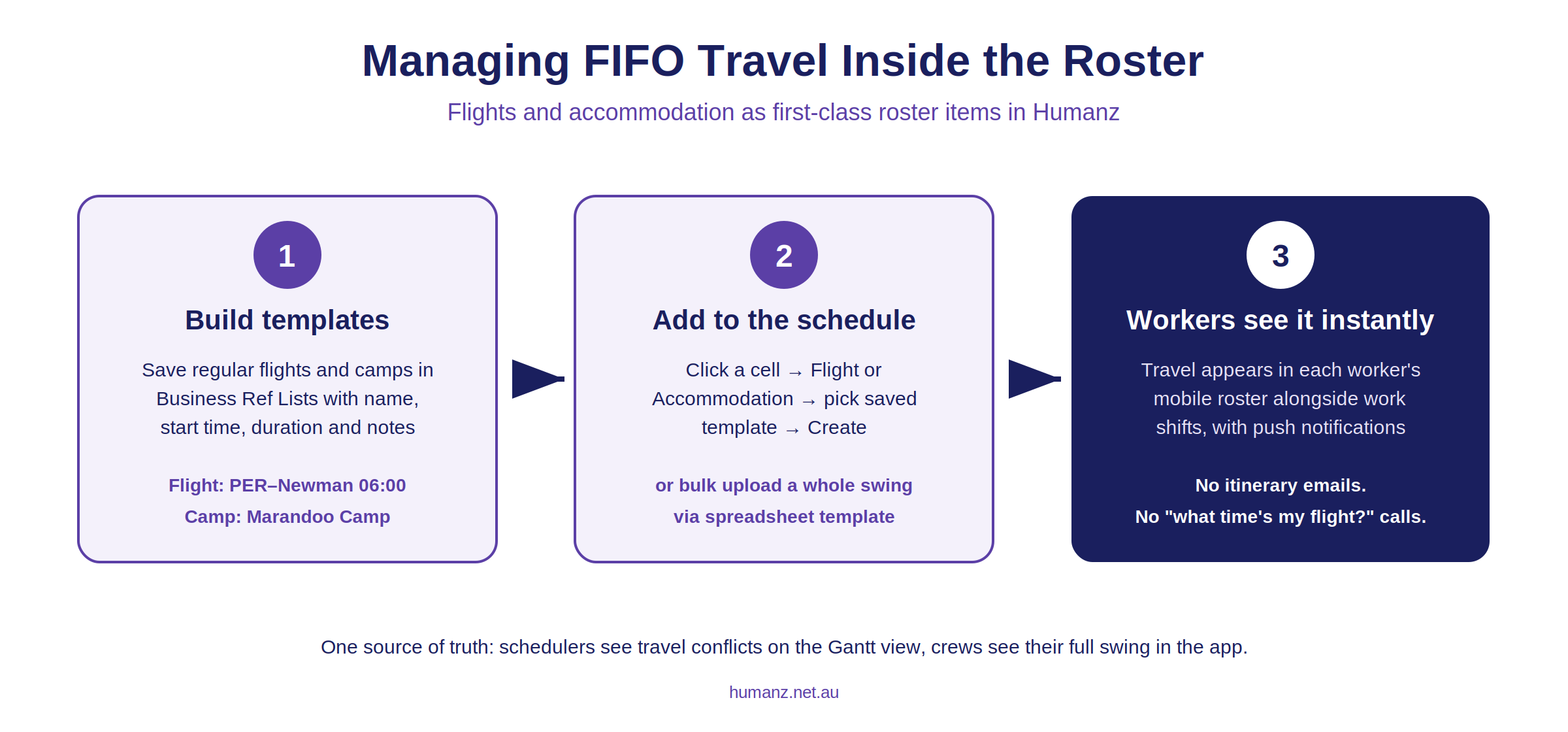
1. Flight and accommodation templates
Most FIFO operations use the same handful of flights and camps over and over. Rather than typing “PER–Newman, 06:00 departure” hundreds of times, save them once as templates in your Business Reference Lists:
- Flights carry a name, start time, duration and notes (terminal, check-in cut-off, airline reference).
- Accommodation carries a name and notes (camp check-in details, room allocation process).
Once saved, adding travel to the roster takes seconds. Click a cell on the scheduler, choose Flight or Accommodation, pick the saved template, and create. The saved details fill in automatically.
2. Bulk upload for whole swings
For large crews, even template entry is too slow. Download the non-work shift spreadsheet template from Scheduler Settings, fill in the rows (project, task, job, worker name, date, start and end times, shift type, notes) and upload the whole swing’s travel in one pass.
That’s the difference between an afternoon of clicking and a five-minute import when you’re mobilising 60 people for a shutdown. Map the dates first. The free FIFO roster calculator and swing calendar turns a pattern like 2/1 into actual fly-in and fly-out dates to build the spreadsheet around. If you’re coordinating subcontractors as well as direct employees, the same approach works alongside your subcontractor management process.
3. Workers see it instantly, or when your coordinator chooses
Shifts in Humanz carry a status, so planners can build and rework travel freely without every draft change pinging the crew. Once a swing is approved and confirmed, the team sees what’s planned and hears about it when it changes.
Because flights and accommodation are roster items, they appear in each worker’s mobile schedule alongside their work shifts, with push notifications for changes. No separate itinerary email. No “what time’s my flight” calls to the office.
Practical tips for setting this up
- Build the template library first. List every regular flight route and camp before you start scheduling. Ten minutes of setup saves hours every roster cycle.
- Put detail in the notes field. Check-in cut-offs, terminal numbers and camp reception hours belong in the template so they land on every booking.
- Bulk upload at mobilisation. When a new job kicks off, upload the first swing’s travel in one spreadsheet, then maintain it with template entries as things change. This pairs well with a structured field worker onboarding process. New starters get their first flight on their roster the moment they’re mobilised.
- Keep travel and fatigue planning connected. Long travel days compress rest windows. With flights on the same schedule as work shifts, your fatigue rules built into the roster check against reality, not just rostered hours. The WA Mental Health Commission’s FIFO research goes as far as recommending that travel to and from site, and day-to-night transitions, be risk-assessed for their fatigue and mental-health impact. A risk assessment can only see travel that is actually on the roster.
For trades and resources businesses comparing platforms, travel handling is a genuine point of difference. Most generic rostering tools don’t model non-work shifts at all, which is one reason purpose-built rostering software for Australian field teams wins in mining and remote construction. The broader swing picture (patterns, fatigue gates, crew confirmation) is covered in our FIFO rostering software guide, and the wider site picture, from shutdowns to inductions, in our guide to mining workforce management software.
Frequently asked questions
Why put flights and accommodation on the roster instead of a spreadsheet? Because a work shift only happens if the worker can physically be on site for it, and the roster is the only place that can check both at once. When travel sits outside the roster the same three problems keep turning up: conflicts that surface only when someone misses a swing, double data entry across booking spreadsheets, and crews relying on a text from three weeks ago. Rostered travel means the scheduler and the worker both see the full picture in one place.
Can workers see flight details in the app? Yes. Flights and accommodation appear as shifts in the worker’s mobile schedule, including the notes saved on the template.
Does travel time count in fatigue planning? Yes, if the travel is on the roster where fatigue rules can see it. Remote site travel is a recognised fatigue factor, and long travel days compress the rest window on either side of a swing. With flights on the same schedule as work shifts, fatigue checks run against what the worker is really doing rather than rostered work hours alone.
Do I have to use templates, or can I enter one-off travel? Both work. Templates speed up repeat routes, but you can create a flight or accommodation shift manually with custom details any time.
What format is the bulk upload? A spreadsheet template downloaded from Scheduler Settings. You fill in the rows (worker, date, times, shift type, notes) and upload it back. Humanz creates all the shifts at once.
Does travel data flow into reporting? Yes. Non-work shifts sit in the same scheduling data as work shifts, so they show up in exports and reports alongside everything else.
Is this only for FIFO mining crews? No. Any business that moves people around can use flights, accommodation and other non-work shift types, from remote construction to shutdown crews and regional service teams. The same scheduling approach extends to logistics and transport workforces, where drivers and field crews are constantly on the move.
Related articles
Ready to see Humanz on your own roster?
Free 30-minute walkthrough, we'll use your real crews, sites and shift patterns.