
 Login
Login 

Rostering & Scheduling
Automated staff rostering and auto-rostering: how automation speeds up roster building
By Duane Butler · 26 June 2026 · Updated 14 September 2026

Automated staff rostering is software that builds, fills and checks a roster for you from templates, recurring patterns and live availability, so a coordinator reviews a draft instead of assembling one shift at a time. Building a roster by hand is slow, repetitive and easy to get wrong. A coordinator running multiple sites can spend half a day dragging shifts into a grid, cross-checking who’s available, who holds the right tickets and who’s already booked, then starting again the moment a job moves. Automatic scheduling software exists to take that manual assembly off your plate.
This guide covers how automated roster generation saves time against manual rostering, and the difference between the rules-based automation you can use today and the AI scheduling still on the horizon. The short version is that today’s automation runs on roster templates, recurring patterns and live data, not artificial intelligence.
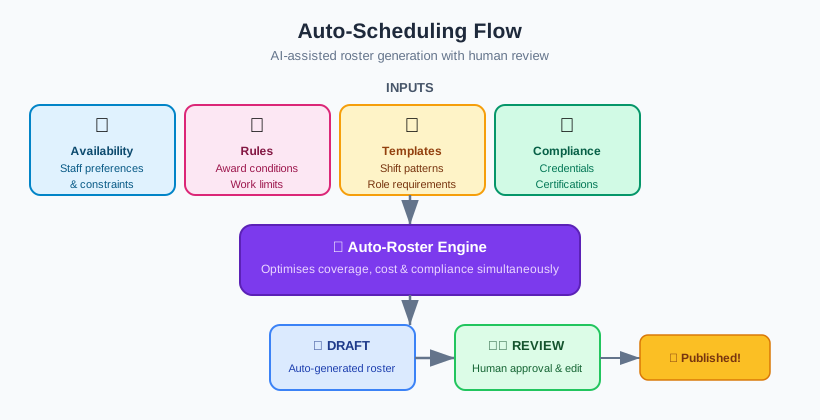
What is automated staff rostering?
Automatic scheduling (or auto-rostering) is the use of software to build, fill and check rosters with far less manual input than starting from nothing. An automated rostering system holds that structure as templates, recurring patterns and availability and qualification rules, so instead of placing every shift by hand you set it up once and let the system fill in the rest.
In practice, automated shift scheduling in Australia usually covers a combination of:
- Roster templates, pre-built shift patterns for a site, crew or project that you apply in one click rather than rebuilding each cycle
- Recurring rosters that repeat on their own, whether that’s a standard week or one of the longer swing and day/night rotation patterns, so the baseline generates itself
- Auto-fill from live availability and qualifications, suggesting workers who are free, hold the right tickets and aren’t booked elsewhere
- Conflict and compliance detection that flags double-bookings, fatigue breaches and expired licences before a roster is published
- Bulk actions for copying a week, shifting a crew’s start times or reassigning a site’s shifts in one step
The thread running through all of these is that the software handles the predictable parts of rostering so a human can focus on the decisions that need judgement.
The time automation saves versus manual rostering
The biggest cost of manual rostering isn’t any single task. It’s the constant re-doing. Every change ripples, and every ripple has to be checked by hand. And change is the normal state of an Australian roster. In the ABS Working arrangements figures for August 2025, 17% of employees, 2.0 million people, did not usually work the same number of hours each week.
It’s worth being honest about what the manual version really is, because plenty of businesses still run it. A planner, a wall calendar or a spreadsheet, and a coordinator holding the cross-checks in their head. Who’s on leave, whose ticket lapses Friday, which crew is already at 50 hours. The planner records decisions. It contributes nothing to making them, and it re-checks nothing when one of them changes.

Every section below is describing the same shift. Moving those cross-checks out of the coordinator’s head and into the system, so the planner stops being the single point of failure with annual leave.
Starting from a baseline instead of a blank grid
Most rosters are roughly the same week to week. With templates and recurring patterns, the baseline roster is already in place when the coordinator sits down. Coverage met, regular crews assigned, standard shifts populated. The work shifts from building a roster to adjusting one, which is far faster. This is the practical payoff of keeping every site live in one rostering view. The structure persists, so you’re never starting from zero. If you’re still working out what that baseline should look like, the free crew planner is a quick way to rough out crew sizes and coverage before you commit a template.
Filling gaps without manual cross-checking
When a slot needs filling, the slow part is mentally cross-referencing availability, qualifications and existing bookings. Labour scarcity raises the stakes here. In Jobs and Skills Australia’s Recruitment Experiences and Outlook Survey for July 2026, 43% of recruiting employers reported difficulty filling roles, and a coordinator who can’t see who’s free is wasting workers the market won’t easily replace. Auto-fill from live data collapses that into a shortlist. Everyone on it is available, ticketed and unbooked. The coordinator picks. The software has already done the checking.
Catching problems before they cost you
Manual rostering catches conflicts only when someone notices, often after the roster is published. Automated conflict detection surfaces double-bookings and compliance issues as you build, which is exactly where the day-of disruption that no-shows and rostering slips cause gets driven down. Fewer errors at build time means fewer fires to fight on the day.
Quietly absorbing a roster error is also less of an option than it used to be. Anonymous tip-offs to the Fair Work Ombudsman jumped 50% in a year to 25,608 in 2024-25, so a mistake that reaches a payslip is more likely than ever to be reported rather than shrugged off.
Making bulk changes in one move
When a project slips a week or a site changes hours, manual rostering means editing dozens of shifts. Bulk actions (copy, shift, reassign) turn that into a single operation. That’s where a lot of the day-to-day time saving lives.
Rules-based automation today versus AI scheduling tomorrow
This is the most important distinction in the whole category, and the one most often blurred in marketing.
What rules-based automation is
The automation available now (templates, recurring rosters, auto-fill, conflict and compliance detection) is rules-based. It follows deterministic logic you can read like a sentence. This worker is available, holds a current ticket and is not double-booked, so they can be slotted into this shift. There’s no guessing. The same inputs always produce the same result, which is exactly what you want for compliance-sensitive decisions.
What AI scheduling adds
AI scheduling is a separate, future direction. Rather than applying fixed rules, it uses optimisation and machine learning to generate a draft roster, balance the whole schedule at once, and predict problems like likely no-shows. It’s powerful, but it’s a different class of technology, with its own risks around bias, transparency and data quality. We work through those trade-offs in our companion guide to AI-driven scheduling in Australia.
The contrast fits in one line. Rules-based automation does the repetitive work predictably. AI scheduling proposes and optimises. The time savings above come entirely from rules-based automation, no AI required. It’s the next step, not the current one.
Keeping a human in control
Automation is there to remove busywork, not to make the final call. The model that works, for rules-based automation today and AI tomorrow alike, is software doing the grunt work and an experienced coordinator approving the result.
This matters because the hardest scheduling decisions are the ones automation can’t see: crew dynamics, a client’s preference for a particular team, a one-off site requirement, or the knowledge that two workers shouldn’t be paired on a tricky job. A template can place the regulars and auto-fill can suggest the rest, but the coordinator’s judgement is what turns a technically valid roster into the right one. Features like filters, teams and reason codes in the scheduler exist to keep that human oversight fast and informed rather than slowing it down.
Automation should also make compliance impossible to skip. The strongest setups treat fatigue and licence checks as hard gates at the point of scheduling, so a non-compliant shift can’t be confirmed in the first place. Our guide to enforcing fatigue rules at the point of scheduling shows how those gates work in practice.
Why data quality decides how well automation works
Every form of automatic scheduling depends on the quality of the data underneath it.
Auto-fill can only suggest the right people if availability is current and qualifications and licence expiries are recorded accurately. Conflict detection can only flag a double-booking if every booking lives in the same system. If the data is stale or scattered across spreadsheets, automation will confidently produce a roster that looks fine and isn’t.
Practical foundations for good data:
- Keep availability live. Workers updating their own beats a coordinator guessing from memory.
- Record qualifications and expiry dates properly, so matching and compliance gates have something to check against.
- Hold every booking in one place, including subcontractors, so conflict detection sees the whole picture.
- Close the loop by getting shifts confirmed over team messaging, turning a generated roster into a confirmed one.
Get the data right and automation saves real time. Get it wrong and you’ve automated the production of bad rosters.
How Humanz builds rosters for you today
As an automated rostering system, Humanz is rules and template based: deterministic checks you can read like a sentence rather than a model making a probabilistic guess. The whole job is taking the routine assembly off a coordinator’s plate using live data, while they keep the final say.
In practice that means the baseline roster is already there before anyone touches it. Apply a standard week, swing or rotation in a single step from a saved template, and every site, crew and shift stays current in one real-time, multi-site view. When a gap opens, auto-fill reads live availability and matches qualifications so you see who is free, ticketed and not already booked before you assign. Conflict detection flags double-bookings and clashes as you build rather than after publishing. Because direct employees and subcontractors sit in the same interface, those checks see the whole picture.
Compliance works the same way, with fatigue thresholds enforced inside the roster and licence-currency checks acting as hard gates that stop a non-compliant shift being confirmed at all. When the plan changes, bulk actions copy, shift and reassign across a week or a site in one move, and workers pick up shifts, changes and reminders instantly through the Humanz mobile app. See how Humanz handles rostering from template to confirmed shift.
All of that runs on clean, live data and hard compliance rules, the same foundations responsible AI scheduling will eventually depend on. AI-assisted scheduling sits on the roadmap as part of how we keep developing the platform. Today, the speed comes from rules-based automation with a human firmly in control.
Frequently asked questions
What is automated staff rostering?
Automated staff rostering, also called auto-rostering, is software that builds, fills and checks rosters with far less manual input than starting from a blank grid. You set the structure up once as templates and recurring patterns, and the automated rostering system generates the baseline, suggests available and qualified workers for gaps, and flags conflicts before publishing. It runs on fixed rules rather than AI, so the coordinator reviews and adjusts instead of assembling every shift by hand.
What does an automated rostering system check before it fills a shift?
It checks that the worker is available, holds the tickets and inductions the shift requires, is not already booked elsewhere, and stays inside the fatigue limits set for the site. A shift that fails one of those checks is flagged, or blocked outright where the check is a hard gate, before the roster is published. The checks are only as reliable as the availability, qualification and booking data they read.
What is the difference between auto-rostering and AI scheduling?
Auto-rostering applies fixed rules and templates, so the same inputs always produce the same result. AI scheduling uses optimisation and machine learning to generate and optimise drafts and predict problems. Rules-based automation is available today. AI scheduling is a separate, future direction, covered in our AI rostering guide.
Does Humanz use AI to schedule?
Not yet. What Humanz runs today is deterministic: saved templates, recurring patterns, auto-fill from live availability and qualifications, plus conflict and compliance checks. AI-assisted scheduling is something we’re working towards, but the speed you get right now comes from fixed rules doing the same checks every time, not from machine learning.
How much time does automatic scheduling actually save?
The biggest saving comes from starting with a template-based baseline instead of an empty roster, then using auto-fill and bulk actions for changes. Coordinators move from building rosters by hand to reviewing and adjusting them, which removes most of the repetitive cross-checking that makes manual rostering slow.
Does automated roster generation handle Australian compliance?
It should treat compliance as hard rules, not suggestions. The strongest tools enforce WHS fatigue obligations and award conditions as gates at the point of scheduling, blocking non-compliant shifts rather than producing them. Safe Work Australia’s fatigue guidance covers the WHS side, while Fair Work sets the award and hours obligations any automated roster must respect.
Can auto-rostering handle swing and non-weekly roster patterns?
Yes. Recurring rosters aren’t limited to a standard week, so swing patterns and day and night rotations can repeat on their own cycle and the baseline generates itself. The pattern is saved once and rolled forward, rather than copied and pasted each fortnight.
What makes auto-rostering work well?
Data quality. Auto-fill, qualification matching and conflict detection are only as good as the live availability, qualification and booking data behind them. Keeping availability current, recording expiries accurately and holding every booking (subcontractors too) in one place is what makes automation reliable.
Will automation replace coordinators?
No. Automation removes the assembly and checking. Coordinators still make the judgement calls: crew dynamics, client preferences and one-off site needs that software can’t see. The right model is the system doing the heavy lifting and a human approving the result.
Related articles
Ready to see Humanz on your own roster?
Free 30-minute walkthrough, we'll use your real crews, sites and shift patterns.