
 Login
Login 

Subcontractors
Using Labour Hire: The Host Employer's Obligations, State by State
By Christian Tietzel · 2 September 2026 · Updated 16 September 2026

Search for labour hire licensing and nearly everything you find is written for the agency. How to apply, what it costs, how long approval takes. Very little is written for the business on the other side of the invoice, which is odd, because in four Australian jurisdictions that business commits an offence of its own by using an unlicensed provider.
That is the host’s position in Victoria, Queensland, South Australia and the ACT. The fine lands on you, not just the agency, and in Victoria and Queensland the published maximums for a company run well past half a million dollars. Beside it sits a second obligation that applies in every state and territory, scheme or no scheme. Once an on-hire worker starts on your site, your duty for their health and safety is the same as for your own employees, and no clause in the supply agreement moves it.
This guide covers both hats, state by state. Which register to search, what the regulators say the penalties are, what changed in South Australia this year, the Commonwealth same-pay layer, and what to record so proving you checked is a filing exercise rather than a week of inbox archaeology. This is general information, not legal advice. Check the regulator’s page for the state where the work is done before you rely on any figure here.
The two hats every host wears
The first hat is the licensing check. Victoria, Queensland, South Australia and the ACT each run a labour hire licensing scheme, and each polices it from both ends. The provider needs the licence, and you need to have confirmed they hold it. Every scheme keeps a public register, so “we assumed they were licensed” survives about as long as it takes an inspector to type the provider’s name into one.
The second hat is the safety duty, and it doesn’t stop at any border. Under work health and safety law, both the labour hire agency and the host are PCBUs, persons conducting a business or undertaking, and both owe the on-hire worker a duty of care. Safe Work Australia is blunt about the boundary. Neither party can contract out of its WHS duties or transfer them to the other. As the PCBU at the workplace, the host must provide adequate facilities, first aid access and an emergency plan, and must work with the provider on induction, training, supervision and confirming that workers hold the qualifications and licences the job needs. Where the on-hire worker drives a heavy vehicle, the host that sets their shifts is also a scheduler in the chain of responsibility, a duty that cannot be contracted away either.
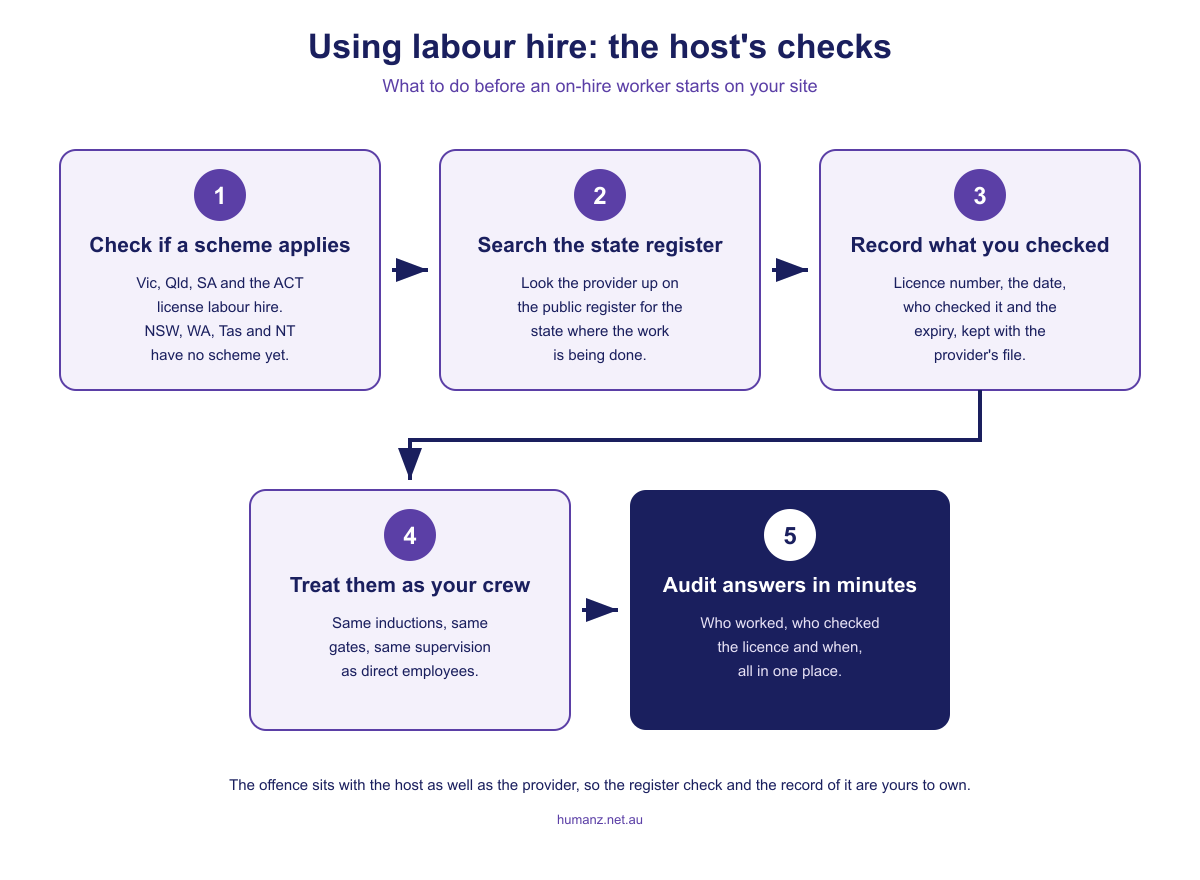
Two hats, two failure modes. Miss the licence check and you are exposed to a fine of your own. Miss the safety duty and you are exposed to everything that follows an incident. Here is the whole job in one picture, then the detail.
The scheme states, one by one
Victoria
Victoria’s scheme runs under the Labour Hire Licensing Act 2018, administered by the Labour Hire Authority. The rule is one line. Hosts must only use licensed providers, and the place to confirm a licence is the Labour Hire Licence Register at register.labourhireauthority.vic.gov.au. That register is not a token list, either. The Authority’s year in review for 2024-25 reports 5,788 businesses holding a licence at the end of the year, the highest since the scheme began in 2019, including 889 new licences granted along the way. Any provider seriously in this market is on it, so a provider that can’t be found there is telling you something.
For 2026-27, the Authority puts the maximum penalty for engaging an unlicensed provider at $167,280 for an individual and $669,120 for a corporation, the same category as the provider’s own offence of operating without a licence. Those are host numbers, not someone else’s problem. And the courts use this Act. The same review records the Supreme Court of Victoria issuing $759,674 in penalties to five companies and three company directors in September 2024, for their involvement in unlicensed labour hire operations.
Victoria also hands hosts a positive duty that most miss. If you become aware, or reasonably suspect, that an avoidance arrangement is in place (an arrangement structured to get around the scheme), you must notify the Authority, and failing to do so carries penalties of $41,820 for an individual and $167,280 for a corporation. The Authority adds that hosts may be liable for a provider’s contraventions under workplace and migration law, with shared responsibility for safety on top. In Victoria, “not my worker” is not a sentence the law recognises. One date to diarise: the Victorian Government’s proposed construction regulations, which would define specific construction activities as labour hire, are proposed to commence on 29 October 2026, with consultation closing on 21 September 2026, so a host using construction labour in Victoria should read the Authority’s page again before then.
Queensland
Queensland’s scheme runs under the Labour Hire Licensing Act 2017, and using an unlicensed provider is an offence committed by the user as well as the provider. The register lives at ols.oir.qld.gov.au/licence-register. Queensland also publishes a list of pending applications, with a trap attached. A provider that has merely applied cannot be used. Current licence or nothing. The trap works at the other end too, because it is also an offence to use a provider whose licence is suspended, which means a check on day one doesn’t cover month nine.
The maximums, based on the penalty unit value from 1 July 2026, are $518,100 for a corporation and $178,571.80 or three years imprisonment for an individual. Entering an avoidance arrangement attracts the same maximum dollar penalties, and a host that fails to notify the regulator of one faces up to $34,540.
This scheme is enforced, not decorative. In October 2025 the state’s labour hire compliance unit prosecuted an unlicensed provider, a security company, at the Mount Isa Magistrates Court. The result across 13 charges was a $240,000 fine for the company and $80,000 for its director. That prosecution landed on the provider’s side of the fence, but the host-side offence sits in the same Act, and the register search that keeps you off the wrong side of it takes about a minute.
South Australia
South Australia is the state to re-read even if you checked the rules last year, because the answer changed. Until January 2026, the Labour Hire Licensing Act 2017 (SA) covered five prescribed sectors: horticulture processing, meat processing, seafood processing, cleaning and trolley collection. From 29 January 2026 the scheme expanded to every industry, with a transition that ended on 29 July 2026. If on-hire workers are on your SA sites now, in any industry, the scheme covers you.
The transition tail is the live detail. Providers whose paid licence applications were accepted by Consumer and Business Services on or before 29 July 2026, but are still being finalised, hold temporary exemptions, and those exemptions cover the hosts using them as well. If your provider says they are in that queue, ask for the CBS email acknowledging their application and file it.
Maximum penalties are $140,000 for an individual and $400,000 for a body corporate, and CBS confirms the same maximums apply to a host that signs with an unlicensed provider. Hosts must not enter avoidance arrangements, must report non-complying labour where it is reasonable they would be aware of it, and can have their workplaces entered by inspectors. The register of licensed providers is on sa.gov.au, under check if a labour hire provider is licensed.
The ACT
The ACT scheme has run since 27 May 2021 under the Labour Hire Licensing Act 2020, through WorkSafe ACT. Hosts need no licence of their own but must only use licensed providers, and WorkSafe ACT’s guidance says financial penalties may apply to hosts that engage unlicensed ones. The Act itself sets the host’s exposure as a civil penalty of up to 800 penalty units for an individual and 3,000 for a corporation, with an exception where the provider was on the register at the time, which is the whole argument for searching it. The register sits on the WorkSafe ACT portal at portal.worksafe.act.gov.au/s/labour-hire-register, and searching it costs nothing.
No scheme in your state? Read this anyway
New South Wales has no labour hire licensing scheme. The state’s official position is that it is working with the Commonwealth and the remaining states on a nationally consistent framework, and in August 2026 the NSW Government said it still prefers a nationally harmonised scheme while examining all options, including a scheme of its own. Nationally, ministers endorsed a model in December 2023 and a senior officials’ report on national model law principles, from the Commonwealth and five jurisdictions, was published in September 2026, but nothing has been legislated. Harmonisation is on the table, and the four state schemes are what bind hosts today, so nothing about a future framework helps you at a Victorian or Queensland site this month.
Western Australia doesn’t license labour hire either, and labour hire companies are expressly exempt from WA’s employment agent licence. What WA does have is the Work Health and Safety Act 2020, under which a PCBU’s primary duty of care extends to labour hire workers, covering both the agency and the host, and duty holders cannot contract out of or transfer those obligations.
No labour hire licensing scheme operates in Tasmania. WorkSafe Tasmania’s guidance for hosts is the sentence you would want your own supervisors to say anyway: manage the safety of labour hire workers the same way you manage the safety of your own. No labour hire licensing scheme operates in the Northern Territory either, and the same shared safety duty applies there.
Two traps for businesses working across borders. First, run the check for the state where the work is done, not where your head office sits. A Sydney company putting an on-hire crew into a Victorian site should not be reasoning from the NSW position. Second, the schemes are separate laws with separate registers, so treat a licence as proof only in the state that issued it. When crews cross borders, search each state’s register and keep each result.
Same job, same pay: the Commonwealth layer
Licensing is state law. Since the Closing Loopholes changes there has been a Commonwealth layer on top, and it applies in every state, scheme or not. Employees, unions and host employers themselves can apply to the Fair Work Commission for a regulated labour hire arrangement order. When an order applies, labour hire employees working for that host must be paid no less than they would receive under the host’s enterprise agreement or other relevant instrument, which Fair Work calls the protected pay rate.
An order carries host obligations that are easy to miss in a tender rush. A covered host must answer a labour hire employer’s written information request in time for people to be paid correctly, must tell potential and successful tenderers in writing that an order applies and how it may affect them, and must apply to the Commission to extend the order when new labour hire employers come on board. Anti-avoidance rules wrap around all of it. Neither hosts nor providers can act to stop an order being made, or dodge the protected rate by shifting the work to other employees, independent contractors or fresh labour hire agreements.
There are limits. No order can be made where a genuine service is being supplied rather than just labour, where the host is a small business employer with fewer than 15 employees counting associated entities (casuals only count when regular and systematic), or where an order would not be fair and reasonable. The protected rate also doesn’t apply to employees on training arrangements or engaged short term, usually three months or less. One asymmetry is worth knowing. Labour hire employers cannot apply for an order, but the host can, and where the criteria are met the Commission must make one.
If you host at scale under an enterprise agreement, find out whether an order covers you before pricing the next contract, because the rates in your provider’s quote may not be the rates the law requires you to fund.
What to record so an audit takes minutes
Every obligation above ends the same way, with someone official asking you to prove something. Which provider supplied which workers. Whether the licence was current, who confirmed it and when. Whether the worker at the centre of an incident was inducted, supervised and qualified for the task. The obligations themselves are bearable. The scramble to evidence them out of inboxes and spreadsheets is what hurts.
A workable minimum record per provider:
- The licence number, the register searched, the date and the person who ran the search
- The licence expiry, with a re-check scheduled before it and periodically in between, since a licence can be suspended mid-engagement
- The supply contract, plus any written notifications if a regulated labour hire arrangement order touches your operation
- For each worker: induction records, verified qualifications and licences, and the supervision arrangements agreed with the provider
Software will not search a state register for you, and any vendor implying otherwise is selling something. That check is yours. What software does is make the result durable and the rest of the file automatic. In Humanz, on-hire workers sit on the same roster as your employees with a compliance profile per worker type, so the provider’s licence and insurance records live beside the tickets and inductions of the people they send, expiry alerts fire before anything lapses, and a worker missing a required credential is not bookable onto the job in the first place. The same structure holds subcontractor businesses, usually the next file the same auditor asks about. The credential side is covered in our guide to tracking qualifications, inductions and credentials, the entity-level checks in contractor licence checks, and the day-to-day running of a blended crew in labour hire workforce management.
Set up properly, the whole file takes an afternoon to build and minutes to maintain. That is a fair price for never being the business a regulator’s newsletter writes about.
Frequently asked questions
Which Australian states require labour hire providers to be licensed?
Victoria, Queensland, South Australia and the ACT run labour hire licensing schemes, and in each one a host must only use licensed providers. NSW, WA, Tasmania and the NT have no scheme, though NSW says it is working with the Commonwealth and other states on a nationally consistent framework. Safety duties to labour hire workers apply in every state and territory regardless.
Do you need a labour hire licence in Queensland?
Yes, if you provide labour hire: every provider operating in Queensland must hold a licence under the Labour Hire Licensing Act 2017, including providers based interstate or overseas who supply workers into Queensland. A host doesn’t need a licence but commits an offence by using an unlicensed provider, with maximums from 1 July 2026 of $518,100 for a corporation and $178,571.80 or three years’ imprisonment for an individual. Check the provider on the Queensland labour hire licence register before work starts, and again during the engagement, because using a provider whose licence is suspended is also an offence.
Do you need a labour hire licence in Victoria?
Providers do: the Labour Hire Licensing Act 2018 requires a licence to supply labour hire in any industry, administered by the Labour Hire Authority, and it covers work performed in Victoria whoever the provider is. Hosts need no licence but must only use licensed providers, with 2026-27 maximum penalties of $167,280 for an individual and $669,120 for a corporation, and must report suspected avoidance arrangements to the Authority. Construction-specific regulations are proposed to commence on 29 October 2026, so a host using construction labour should re-read the Authority’s guidance before then.
Do you need a labour hire licence in South Australia?
Yes, for providers in every industry since 29 January 2026, when the Labour Hire Licensing Act 2017 (SA) expanded from five sectors to all of them, with a grace period that ended on 29 July 2026. Consumer and Business Services runs the scheme and the public register. A host that signs with an unlicensed provider faces the same maximums as the provider, $140,000 for an individual and $400,000 for a body corporate, unless the provider holds one of the temporary exemptions CBS granted to licence applications paid and accepted by 29 July 2026, which also cover the hosts using them.
Do you need a labour hire licence in NSW?
No. NSW has no labour hire licensing scheme as at September 2026, and its government says it prefers a nationally harmonised scheme while examining all options, including a scheme of its own. A national scheme has been discussed since 2023 but nothing has been legislated. Hosts in NSW still owe on-hire workers the same WHS duty as their own employees, and a NSW-based provider sending workers into Victoria, Queensland, South Australia or the ACT must hold that state’s licence.
Does a host employer need a labour hire licence of its own?
No. In every scheme state the licence sits with the provider, and no Australian jurisdiction requires a host to hold one. The host’s job is to use only licensed providers, confirmed against the state register before work starts, and to meet the WHS duties owed to on-hire workers once they are on site.
What penalties does a host face for using an unlicensed labour hire provider?
For 2026-27, Victoria’s Labour Hire Authority publishes maximums of $167,280 for an individual and $669,120 for a corporation, and Queensland’s figures based on the 1 July 2026 penalty unit are $518,100 for a corporation and $178,571.80 or three years imprisonment for an individual. South Australia’s maximums are $140,000 for an individual and $400,000 for a body corporate, and they apply equally to hosts. The ACT’s Act sets a civil penalty of up to 800 penalty units for an individual and 3,000 for a corporation for engaging an unlicensed provider, though WorkSafe ACT publishes no dollar figure.
Does a host employer owe WHS duties to labour hire workers?
Yes. Both the labour hire agency and the host are PCBUs, both owe the worker a health and safety duty, and neither can contract out of that duty or transfer it. As the PCBU at the workplace, the host must provide facilities, first aid access and an emergency plan, and must work with the agency on induction, training and supervision.
How does a host prove it checked a labour hire licence?
Keep the licence number, the name of the register searched, the date of the search and the person who ran it, together with the licence expiry. Re-check on a schedule rather than once, because a licence can be suspended or lapse partway through an engagement. Holding those records with the provider’s file, beside each worker’s induction and qualification records, is what turns an audit into a short email.
What is a regulated labour hire arrangement order?
It is a Fair Work Commission order requiring labour hire employees working for a host to be paid no less than they would receive under the host’s enterprise agreement or other relevant workplace instrument, called the protected pay rate. Employees, unions and the host itself can apply, while labour hire employers cannot. Exclusions cover small business hosts, genuine services rather than labour, training arrangements and short-term engagements of usually three months or less.
Which state’s labour hire rules apply when workers cross borders?
The rules of the state where the work is performed, not where your head office sits. Each scheme is a separate law with its own register, so a licence is proof only in the state that issued it. When crews work across borders, search each relevant state’s register and keep each result on file.
Related articles
Ready to see Humanz on your own roster?
Free 30-minute walkthrough, we'll use your real crews, sites and shift patterns.