
 Login
Login 

Subcontractors
Managing Subcontractors Without Spreadsheets: What Breaks First
By Christian Tietzel · 15 June 2026 · Updated 14 September 2026

Most Australian construction and trades businesses reach the same breaking point. The business grows, the subbie count grows with it, and the system that used to work (a spreadsheet, a few WhatsApp groups, a folder of emailed licences) falls apart. It’s the same wall builders hit with their own crews, covered in what to look for in construction workforce management software.
There’s a structural reason it plays out this way in construction. On the Australian Bureau of Statistics’ Working Arrangements figures for August 2025, 21% of the people employed in construction are independent contractors, second only to administrative and support services at 22%. Roughly one worker in five is a subbie, so the file that tracks them grows whether or not anyone is resourced to keep it.
A licence expires and nobody catches it. A subcontractor is double-booked across two jobs. An invoice arrives for hours that don’t match what anyone recorded. A Fair Work audit reveals your contractor classification records are incomplete.
What Australian contractors actually need here isn’t complicated, but it is specific. (If you’re at the very start, engaging a subbie for the first time, begin with the onboarding checklist and come back once the folder exists.) This article covers where the spreadsheet gives out, what good subcontractor admin looks like once it does, and what to fix first. If your engagements run with individual ABN holders rather than subbie companies, our buyer’s guide to contractor management software goes deeper on the classification and insurance side.
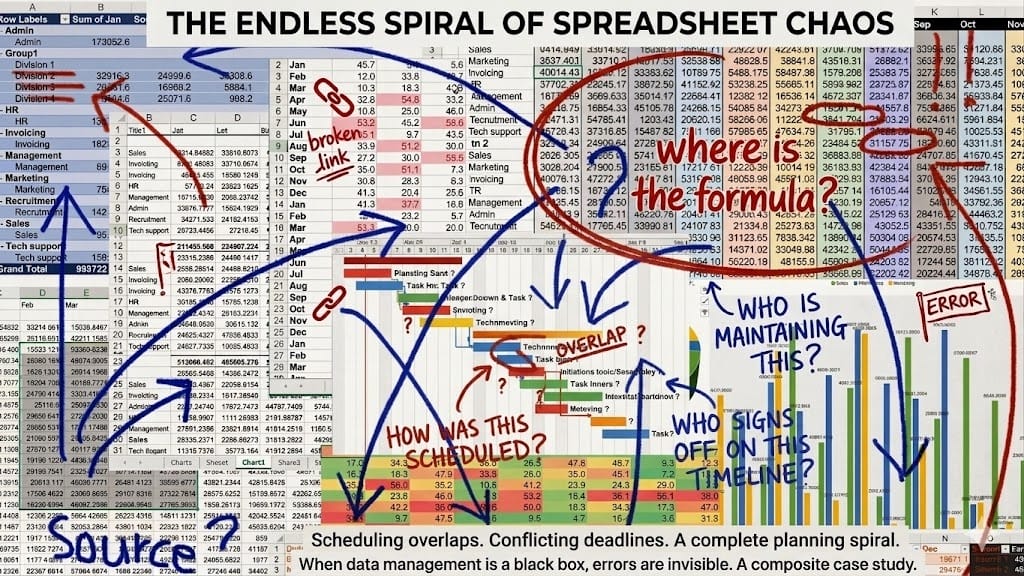
Why spreadsheets fail for subcontractor management
Spreadsheets are a perfectly reasonable starting point. The problem is they don’t scale, and they rely on someone remembering to update them. Nothing in a spreadsheet taps you on the shoulder.
Here’s what typically breaks down:
- Licence and insurance expiry. Someone has to check every date by hand, every month. It doesn’t happen consistently, and the first sign of trouble is often an incident or an audit.
- Double-booking, because without a live system it’s easy to commit the same subbie to two jobs. The conflict surfaces on the day, when it’s too late to fix cleanly.
- Communication. Job briefings, scope changes and safety updates sent by text or WhatsApp create no audit trail and no confirmation of receipt.
- Hours and invoicing. Reconciling a subcontractor’s invoice against hours worked, without a connected timesheet system, eats an afternoon and often still ends in a dispute.
- Compliance records when someone asks for them. A principal contractor or regulator wants proof that every person on site was licensed and inducted. A spreadsheet doesn’t produce that quickly or reliably.
The real cost goes beyond admin time. It’s the incidents, the disputes, the failed compliance checks, and the relationships that sour because a subbie wasn’t briefed clearly.
What good subcontractor management looks like
Scheduling and availability
The foundation is knowing who is available, when, and for what type of work. A good system holds a live view of each subcontractor’s availability. Not just what you’ve already booked, but what they’ve said they’re free for.
When you’re filling a shift or a job, you should be able to filter by trade, location, availability and compliance status at the same time. A spreadsheet can’t do that.
Compliance and licence tracking
Every subcontractor on your sites has credentials that expire. White Card, trade licence, public liability insurance, vehicle registration, working at heights certification, and more. A compliance-capable system tracks these automatically, alerts you before they lapse, and (critically) stops you rostering an uncompliant contractor onto a job.
Under Australian WHS law, your duty of care extends to subcontractors on your sites. The incidents that test that duty are routine, not rare. Safe Work Australia’s national statistics for 2025 record 146,700 serious workers’ compensation claims in 2023-24, each one involving at least a week of lost work. If someone is injured and their licence had lapsed, your compliance tracking records (or the lack of them) will be front and centre in the investigation.
Those duties sit under the model WHS laws that Safe Work Australia maintains and your state regulator enforces. The practical expectation is consistent everywhere: principal contractors keep documented evidence that everyone on their site is licensed and inducted.
Tracking expiry dates only works if the credential was genuine to begin with, which means verifying it at the source before it enters your system. Licences get checked against the issuing state’s register, insurance against a certificate of currency naming the right legal entity, and the check itself gets recorded with a date. Our state-by-state guide to checking a contractor’s licence, White Card and high risk work ticket walks through exactly where to look for each credential type and what the registers won’t tell you.
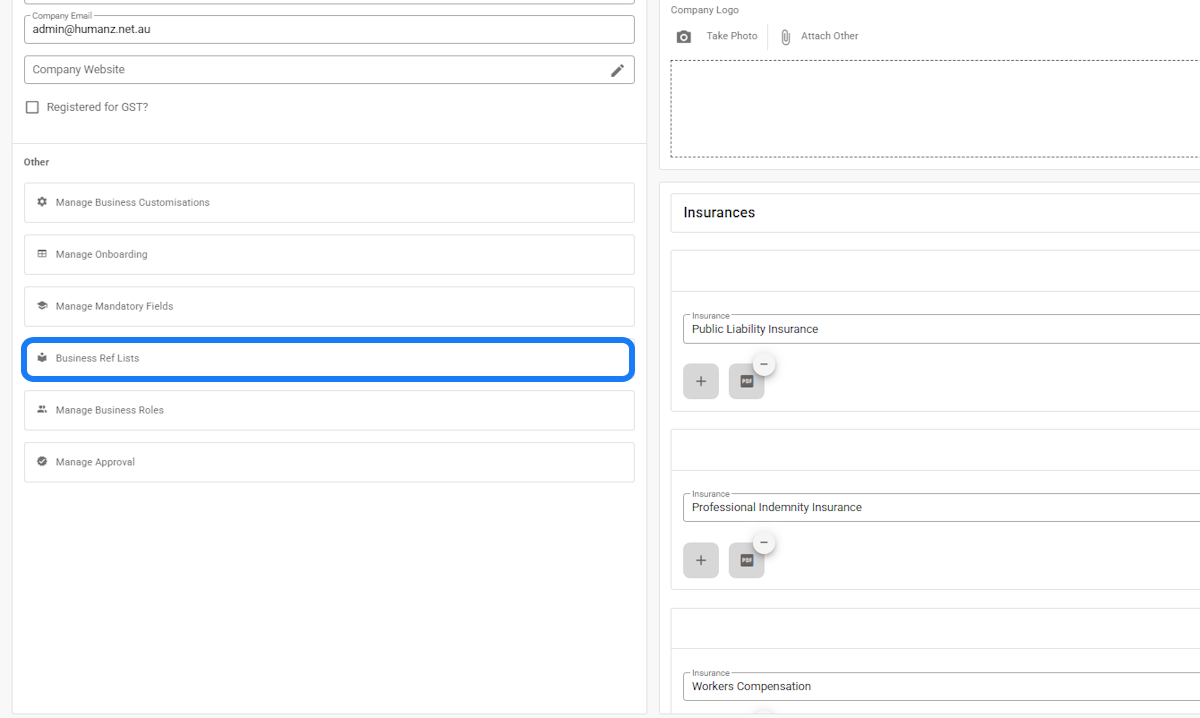
Once verified, the credentials live on the contractor’s profile beside their insurances, where expiry alerts and roster gates can actually use them.
Communication and job briefs
A subcontractor who turns up to site without a clear brief is a safety risk and a rework cost waiting to happen. Good subcontractor management includes a structured way to communicate job details, scope, site conditions and safety requirements before work starts.
This is where purpose-built in-app messaging beats WhatsApp. Job-linked messages attach the brief to the specific engagement, visible to the subcontractor, timestamped and retrievable. For more on why this matters operationally, see our article on in-app messaging for field teams.
Timesheets and hours
Subcontractor hours need the same rigour as your direct employees’ hours, for payroll accuracy and for Fair Work compliance. A connected system pre-fills timesheets from roster data, lets subbies submit hours from mobile, and gives a supervisor an approval step before anything locks in.
That kills the end-of-week invoice reconciliation problem and gives you a running view of labour costs per job. For the full picture, see our guide on digital timesheets for tradies.
What to look for when you replace the spreadsheet
Not all workforce platforms handle subcontractors well. Many are designed for direct employees first, which is why it pays to consider a purpose-built alternative to general rostering tools when subbies are a core part of your workforce. Here’s what to look for:
- Separate contractor profiles, distinct from employees, with their own compliance fields (ABN, public liability insurance, trade licences)
- Licence and certification tracking with expiry alerts sent to both the manager and the contractor as credentials approach expiry
- Compliance-gated rostering that stops you scheduling a subcontractor whose credentials have lapsed
- Mobile-first access, because subbies need to view their schedule, submit timesheets and message you from a phone in a ute
- Job-linked communication rather than one general chat thread
- Timesheet integration, with subcontractor hours in the same system and approval workflow as your direct workforce
- ABN and insurance verification fields recording policy numbers and expiry dates
Under Fair Work rules on contractor classification, you also need to be clear on whether you’re engaging genuine independent contractors or employees. Your system should support clean records that reflect the true nature of each engagement. That’s worth doing properly, because the regulator checks. The Fair Work Ombudsman’s annual report for 2024-25 counts 1,220 compliance notices recovering $8.2 million for 3,438 workers, and a record $23.7 million in court penalties on top. If you’re weighing your options, the workforce management software Australia businesses rely on should handle all of the above in a single platform rather than separate tools stitched together.
How Humanz manages subcontractors end-to-end
Humanz is a subcontractor tracking app and full workforce management platform built for Australian trades and construction businesses. Subcontractors live in the same system as your direct workforce, not bolted on as an afterthought. (If you supply workers to host clients rather than engaging subbies, that model runs on the same platform: see labour hire software and our labour hire operations guide.)
Here’s how it works in practice:
- Contractor profiles hold each subbie’s ABN, trade licences, insurance details, certifications and expiry dates in one place
- Compliance-gated scheduling alerts you when credentials are approaching expiry and blocks rostering once they’ve lapsed
- Availability management lets subcontractors update their own availability in the app, so you’re filling jobs from a live view
- Timesheets work the same way they do for direct workers. Pre-filled from roster data, submitted on mobile, approved by a supervisor
- Job-linked messaging ties every conversation to the specific job, timestamped and stored
- Digital forms cover inductions, pre-start checks and any other compliance documentation, completed on mobile before work starts
For businesses running crews across multiple sites with a mix of direct employees and subbies, one system removes the version control problem. Everyone works from the same data. For a full feature breakdown, see subcontractor management software.
Subcontractor management connects directly to construction site compliance. When your subbies’ credentials are tracked automatically, your site compliance improves without extra admin.
Frequently asked questions
When is it time to replace the spreadsheet for managing subcontractors?
When keeping it current has become someone’s job and things still slip through. The usual signs are a licence expiry nobody caught, a subbie double-booked across two jobs, or an invoice that doesn’t match any recorded hours. A spreadsheet only works while someone remembers to check it, and a growing subbie count is exactly what makes them stop.
Can subcontractors access the system themselves?
Yes, in platforms like Humanz. Subcontractors log in to the app, view their scheduled jobs, submit timesheets, complete forms and message the coordinating business, all within the platform. That removes the overhead of a coordinator manually relaying information.
What records do I need to keep for subcontractors?
At minimum: ABN, insurance certificate of currency, trade licences, White Card, induction records per site, and timesheet or hours records. Keep them for at least seven years for Fair Work purposes, and for the duration of any applicable warranty or defect period for WHS incident purposes.
How does subcontractor management software reduce invoice disputes?
By creating the hours record before the invoice arrives. Subbies submit timesheets from their phones, pre-filled from the roster, and a supervisor approves them as the work happens. When the invoice lands, it’s reconciled against approved hours in minutes rather than argued about from memory weeks later.
What’s the difference between a subcontractor and an employee under Australian law?
The distinction matters because it affects entitlements, tax obligations and liability. The Fair Work Ombudsman provides guidance on the difference. Key factors include whether the worker is engaged for a specific outcome, uses their own tools, sets their own hours and carries their own insurance. Misclassifying an employee as a contractor creates serious legal exposure.
Do subcontractors need a White Card?
Yes. Holding an ABN or working under a subcontract arrangement changes nothing here. Anyone performing construction work in Australia must hold a White Card (Construction Induction Card), and principal contractors are expected to verify it before the subbie starts on site.
How do I verify a subcontractor’s public liability insurance?
Ask for a certificate of currency from their insurer or broker, noting the insured name, policy number, limit of liability and expiry date. A good subcontractor management system stores this against the contractor’s profile and alerts you when renewal is approaching. There is no single legal minimum for most trades, so check the limit against the figure your head contract or client sets, and confirm the policy with the broker.
How do I handle a subcontractor who works across multiple of my jobs?
A system like Humanz maintains one contractor profile that applies across all jobs. Compliance credentials are tracked centrally, so a renewed licence updates everywhere. Hours are tracked per job, which means you can see their total engagement across your business at any point.
Related articles
Ready to see Humanz on your own roster?
Free 30-minute walkthrough, we'll use your real crews, sites and shift patterns.