
 Login
Login 

Rostering & Scheduling
Rostering apps compared: Zenshifts, Rosterspace and the field alternative
By Duane Butler · 16 September 2026

A rostering app builds the roster, publishes it to workers’ phones and handles the changes that follow. A simple app such as Zenshifts does that well for a café or a shop, at a published $30 a month per ten staff. A crew with subcontractors, several sites and tickets to check needs the app to carry far more.
We build one of the platforms discussed here, so read the Humanz section as a vendor’s view and the rest as a fair account of what each product’s own website says. Where a vendor’s site doesn’t mention something, we say so rather than assuming it can’t be done. Prices and features were read on 16 September 2026 and will move.
What a rostering app has to do
Every rostering app does three jobs. It builds the roster from a pattern or a blank week, it gets the roster to the people on it, and it absorbs the changes that arrive between publishing and the shift. The simple apps do those three jobs cleanly, and on a fixed site with one kind of worker there is nothing else to do.
A field crew adds four more jobs, and they are the ones that decide whether an app fits. The roster has to hold subcontractors and labour hire beside employees. It has to check tickets, inductions and fatigue limits before a booking is confirmed, not report the breach afterwards. It has to run several sites in one view. And it has to keep working where the signal doesn’t. The subcontractor point is the big one: the ABS put independent contractors at 1.1 million in August 2025, 7.6% of everyone employed, and in construction they are 21% of the workforce.
Zenshifts: simple rostering for small teams
Zenshifts is built by Zenshifts Holdings Pty Limited, a New South Wales company, and pitches itself as Australia’s simplest rostering software and the best rostering system for small business. The pitch is deliberate: the site promises no clutter, no complexity and no extra features to confuse and overwhelm you, and positions the product as the step up when a spreadsheet stops coping.
What the site describes:
- Roster building. Rosters in minutes, viewed by employee or by position, copied week to week, planned then published, and printable. The app warns if a planned shift conflicts with a worker’s availability, and it reminds staff to submit their availability.
- Publishing. The roster and any changes go out by email and SMS, with SMS billed at 9 cents per 160-character message, and staff can see the roster on a phone, tablet or computer, including through its iOS and Android apps.
- Timesheets. A timesheet calculator generates timesheets from the roster, calculates hours and costs live, lets you adjust, add or remove entries, print or download to Excel or PDF, and export to your payroll system. Integrations listed in the site footer are Xero, MYOB, Elmo Payroll and KINGpay.
- Locations. The pricing page says you can run as many companies or locations as you like in one account, each with its own schedule.
- Price. Published, which is rare and welcome: $30 a month in Australian dollars for up to 10 staff, rising in $30 steps per ten staff to $450 a month at 150, pay as you go, after a 14-day trial. The terms say fees are exclusive of taxes including GST, so read the slider as before GST.
What the site doesn’t mention: subcontractors, swing or FIFO rosters, fatigue rules, licence or ticket tracking, offline use, or any of construction, mining and trades. That is consistent with the pitch. Its website presents it as a shift app for teams of employees, run one schedule per location. Its quoted testimonials come from hospitality venues, and the logo strip beside them adds retail, pharmacy, fitness and aged care.
Two things to ask the vendor before signing. On 16 September 2026 the iOS listing showed its latest version dated 22 July 2024 and the Android listing 5 August 2024, and the Help Centre link in the site footer went to a Freshdesk page saying the account could not be found. Neither is a verdict on the product. They are reasonable questions about update cadence and where support lives, and the vendor is the right place to put them.
Rosterspace: award interpretation for mid-sized organisations
Rosterspace is a different animal, and its name gives away less than it should. Built by Code21 Solutions Pty Ltd and founded in 2010, it describes itself as workforce management software made for advanced award interpretation, built to make light work of Australian and New Zealand modern awards and enterprise agreements. Its founders came from rostering, HRIS and payroll consulting, and it says it was built because in 2010 the tools that could handle Australian awards and enterprise agreements were not affordable for mid-sized organisations.
What the site describes:
- Costed rosters. Rosters built against workers’ availability and costed using award conditions, with alerts, plus what-if scenarios for comparing roster options on cost.
- Award interpretation. The core of the product: calculating pay outcomes from the roster and the timesheet so payroll receives interpreted hours rather than raw ones.
- Timesheets and approval. Approval by exception, so managers only review the timesheets that differ from the plan, and clock-in either at a facial recognition device or from the mobile app, with GPS location capture.
- Leave and self-service. Leave applications and availability captured in one place, and leave management aimed at leave leakage.
- Integrations. Bi-directional integration with payroll, HR and finance systems, with Datapay, ADP, Ascender Preceda, Affinity, Access MicroPay and Dayforce shown on the homepage.
- Industries named. Disability and social services, automotive, retail, manufacturing, early education, and health and aged care.
- Price. Not published. The site invites a demo request, and offers implementation, training, support and consulting services alongside the software.
What the site doesn’t mention: subcontractors, swing or FIFO rosters, fatigue rules, offline use, or construction, civil and trades. Mining appears once, as the Mining Industry Award in the award list under its manufacturing entry. Vacant shifts are offered automatically to eligible and available workers, by SMS according to its retail page, and the first to respond is allocated. How a published roster reaches workers beyond the app and self-service roster view isn’t described. Its mobile app was updated in September 2026, so it is plainly in active development.
If your hardest problem is award complexity, meaning penalty rates, allowances and enterprise agreement clauses that payroll keeps getting wrong, Rosterspace is built around exactly that problem. If your hardest problem is who is on which site tomorrow with which ticket, its website doesn’t describe that one.
The three side by side
| Zenshifts | Rosterspace | Humanz | |
|---|---|---|---|
| Built for | Small teams, one schedule per location | Mid-sized, award-heavy organisations | Field crews across sites, with employees and subbies together |
| Roster building | By employee or position, copy week to week | Costed rosters against award conditions, what-if scenarios | Templates for swings and rotations, drag-and-drop changes |
| Getting it to workers | Email, SMS and the mobile app | App and self-service roster view; vacant shifts offered by SMS | Shifts to phones with seen and unseen tracking |
| Subcontractors on the roster | Not mentioned | Not mentioned | Booked beside employees, each with a compliance profile |
| Tickets and inductions checked at booking | Not mentioned | Qualifications and checks named for health and aged care | Expiry dates checked as the shift is placed |
| Fatigue rules | Not mentioned | Not mentioned | Named policies with hard limits, checked at booking |
| Swings and FIFO | Not mentioned | Not mentioned | Native, with flights and rooms tied to the roster |
| Timesheets | Generated from the roster, exported to payroll | Approval by exception, clock-in by facial recognition device or mobile app | Prefilled from the roster, approved by a supervisor |
| Award interpretation | Not mentioned | The core of the product | No. Approved hours go to payroll, which calculates pay |
| Payroll integrations | Xero, MYOB, Elmo Payroll, KINGpay | Datapay, ADP, Ascender Preceda, Affinity, Access MicroPay, Dayforce | Two-way with Xero |
| Price | Published: $30 a month per ten staff, before tax | By demo request | Quoted per business on workforce size, every module included |
| Trial | 14 days | Demo | Demo with your own roster |
Read the table by column, not by counting ticks. A café doesn’t need fatigue rules, and a civil contractor doesn’t need award interpretation inside the roster if payroll already does it. The column that matches how you operate is the right one.
When a simple rostering app is the right call
Buy the simple app when all of the following are true: one location or a handful of near-identical ones, employees only, fewer than about 20 people, no tickets or inductions that expire, and changes that can wait for the next email. That describes most cafés, retail stores and small offices, and it describes plenty of small trades businesses in their first years too. A field platform for that business is a truck bought to move a couch.
Buy the award-led platform when pay complexity is the problem that keeps landing on the accountant’s desk, and the roster is mostly a means of getting the pay right.
Six signs a crew has outgrown a shift app
The signs are the same across the businesses we hear from, and they arrive in roughly this order.
- The subbies live in a spreadsheet next to the roster. The app holds employees, so the electrician and the traffic crew are booked by phone and tracked somewhere else, and the two never quite agree.
- A ticket expiry turned up at the gate. The White Card or the VOC lapsed and nobody knew until the site refused the worker, because the roster had no idea what a ticket was.
- Two sites means two rosters. Each site has its own schedule, so nobody can see that the same fitter is on both, or that the second site is short.
- Fatigue is managed from memory. Someone knows the crew’s limits, and that someone is on leave the week it matters.
- Timesheets are re-keyed. Hours come out of the app as a file, get corrected in a spreadsheet, and go into payroll by hand, which is where the pay disputes start.
- Roster changes happen in a group chat. The app published the roster, but Thursday’s change went out on WhatsApp, and there is no record of who saw it.
Three of the six and the app is no longer the problem. The category is.
Moving a crew off a shift app
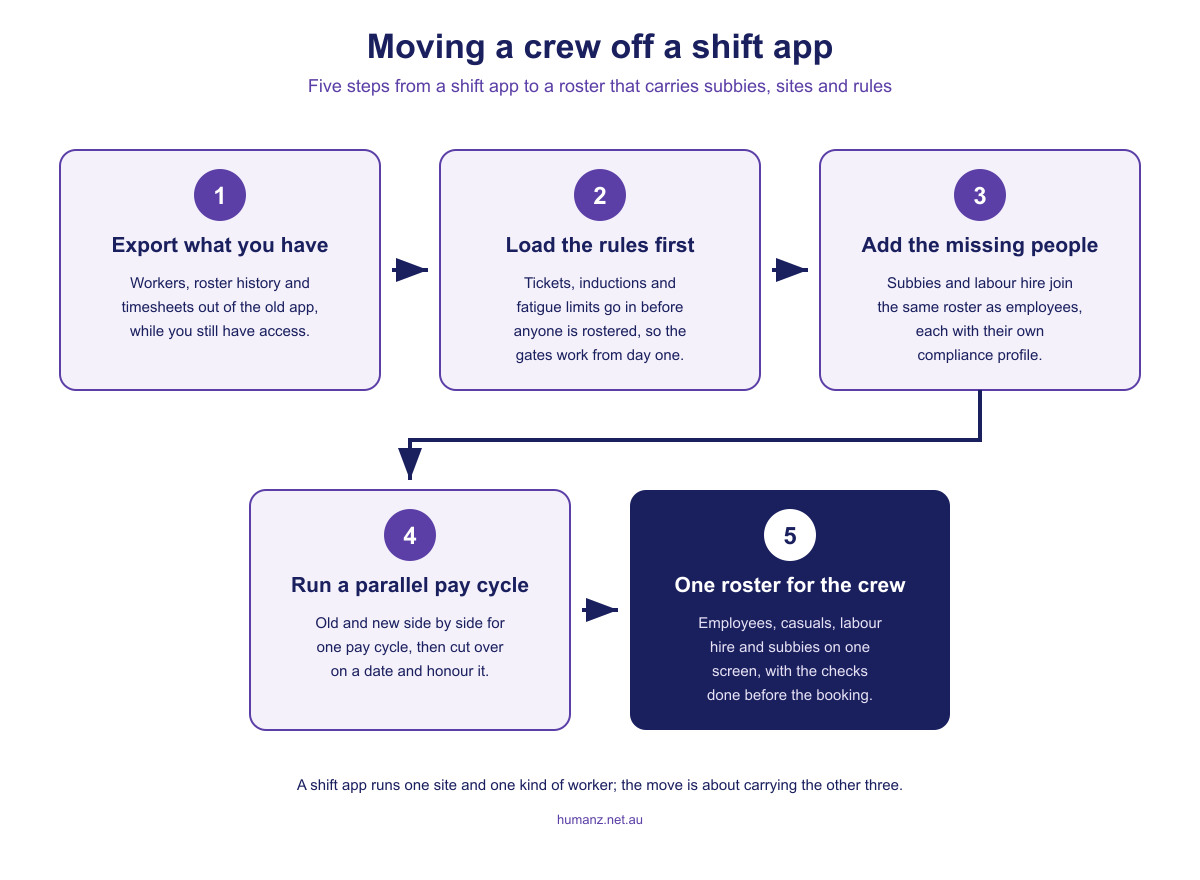
Switching is a real project, though a shorter one than most people expect. The order matters more than the effort.
- Export what you have while you still have access. Workers, roster history and timesheets. Most apps export a spreadsheet; take it before the subscription lapses.
- Load the rules before the people. Tickets, inductions and fatigue limits go in first, so the gates work from the first roster rather than being switched on later.
- Add the people the app never held. Subcontractors and labour hire join the same roster as employees, each with their own compliance profile. This is the step that changes what the roster can see.
- Run one parallel pay cycle. Old and new side by side for one cycle, then a cutover date that gets honoured, because a parallel run with no end date leaves the old app as the real roster.
- Measure from the first month. Fill rate, unfilled shifts and confirmation lag become the baseline the next quarter is judged against.
The wider migration questions, data mapping and crew adoption among them, are in our guides to switching from Deputy, Tanda and the other general tools and to choosing rostering software for field crews.
Where Humanz fits
Humanz was built in Perth in 2019 for the crew in the six signs above, and its rostering software for field crews starts from the jobs a shift app leaves out. Employees, labour hire and subcontractors are booked from one pool, already narrowed to the people who are free, hold the ticket and are inside their hours. Qualifications, inductions and fatigue limits are checked as each shift is placed, and a booking that would breach either is flagged before it’s confirmed. Shifts land on workers’ phones with confirmations tracked, templates capture swings and rotations, timesheets prefill from the roster, and approved hours flow to payroll without re-keying, including through the two-way Xero integration. The mobile app runs on iOS and Android, and its key functions work offline and sync when the signal returns.
Two honest limits. Humanz doesn’t calculate pay or interpret awards, so payroll stays the place that turns hours into money, and it runs on rules rather than AI, so the same inputs give the same answer every time. And it doesn’t publish a per-user price: quotes are shaped per business on workforce size, with every module included, which suits a crew of 30 better than a café of six.
If you’re on a shift app and three of the signs above read like your week, bring your current roster to a walkthrough and we’ll rebuild it live, subbies and all.
Frequently asked questions
What is a rostering app?
A rostering app is software that builds a staff roster, publishes it to workers’ phones and handles the changes that follow, such as swaps, sick calls and shift moves. Simple rostering apps cover employees at a fixed location, while field platforms add subcontractors, multiple sites, ticket and fatigue checks at booking, and offline use on remote sites.
Is there a free rostering app in Australia?
Not as an ongoing plan among the products compared here. Zenshifts advertises a free account, which its pricing page describes as a 14-day trial before you pick a plan from $30 a month for up to ten staff. Rosterspace sells by demo request, and Humanz quotes per business. Some overseas apps offer free tiers capped by user count, and the cap usually arrives before the crew does, so price any tool on the roster you actually run.
What is Zenshifts?
Zenshifts is a small-business rostering app from Zenshifts Holdings Pty Limited, a New South Wales company. Its website describes roster building by employee or position, availability reminders, roster publishing by email, SMS and its mobile apps, a timesheet calculator that exports to payroll with Xero, MYOB, Elmo Payroll and KINGpay listed as integrations, and published pricing of $30 a month per ten staff before tax, after a 14-day trial.
What is Rosterspace?
Rosterspace is workforce management software from Code21 Solutions Pty Ltd, founded in 2010 and built around advanced award interpretation for Australian and New Zealand awards and enterprise agreements. Its website describes costed rosters, approval-by-exception timesheets, mobile clock-in, leave management and payroll integrations, aimed at mid-sized organisations in sectors such as disability services, retail, manufacturing and aged care. Pricing is by demo request.
Which rostering app is best for tradies?
It depends on the crew. A trades business with employees at one depot and no expiring tickets can run on a simple rostering app such as Zenshifts. One that books subcontractors, works across several sites or has to check licences, inductions and fatigue limits before a shift is confirmed needs a field platform such as Humanz, because the simple apps don’t describe any of those jobs on their websites.
Can a rostering app handle subcontractors?
Some can, and the category decides it. The simple apps compared here don’t mention subcontractors on their websites, and most shift apps treat the roster as an employee-only list. A field platform books subcontractors and labour hire beside employees on the same roster, with each worker carrying their own compliance profile, insurances and ticket expiry dates, so the booking can be checked the same way an employee’s is.
How do you switch rostering apps without losing history?
Export workers, roster history and timesheets from the old app while you still have access, load the compliance rules into the new system before any roster is built, add the subcontractors and labour hire the old app never held, run one pay cycle in parallel, then cut over on a fixed date. Keep the exported files as your record of the old system, because Fair Work time and wages records must be kept for seven years whichever tool produced them.
Related articles
Ready to see Humanz on your own roster?
Free 30-minute walkthrough, we'll use your real crews, sites and shift patterns.