
 Login
Login 

Guides
Best workforce management software in Australia: 2026 buyer's guide
By Richard Lomen · 20 June 2026 · Updated 16 September 2026

Workforce management software is the platform a business uses to roster its people, capture the hours they work, keep the compliance records behind both, and get approved time to payroll. In Australia that means carrying modern awards, WHS duties and state variations as well, which is why the choice is harder than a feature list makes it look.
The market has matured. There are purpose-built platforms for specific industries, mobile-first tools for field teams, and integrated suites that fold HR, payroll and workforce management into one system. Plenty of choice, which also makes the buying decision harder. Many businesses start their search by weighing up alternatives to Deputy and Tanda, particularly when those hospitality- and retail-first tools don’t fit a field-based or trades workforce, or by comparing against Humanforce, Employment Hero and Dayforce at the HR-suite and enterprise end.
This guide covers what workforce management software does, what Australian businesses need to account for, the warning signs your current system isn’t working, and the questions to ask when evaluating any platform.
What is workforce management software?
At its core, workforce management (WFM) software covers five jobs:
- Rostering and scheduling. Building rosters, assigning workers to shifts or jobs, and managing availability and conflicts.
- Time and attendance. Recording when workers clock on and off, and the hours they worked.
- Leave management. Requests, approvals and balances.
- Compliance. Keeping scheduling and pay decisions in line with the applicable Awards, legislation and workplace policies.
- Communication. Connecting managers and workers around shift information, changes and operational updates.
More comprehensive platforms extend into digital forms, asset management, fatigue monitoring, onboarding, subcontractor management and payroll integration.
Workforce management tools: what a full solution includes
Vendors sell the category as modules, and the bundle is what people mean by a workforce management solution. The useful way to read a module list is by the record each tool leaves behind, because the records are what a Fair Work Inspector, a client auditor or your own payroll team will ask for.
| Tool | What it does | The record it leaves |
|---|---|---|
| Rostering and scheduling | Builds the roster, publishes it to phones, handles changes and backfill | Who was rostered where, who confirmed, who changed what |
| Time and attendance | Captures start, finish and breaks, usually from the phone at site | Time and wages records for the seven years Fair Work requires |
| Timesheets and approval | Prefills hours from the roster and routes them to a supervisor | Approved hours with an approval trail, which is payroll’s input |
| Leave management | Requests and approvals, with approved leave blocked out on the roster | A dated record of each decision, while balances stay in payroll |
| Compliance and fatigue | Holds tickets, inductions and fatigue policies and checks them at booking | Expiry dates, gate outcomes and the policy each shift was tested against |
| Digital forms | Prestarts, incident reports and SWMS sign-ons completed on mobile | Timestamped submissions stored against the job |
| Communication | Job-linked messaging and shift notifications | Who was told, and whether they read it |
| Subcontractor management | Entities, insurances and licences beside employee profiles | Certificates with expiry dates, and bookings gated on currency |
| Onboarding and documents | New starter requirements and a document portal | Completion status per worker, documents with dates |
| Mobilisation | Flights, accommodation and travel days tied to the roster | Who is in transit, and when |
| Asset tracking | Plant and vehicles allocated beside the people using them | Who had what, and when |
| Payroll integration | Hands approved hours to payroll, ideally in both directions | A reconciled record of planned, worked and paid |
| Analytics | Fill rates, unallocated shifts, fatigue alerts and cost by site | The roster’s own scoreboard |
Two questions sort the bundles. First, do the modules share one worker record, so a ticket expiry entered once gates the roster, the timesheet and the subbie booking together, or is each module a separate product with a shared logo? Second, which modules are native and which were bolted on later, because a platform is strongest at whatever it was built around, and that origin decides its fit more than its module count does.
Rostering is the module most businesses start with, and choosing rostering software for field crews goes deeper on that one. The mobile end matters as much as the modules: the workforce management applications workers carry decide whether any of the above gets used at all.
The Australian compliance context and why it matters for your software choice
Choosing workforce management software in Australia is different from choosing it in most markets, because the compliance load is heavier. Any platform you evaluate needs to handle four things.
Modern Awards and the Fair Work Act
Australia’s Modern Award system, administered by the Fair Work Commission, covers 121 industry and occupational modern awards, and 155 modern awards in total once enterprise and state public sector awards are counted (the Commission’s own count as at 26 September 2025). Each one sets minimum rates, overtime provisions, penalty rates, rest break requirements and allowances. A platform that can’t handle that complexity without heavy manual configuration is creating ongoing compliance risk.
The Fair Work Ombudsman’s 2024-25 annual report puts recoveries at $358 million for more than 249,000 underpaid workers, taking back-payments past $2 billion over five years, with a record $23.7 million in court penalties on top. Botched shift and overtime calculations are among the most common causes. For businesses managing shift workers, our article on Fair Work compliance for shift workers covers the obligations in detail.
WHS obligations
The model Work Health and Safety Act, developed by Safe Work Australia and adopted in every jurisdiction except Victoria, gives employers a primary duty of care that extends to workforce scheduling. Fatigue, understaffing and inadequate induction are all workplace hazards an employer is legally obliged to manage.
WorkSafe WA and the equivalent state regulators have broad inspection and enforcement powers. A business that can’t produce documented evidence of its safety controls (fatigue monitoring, induction records, incident reporting) is exposed to real penalties.
ATO and STP reporting
Every pay cycle you’re also reporting to the tax office under Single Touch Payroll, and that reporting is only ever as good as the timesheets feeding it. A workforce management platform that produces clean hours data is quietly doing tax compliance work as well as operational work.
State-based variations
Compliance obligations vary by state. Western Australia has its own industrial relations system that applies to some employers, administered by the Western Australian Industrial Relations Commission. Long service leave legislation varies by state too, as does the administration of portable long service leave schemes in construction.
A platform built for and by Australians, rather than adapted from a US or European product, is more likely to reflect these quirks out of the box.
Warning signs your current system isn’t working
Before evaluating new platforms, work out where the current one is failing. The most common warning signs:
Timesheet problems:
- Supervisors spend hours every week compiling and correcting timesheets by hand
- Payroll disputes are common because workers and managers hold different records of hours worked
- You couldn’t produce a 7-year timesheet history if asked, because the records are incomplete or scattered
Rostering problems:
- No-shows happen regularly because shift confirmations are informal or non-existent
- Workers or subcontractors get double-booked more than once a month
- Roster changes go out via WhatsApp or text, with no audit trail and no confirmation
Compliance problems:
- You don’t have a live view of which workers hold current licences and which have lapsed
- Site induction records are paper in a filing cabinet, or don’t exist at all
- A Fair Work or WHS audit would mean a scramble to produce the required records
Communication problems:
- Critical safety updates go out through personal WhatsApp groups with no record of who read them
- Workers regularly show up to the wrong site or at the wrong time
- Subcontractors are briefed verbally with nothing written down
If several of these apply, the case for a purpose-built platform is strong. The cost of not acting is measurable, and the cost of acting is smaller than most people assume: our breakdown of what workforce management software costs in Australia puts real published numbers against it.
Industry-specific requirements: what your sector needs
Workforce management needs vary a lot by industry. A platform that works well for one sector can fall short for another.
Construction and trades
The most demanding use case in the Australian market. Requirements include fatigue monitoring, subcontractor management with licence and insurance tracking, digital forms for pre-start checks and inductions, asset tracking, offline-capable mobile, and multi-site rostering. Master Builders Australia and the HIA both publish operational guidance for construction businesses that informs what compliant workforce management looks like in practice.
For a detailed breakdown, see our article on workforce management software for construction.
Mining and resources
FIFO roster management, extended swing compliance, fatigue risk management systems, and principal contractor reporting requirements. WorkSafe WA regulates WA mines under the Work Health and Safety (Mines) Regulations 2022, which go beyond the general WHS framework, and our guide to fatigue and rosters under the WA mines regulations covers the roster side of that.
Logistics and transport
Driver fatigue management under the Heavy Vehicle National Law (HVNL), depot and field worker rostering, and integration with vehicle telematics systems.
Field services and utilities
Multi-site scheduling, asset allocation, and compliance with industry-specific licensing requirements (electrical, gas fitting, plumbing).
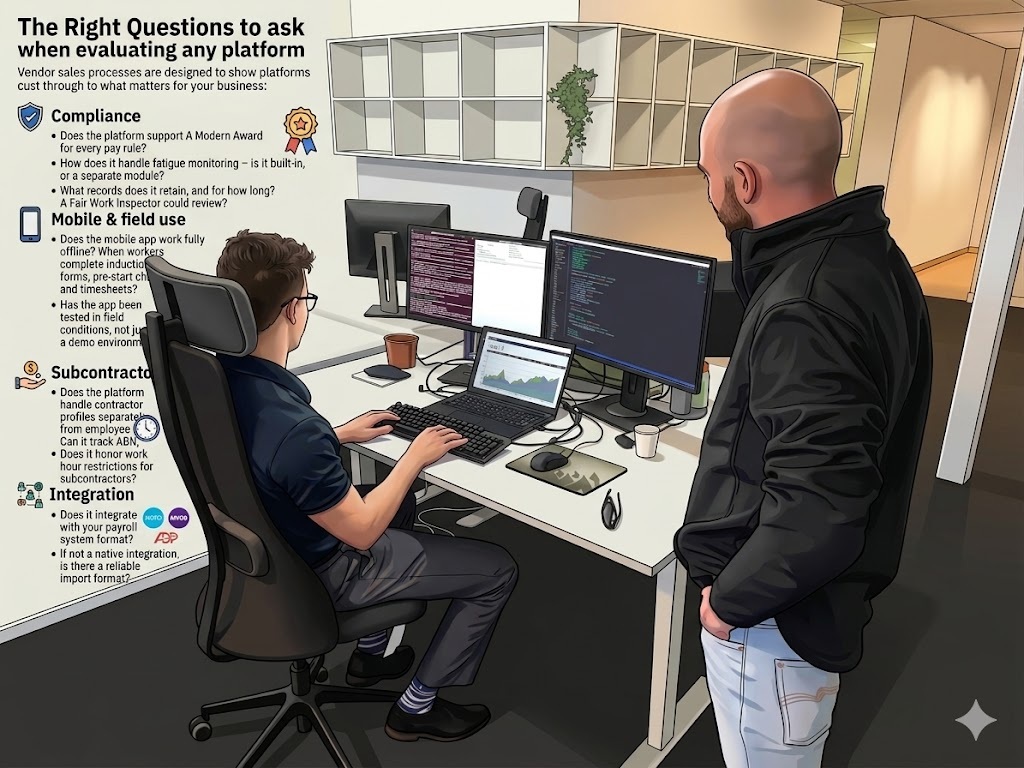
The right questions to ask when evaluating any platform
Vendor sales processes are designed to show platforms in their best light. These questions cut through to what matters for your business:
On compliance:
- Does the platform support Australian Modern Award complexity, or does every pay rule need manual configuration?
- Is fatigue monitoring built in, or a separate module?
- What records does it retain, and for how long? Can they be exported in a format a Fair Work Inspector could review?
On mobile and field use:
- Does the mobile app work fully offline? What happens when a worker loses signal on a remote site?
- Can workers complete induction forms, pre-start checks and timesheets entirely from their phone?
- Has the app been tested in field conditions, not just in a demo environment?
On subcontractors:
- Does the platform keep contractor profiles separate from employee profiles?
- Can it track ABN, trade licences and public liability insurance with expiry alerts?
- Does it block scheduling of a contractor whose credentials have lapsed?
Our guide to contractor management software in Australia works through what a good answer to each of those looks like.
On implementation and support:
- Where is the support team based, and what are their hours?
- What does data migration involve? Can you bring existing worker profiles, timesheets and asset records across?
- How long would implementation take for a business your size?
On integration:
- Does it integrate with your payroll system (Xero, MYOB, ADP, KeyPay)? If you are on Xero, our guide to Xero rostering and timesheets sets out the questions that separate a genuine integration from a file export.
- If there’s no native integration, is there a reliable export format?
- Does single sign-on cover the mobile app as well as the browser? Microsoft single sign-on for workforce software explains why that distinction decides whether most of your workforce is covered.
- When you add a new site or project, does the system scale without major reconfiguration?
The Australian Institute of Project Management (AIPM) recommends treating software selection with the same rigour as any other capital investment. That means a structured evaluation against your own requirements, not just a demo from a sales team.
Running the evaluation: five steps that avoid a re-purchase
The questions above tell you what to ask. The order you work in decides whether you buy once or twice. When a business swaps platforms after two years, the post-mortem usually finds a skipped step rather than a bad vendor.
1. Define the workforce you actually manage. Count employees, labour hire and subcontractors separately, then count again at your busiest month. A system sized for a quiet 40 will strain at a shutdown 90, and the strain lands in per-user billing and admin workarounds.
2. Map the compliance load. Write down the awards you pay against, the credentials that need tracking, whether fatigue rules apply to your work, and every state you operate in. That list is what the software has to carry. On paper, “does it handle compliance?” becomes a set of specifics a vendor can’t answer with a nod.
3. Shortlist three platforms from the right category. Fit follows origin, as the category map later in this guide shows. Three is enough to compare and few enough to evaluate properly. Ten open tabs of vendor sites is research theatre.
4. Demo against your own worst week. Bring your messiest real roster, your most awkward award, and a subbie whose insurance lapses mid-job. Vendor demo data always behaves. Your February doesn’t. A platform that stumbles on your worst week in a demo will stumble harder in month three, when it’s holding real pay data.
5. Price the true bill. The per-user headline rarely matches the invoice once modules, implementation and support tiers land. Our Australian cost breakdown puts published numbers against each line.
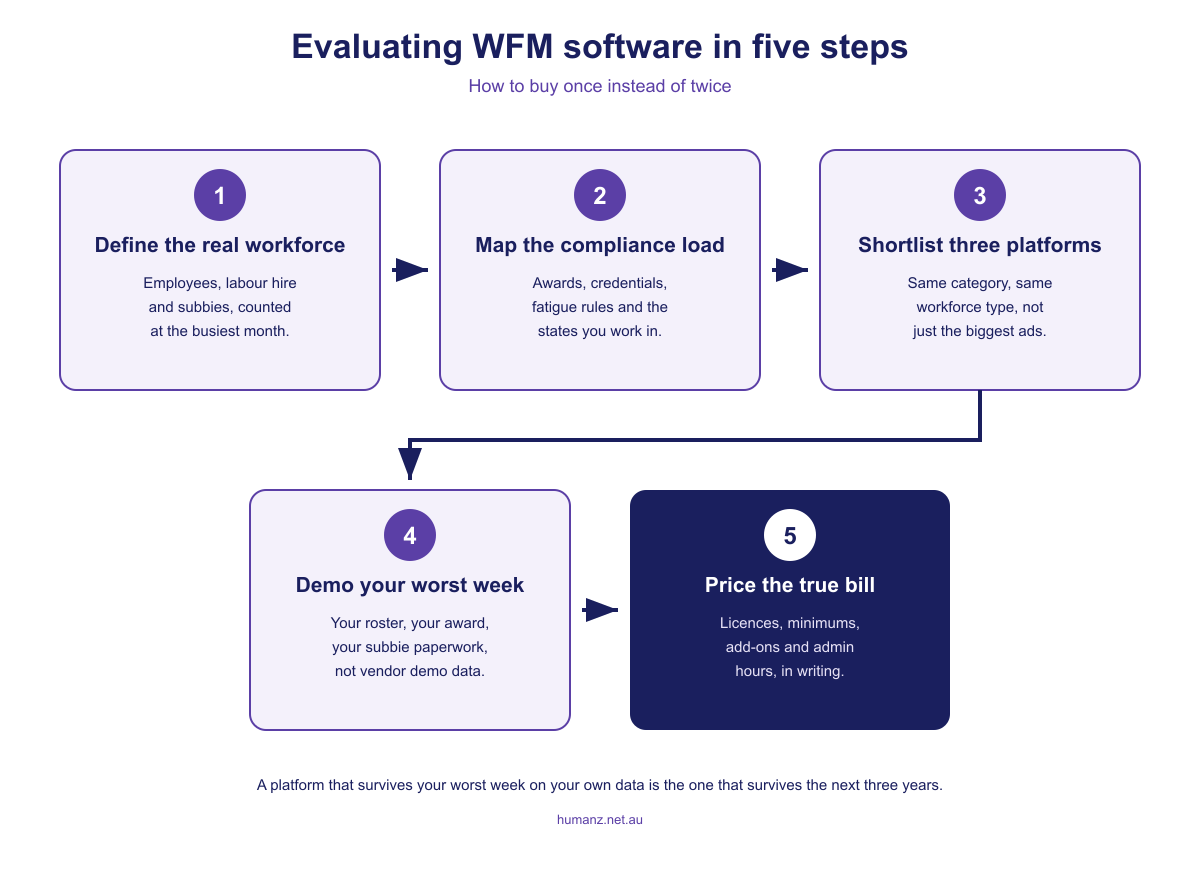
Do the five in order and you’ll buy once. Start at step four and you’re evaluating the vendor’s best week, which is exactly what the demo was built to show.
A scoring sheet for comparing workforce management solutions
Shortlists get decided by whoever ran the most convincing demo unless the scoring is written down first. Here is the sheet we’d use. Score each platform 0, 1 or 2 against every row, multiply by the weight for how your workforce actually operates, and add it up.
| Criterion | Field crew weight | Fixed-site weight | What a 2 looks like |
|---|---|---|---|
| Employees and subcontractors on one roster | 3 | 1 | Both booked from the same screen, each with its own compliance profile |
| Compliance gates at booking (tickets, inductions, fatigue) | 3 | 2 | The booking is stopped and the breach named before it confirms, not reported afterwards |
| A mobile app crews will use, offline included | 3 | 2 | Shifts, timesheets and forms all work from the phone without signal |
| Multi-site live view | 2 | 1 | Every site on one screen, with changes landing on phones immediately |
| Swings, rotations and travel | 2 | 1 | Templates for 2/1 and offset panels, with flights and rooms tied to the roster |
| Timesheets from the roster to payroll | 2 | 3 | Prefilled, approved and integrated with payroll in both directions |
| Award and record-keeping support | 2 | 3 | Seven-year records, rest gaps visible, and pay rules handled by payroll or an interpretation engine |
| Digital forms and documents | 2 | 1 | Prestarts, incident reports and SWMS sign-ons filed against the job |
| Australian support and data | 1 | 1 | Local support hours and Australian hosting, stated in writing |
| Implementation and price transparency | 1 | 1 | Scope, timeline and price in writing before the contract |
The field column adds up to 42 points and the fixed-site column to 32. A platform that scores under 75 per cent on your column is the wrong category for your operation, however good the demo felt, and the row it failed is usually the one that costs the most in month three.
The two columns are the honest version of the market map further down. A hospitality-heritage suite will score well on the fixed-site column and poorly on the first three field rows, and a field-built platform does the reverse.
How to evaluate based on your workforce type
Different workforce shapes call for different priorities.
A field-based workforce with subcontractors. Prioritise offline mobile capability, subcontractor compliance tracking, fatigue monitoring at the point of scheduling and digital forms. These are non-negotiable for construction, mining services and field trades. Generic scheduling tools built for hospitality or retail rarely cover them properly.
Award compliance and payroll accuracy as the main challenge. Look for a strong Modern Award interpretation engine and deep integration with your payroll system. This is the priority for hospitality and retail operators, and for healthcare and aged care providers rostering around clinical coverage.
A small business (under 20 workers) just getting started. Start with a platform that’s simple to implement at a sensible entry price, but check it can scale as you grow. Migrating data between platforms is painful, and our guide to workforce management for startups and small businesses covers what to get right at that size.
An enterprise (500+ workers). You’ll want full HCM capability alongside workforce scheduling, plus enterprise-grade security and support SLAs.
The Australian market, mapped by category
People often ask for a list of workforce management companies, so here’s the landscape as we’d honestly describe it. No scores, because published ratings without disclosed methodology are marketing, but the categories tell you most of what a shortlist needs.
Hospitality and retail heritage. Deputy and Tanda (now part of Workforce.com) built excellent shift tools for fixed locations, and both have grown well beyond cafes. Their centre of gravity remains single-site shift work.
Australian shift-workforce suites. Humanforce and foundU grew up rostering large shift workforces in venues, care and services, with award interpretation as a core strength. RosterElf plays at the simpler end for small teams, and Rosterspace sits between the two, built around award interpretation for mid-sized organisations.
Small-team rostering apps. Zenshifts and its peers do one job, the weekly roster for a fixed location, at a published price a café can afford. Our rostering app comparison covers where that category fits and where a crew outgrows it.
HR-led platforms. Employment Hero approaches from employment admin, contracts, payroll and benefits, with rostering inside that suite.
Enterprise HCM. Dayforce and UKG serve large organisations standardising globally, with implementation scale to match.
Field and site heritage. Assignar focuses on construction operations scheduling. Damstra (now under Ideagen) came from site access and compliance. Humanz, ours, was built in Perth for blended field crews, swings, and compliance gates at booking time.
The pattern worth noticing is that nobody on the list is bad software. Each is strong where it grew up, and the head-to-head comparisons linked earlier in this guide exist precisely because fit follows origin. Match the category to your operating model first and the shortlist mostly writes itself.
How Humanz approaches workforce management for Australian field teams
Humanz is an Australian-built workforce management platform designed for trades, construction, mining support and field-based teams. It was built by people with direct experience in the industries it serves, not adapted from a product made for a different market.
The platform covers the full operational picture for field and construction businesses:
- Multi-site rostering with live visibility across all projects and crews
- Fatigue monitoring built into the scheduling engine, not bolted on as a separate module
- Subcontractor management with ABN, licence and insurance tracking and expiry alerts
- Digital forms for pre-start checks, inductions and incident reports, completed on mobile and stored with timestamps
- Asset tracking integrated with shift scheduling, so plant and equipment get allocated alongside workers
- Timesheet management that starts from the roster, runs through supervisor approval and keeps the seven-year record trail automatically
- In-app messaging tied to specific jobs, with read receipts and retained history
- Leave management with requests approved in the app and approved leave visible on the roster, while balances stay in payroll
For a closer look at specific use cases, see our articles on construction workforce management, fatigue management software Australia, subcontractor management and field worker onboarding.
Humanz is also a field team communication app. Rostering, compliance, communications and timesheets live in one platform, so you’re not bridging between systems to get a full picture of your workforce.
Frequently asked questions
What is the best workforce management software in Australia?
There’s no single best platform, because every product is strongest in the environment it grew up in. Deputy and Tanda suit fixed-location shift work, HR-led suites like Employment Hero suit businesses buying employment admin first, and field-heritage platforms like Humanz suit blended crews across construction, mining services and trades. Match the category to your operating model first and the shortlist mostly writes itself.
What tools are included in workforce management software?
A full workforce management solution includes rostering and scheduling, time and attendance, timesheets and approval, leave management, compliance and fatigue checks, digital forms, job-linked communication, subcontractor management, onboarding and documents, mobilisation, asset tracking, payroll integration and analytics. Not every platform carries all of them natively, and the ones it was built around are the ones it does best. Judge a bundle on whether its modules share one worker record rather than on the length of the list.
How much does workforce management software cost in Australia?
Pricing varies widely by platform and feature set. When we compared the published Australian price lists of eight vendors in September 2026, per-user list prices ran from about $6 to $15 per user per month, with minimum-spend floors, paid add-ons and quote-only tiers changing the real bill on most plans. Enterprise platforms are priced on a custom basis. Humanz pricing is quoted per business (every module enabled, shaped by workforce size) and is designed for the SME to mid-market construction and trades sector.
Is workforce management software worth it for small businesses?
Yes, for most businesses managing more than 5–10 workers. The admin time saved on roster management, timesheet collection and compliance tracking usually exceeds the cost of the software within the first month, and you can test that claim against your own numbers with the free ROI and payback calculator. On top of that sits the reduced compliance risk, particularly around Fair Work record-keeping and WHS obligations, which is harder to quantify but real.
How many platforms should I shortlist and demo?
Three, drawn from the category that matches how your workforce operates. That’s enough to compare properly and few enough to demo each one against your own messiest roster rather than the vendor’s tidy sample data. Evaluating ten platforms usually means evaluating none of them well.
Do I need separate software for subcontractors?
No, and you shouldn’t. A platform that handles employees and subcontractors in the same system gives you full visibility across your labour. The key is making sure it supports contractor-specific compliance fields (ABN, insurance, trade licences) alongside standard employee profiles.
Can workforce management software integrate with my payroll system?
Most platforms integrate with the common Australian payroll systems, including Xero, MYOB, ADP and KeyPay, but the depth varies more than the marketing suggests and it is worth asking exactly which you are being offered. A file export is a snapshot: the moment an hour is corrected on either side, the two systems disagree until somebody reconciles them by hand. A two-way API integration keeps them in step in both directions. At absolute minimum you need a reliable export in a format your payroll system accepts. The ATO’s STP reporting requirements make payroll accuracy a tax compliance matter as well as an operational one.
What’s the difference between workforce management software and payroll software?
Payroll software processes payments. It calculates gross pay, applies tax and generates payslips. Workforce management software manages the inputs to that process: who worked, when, and for how long. The two are complementary and usually integrated. Workforce management sits upstream of payroll and provides the data that makes it accurate.
How long does implementation take?
For SME-focused platforms, a typical construction or trades business is up and running in days to a couple of weeks. The main time investment is loading worker profiles and configuring site and project structures. A vendor with Australian-based support makes this much smoother, particularly for businesses with complex Award arrangements or multi-state operations.
What should I do if I’m currently non-compliant with Fair Work record-keeping?
Start by sizing the gap. What records do you have, and how far back do they go? The Fair Work Ombudsman runs an anonymous inquiry line and provides guidance on voluntary disclosure. Implement a compliant system immediately and maintain it going forward. If the exposure is large, get advice from a qualified employment lawyer before approaching regulators.
Related articles
Ready to see Humanz on your own roster?
Free 30-minute walkthrough, we'll use your real crews, sites and shift patterns.