
 Login
Login 

Compliance, Fatigue & Safety
Fatigue and Rosters Under the WA WHS (Mines) Regulations
By Christian Tietzel · 2 September 2026 · Updated 3 September 2026

The fatigue provision for WA mines is one sentence long. “In complying with regulation 617, the mine operator of a mine must manage risks to health and safety associated with worker fatigue.” That’s regulation 640 of the Work Health and Safety (Mines) Regulations 2022, in full. No maximum shift length. No minimum break. No cap on consecutive nights. In an instrument that runs to several hundred regulations, the word fatigue appears four times.
That brevity is deliberate, and it puts the burden somewhere specific. The law won’t tell you what a safe roster looks like. It tells you to work that out for your own operation, write it down, run it, and show your working when an inspector or an investigator asks. This guide is for the people who carry that burden in practice: mining services contractors, labour hire providers and the supervisors who build the rosters. Less a law summary, more a manual for proving you managed the thing.
Where the duty actually sits
Get the framework right first, because half the confusion in this area starts with the names. The enabling Act is the Work Health and Safety Act 2020 (WA). The Work Health and Safety (Mines) Regulations 2022 are made under it, and most of them commenced on 31 March 2022. The mines regulations are self-contained. They apply to workplaces at a mine and carry their own risk management and psychosocial provisions inside them, with the WHS (General) Regulations covering only the workplaces that the mines and petroleum regulations don’t.
Inside that instrument, three provisions do the fatigue work.
Regulation 617 is the anchor. Any person conducting a business or undertaking at a mine must manage risks to health and safety associated with mining operations, following the standard risk management process, with any risk assessment done by a competent assessor. A note to the regulation lists 640 and 641 among the provisions about complying with it, and ties the whole thing back to the primary duties in sections 19 to 21 of the WHS Act.
Regulation 640 is the fatigue duty, quoted in full above. It sits in a subdivision headed Fitness for work, beside regulation 641, which does the same one-sentence job for alcohol and drugs.
Regulation 675B makes fatigue a training subject. Workers must be given information, training and instruction on the control measures that apply to their work, and 675B(2)(b) names control measures for fatigue, alcohol and drugs specifically. Unlike 640, this one carries its own fine: $4,200 for an individual, $21,000 for a body corporate. If your crews have never been trained on your fatigue controls, that’s not a gap in best practice. It’s a penalty provision waiting.
There’s a fourth piece many operators miss. Since December 2022 the psychosocial provisions, regulations 55A to 55D, have sat inside the mines regulations themselves, binding businesses at mines directly. Assessing a roster against them is covered in psychosocial risk assessment for rosters. Regulation 55D’s control measure factors include the design of work (job demands and tasks), the systems of work, and the design, layout and environmental conditions of workers’ accommodation. A roster is a system of work. A camp room that wrecks day sleep is a listed factor. The evidence base behind that is blunt. The study of more than 3,000 FIFO workers commissioned for the WA Mental Health Commission, the research sitting behind the FIFO code of practice, found one third of them (33%) reporting high or very high psychological distress, against 17% in a benchmark group of comparable non-FIFO workers. Fatigue and psychosocial compliance are now the same conversation, and WorkSafe’s own fatigue guidance frames them that way, recommending a documented fatigue management plan and modified shift work and rosters as control measures.
The numbers live in guidance, not law
Search the mines regulations for a maximum shift length or a minimum rest break and you’ll find nothing. Every numeric threshold that WA mining rosters run on comes from guidance, awards and client standards, and it pays to know which is which.
The regulator is WorkSafe, sitting since 1 July 2025 inside the Department of Local Government, Industry Regulation and Safety and covering both the resources and general industries sectors. Its codes of practice matter more than the non-binding label suggests. An approved code is admissible in court proceedings, a court may rely on one in deciding what was reasonably practicable, and an inspector can refer to one when issuing an improvement or prohibition notice. The Mine safety management system code of practice puts worker fatigue on the list of risks a mine’s safety system is expected to manage and monitor, and tells you to weigh job and work design against the health and fatigue of workers when identifying hazards.
The roster numbers themselves come mostly from the Working hours code of practice, approved in 2006 and continuing today as a transitional code under the WHS Act. It says plainly that it doesn’t have the legal force of a regulation, then adds that courts may use it as the standard when assessing whatever you did instead. Its risk indicator matrix is the closest thing WA has to official roster arithmetic:
- Average weekly hours (other than FIFO): lower risk sits at 35–40 hours, climbing toward 48 and 56
- Daily work hours: 10 hours, rising toward 13
- Shift length, for shiftwork other than FIFO: 10 hours, rising toward 12
- Night shift length: risk starts climbing from 8 hours toward 10 and 12
- Sequential night shifts (other than FIFO): four or more 12-hour nights marks the higher-risk end
- FIFO recovery after a run of nights: 48 hours of non-work is the lower-risk end, with 24 hours the stated minimum
Its night work controls are just as usable. Keep sequential night shifts to a minimum. Allow a rest break of at least 24 hours after each set of night shifts. Don’t let shifts finish after 10am, so day sleep isn’t cut short.
FIFO gets its own hazard factors within the code’s shiftwork group: total hours across a three-month period, sequential night shifts, the recovery period after them, and the return from R&R. A second document sharpens the roster point further. The FIFO mental health code of practice links even-time and shorter rosters, one week on one off or eight days on six off, to better mental health and wellbeing outcomes, links more compressed rosters to fatigue, and links forward shift rotation (day to evening to night) to improved fatigue management. It dates from 2019 and remains the published code at the time of writing.
One thing that no longer exists is the old departmental guideline on preventing mining fatigue. That page now redirects to WorkSafe’s general material. So the working set for a WA mining roster is regulation 640, the codes above and WorkSafe’s fatigue guidance. Awards and enterprise agreements sit in separate industrial relations law and can add hour rules of their own on top.
Building a roster that defends itself
The distance between “we have a fatigue policy” and “our rosters comply with our fatigue policy” is where audit findings live. Closing it means translating the guidance into rules with numbers attached, then putting those rules where roster decisions actually get made.
Choose the swing with the guidance in view. The codes push in a consistent direction: shorter and more even beats longer and more compressed. An 8/6 roster or even-time pattern starts from a stronger position than a 4/1, and if you run a compressed swing anyway, the codes expect the compensating controls to be visible. Our guide to FIFO rostering software covers how patterns, panels and changeover days fit together.
Rotate forward and cap the nights. Day to evening to night, not the reverse (see how a rotating roster works). Keep runs of nights short, and treat four or more 12-hour nights as the flag the Working hours code says it is.
Make breaks a gate, not a reminder. Minimum break between shifts, at least 24 hours after each set of nights, and rolling hour caps across 7 and 14 days. Written into a policy document, these get remembered at 9pm on backfill night roughly never. Written into the scheduler as hard rules, they get checked on every single allocation, including the rushed ones.
Layer the policies, because the numbers differ by client. Your business baseline, a stricter overlay for the client whose site standard demands it, a separate residential policy for the local crew. The applicable rule depends on who the worker is and whose gate they’re driving through that swing.
This is the model fatigue management software is built around. In Humanz, the limits live in the rule engine as layered policies, every booking is evaluated against the policy that applies to that worker on that site, and a breach is flagged before the shift is confirmed rather than discovered after it’s worked. If you want to test your current pattern before touching any software, the free fatigue hours checker runs a fortnight of shifts against limits you set. And for the broader landscape beyond WA mining, our guide to fatigue management software in Australia is the long version.
Contractors, labour hire and whose duty it is
Regulation 640 names the mine operator, and it’s tempting for a contractor to read that and relax. Don’t. WorkSafe WA’s safety performance report for 2023-24 puts contractors at 56% of all hours worked on WA mine sites, more than the operators’ own employees, so the majority of the hours regulation 640 has to cover are worked by people the mine operator doesn’t employ. Regulation 617 applies to every business or undertaking at the mine, and the primary duty in section 19 of the WHS Act applies to your business for your own workers wherever you deploy them. When a labour hire crew works a swing on someone else’s site, the operator’s duty and yours run at the same time, over the same tired human. The heavy vehicle chain of responsibility works the same way once a truck leaves the gate, though WA runs its own version of it.
The mine safety management system is where those overlapping duties are meant to become one working arrangement. The operator must establish and implement an MSMS, and no mining operations can lawfully happen while any relevant part of it isn’t in place. Each of those requirements carries its own fine, $7,000 for an individual and $35,000 for a body corporate. The system must be documented, and where a contractor carries out a mining operation, the contractor’s accepted health and safety management plan becomes part of the operator’s system.
Read the prescribed contents of an MSMS and it sounds like a fatigue evidence checklist. Control measures for contractors’ work and how the contractor’s plan will be integrated. Induction procedures for workers. Supervision arrangements, including type, frequency and method. Competency, certification and assessment records. Arrangements for communicating relevant information across shifts. Workers, health and safety reps and inspectors must get ready access to the documented system on request, so “it’s on the safety manager’s laptop somewhere” is not a compliant answer.
For a mining services or labour hire business crewing WA sites, the practical consequence is that your fatigue rules are never only yours. Your people work under the operator’s system, the client’s site standard usually layers stricter limits on top of your baseline, and your roster has to clear the strictest layer that applies to each worker. That’s an argument for holding the policies in one place per client rather than in each planner’s head.
Proving fatigue was managed
The questions arrive against a live injury ledger. The same WorkSafe WA safety performance report counts 591 workers with a lost time injury in 2023-24, up from 536 the year before, and another 974 with a restricted work injury, costing 17,876 lost days and 49,245 restricted days across 269.7 million hours worked. The same counts, turned into rates, are what tenders ask for, and how LTIFR and TRIFR are calculated has its own guide. That’s the base an inspector’s questions sit on, and because the duty is risk-based, the proof is documentary. When fatigue comes up in an audit or an investigation, the questions follow a predictable path. Show me the documented plan and the limits you chose. Show me the roster as planned and the hours actually worked against it. Show me the allocations your own rules flagged, and what happened next. Show me the training records that say the crew was told about the controls. Show me how information moved between the day shift and the night shift.
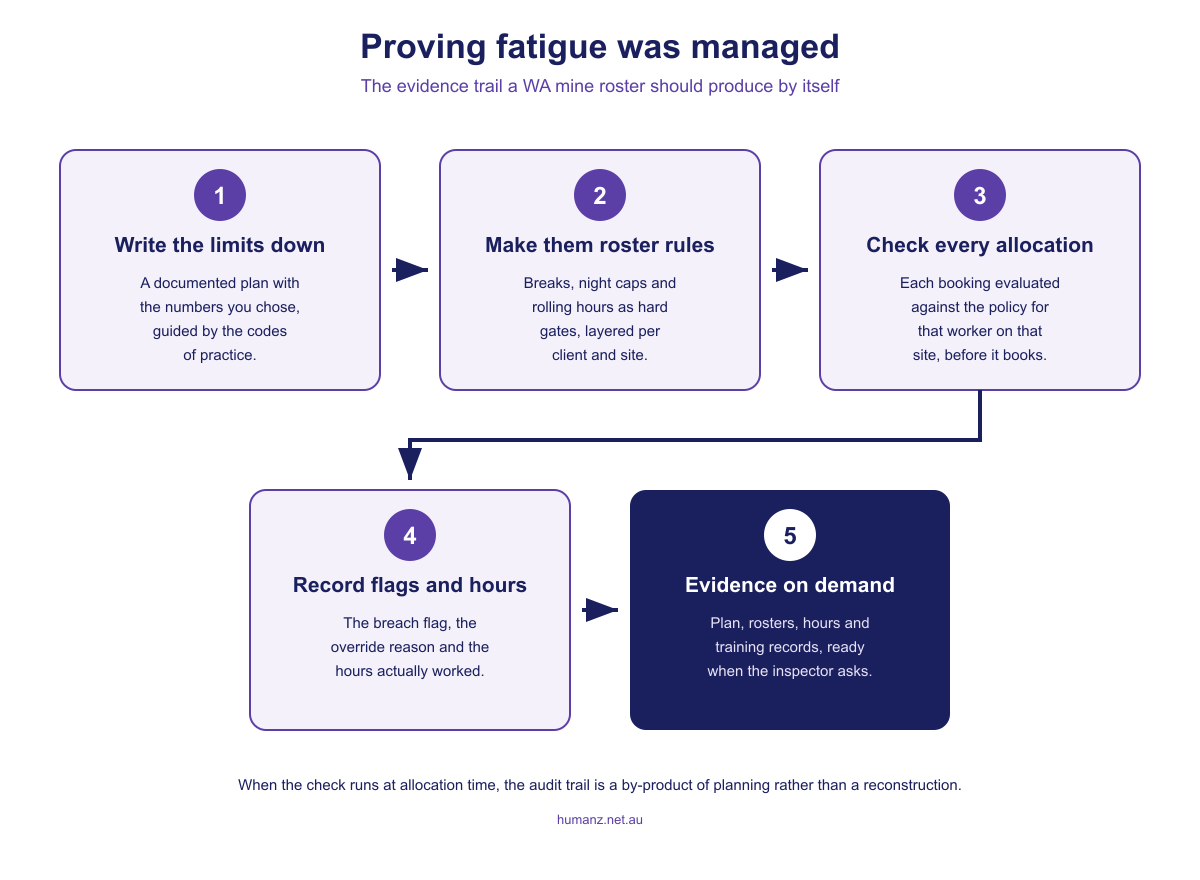
Each answer is cheap or expensive depending on where the check ran. If the fatigue limits live in a PDF, then reconstructing compliance means cross-referencing rosters, timesheets and memory, months after the fact, for a swing nobody remembers. If the limits live in the scheduler, the evidence writes itself as a by-product of planning. The booking was checked against the policy at the moment it was made, the flag and the override reason are on the record, and the timesheet that prefills from the roster closes the loop between hours planned and hours worked.
That last pairing matters more than it looks. Planned hours prove what you intended. Worked hours prove what happened. An investigator cares about the difference, and a business that can produce both, side by side, for any worker and any date range, walks into that conversation in far better shape than one holding a policy document and a shoebox of timesheets.
Regulation 640 spends one sentence on fatigue. Your evidence will run considerably longer. The cheapest way to produce it is a roster that produces it while you plan, not an admin scramble after something has already gone wrong.
Frequently asked questions
Does the WHS (Mines) Regulations 2022 set a maximum shift length?
No. Regulation 640 is entirely risk-based and contains no numbers, and the regulations as a whole set no maximum shift length, minimum break or cap on consecutive shifts. Numeric thresholds come from guidance like the Working hours code of practice, from awards and enterprise agreements, and from client site standards. The duty is to manage the risk and be able to demonstrate how.
What does regulation 640 actually say?
It requires the mine operator, in complying with regulation 617, to manage risks to health and safety associated with worker fatigue, and that is the entire provision. There’s no maximum shift length, no minimum break and no cap on consecutive nights anywhere in it. The numbers WA mining rosters actually run on come from the Working hours code of practice, awards and enterprise agreements, and client site standards, and the duty is to set safe limits for your own operation and prove you applied them.
Who is responsible for fatigue management on a WA mine site?
Regulation 640 places the specific fatigue duty on the mine operator, but regulation 617 requires every business or undertaking at the mine to manage risks from mining operations, and section 19 of the WHS Act gives each employer a primary duty to its own workers. A contractor or labour hire provider holds duties at the same time as the operator. In practice the operator’s safety management system and the contractor’s plan are meant to work as one arrangement.
Is the Working hours code of practice legally binding?
No, and it says so itself: a code does not have the same legal force as a regulation. It continues as a transitional code under the WHS Act, codes are admissible in court proceedings, and a court may use one as the standard when assessing the practices a business used instead. Ignoring it without a well-documented alternative is a poor position to defend.
Do mine workers have to be trained on fatigue controls?
Yes. Regulation 675B requires workers to be given information, training and instruction on the control measures that apply to their work, and names fatigue controls specifically. Unlike regulation 640 it carries its own penalty, so crews who have never been trained on your fatigue controls are a live compliance gap rather than a best-practice shortfall.
What records prove fatigue was managed on a mine roster?
The documented fatigue limits and the plan they belong to, the roster as planned, the hours actually worked, and the record of allocations that were flagged against the limits along with what was done about them. Training records matter too, because regulation 675B requires workers to be given information, training and instruction on fatigue control measures. Records showing communication across shift changes round out the set.
Do the psychosocial regulations apply to roster design?
Yes. Regulations 55A to 55D sit inside the WHS (Mines) Regulations and bind businesses at mines directly. The control measure factors in regulation 55D include the design of work, job demands, the systems of work and the condition of workers’ accommodation, all of which a roster and camp arrangement directly shape. Roster design is a psychosocial control measure, not just a scheduling choice.
Related articles
Ready to see Humanz on your own roster?
Free 30-minute walkthrough, we'll use your real crews, sites and shift patterns.