
 Login
Login 

Guides
Construction Site Compliance Checklist (Australia): What to Track and Automate
By Richard Lomen · 8 June 2026 · Updated 14 September 2026
There’s no single rulebook for construction site compliance in Australia. Safety, licensing, employment law and incident reporting each come with their own regulator, their own records and their own penalties. Keep across it all manually and things slip. A ticket expires quietly, a pre-start goes unrecorded, and you find out during an audit.
Most of what follows applies to subbies as much as employees, and the tracking half of it is automatable. Humanz subcontractor management is where that happens, and for civil and construction contractors the wider picture of crews, plant and tickets on one board is covered on the civil construction rostering software page.
Below is a working construction site compliance checklist, along with the parts your workforce management software for construction should be tracking so you don’t have to.
What does construction site compliance cover?
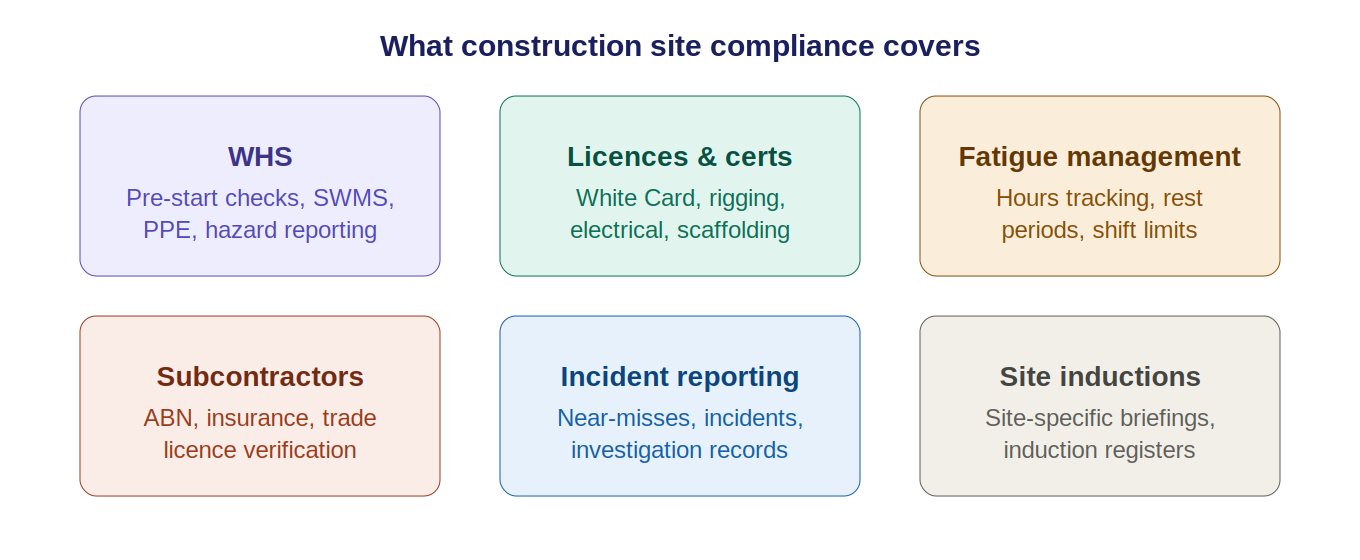
Construction compliance in Australia spans several distinct areas:
- WHS (Work Health and Safety). Pre-start checks, hazard identification, safe work method statements (SWMS), PPE requirements
- Worker licences and certifications. Every worker on site needs current, valid tickets for their role
- Fatigue management. Hours worked and rest periods, tracked and enforced
- Subcontractor compliance. Insurance, ABN and trade licences verified for every contractor
- Incident and near-miss reporting. Records captured and stored in a format that satisfies regulators
- Site inductions. Nobody starts work without completing a site-specific induction
- Fair Work Act obligations. Rest periods, break entitlements, overtime records
Each of these has its own regulatory framework, and falling short in any one of them can mean fines or a project shutdown. The employment side gets enforced as hard as the safety side. In 2024-25 the Fair Work Ombudsman secured a record $23.7 million in court penalties and issued 1,220 compliance notices, recovering $8.2 million for 3,438 workers through the notices alone.
What Australian law requires
WHS obligations
Under the Work Health and Safety Act, adopted across most Australian states and territories, construction businesses have a primary duty of care to make sure workers aren’t exposed to health and safety risks. On a project of $250,000 or more, one of those businesses is also the principal contractor, with a written WHS management plan, signage, site security and SWMS collection on top of the primary duty.
For construction sites, that means:
- Daily pre-start checks documented for plant and equipment
- Safe work method statements for high-risk construction work
- Current induction records for all site personnel
- A way to notify the regulator immediately of any notifiable incident, leave the site undisturbed as the law requires, and keep each notification record for at least five years
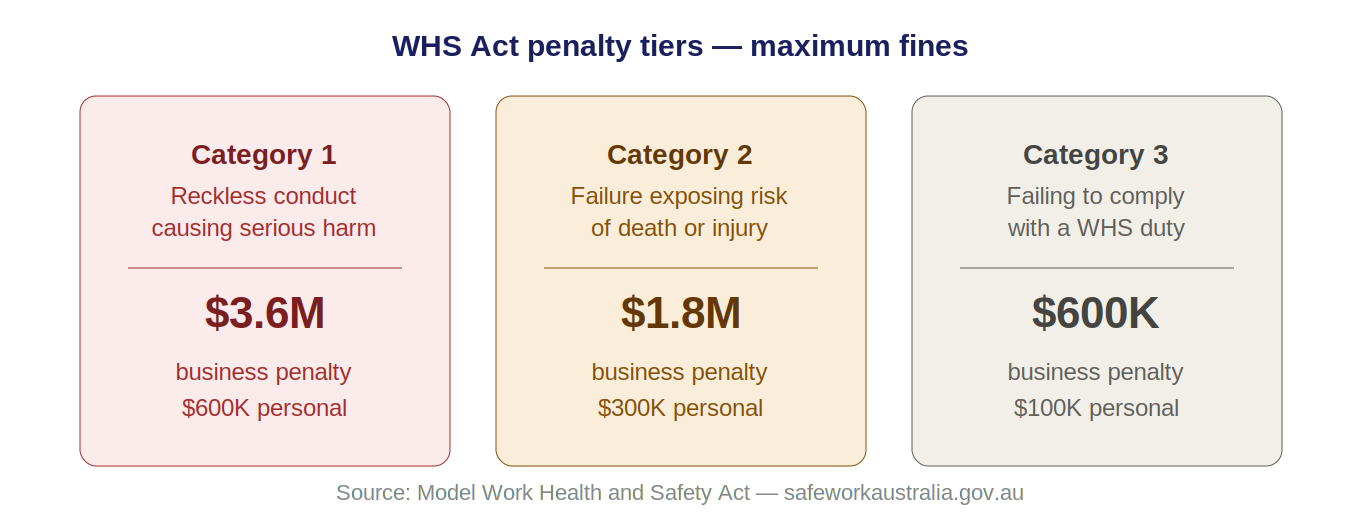
Safe Work Australia publishes the model codes of practice that define what ‘reasonably practicable’ looks like for construction businesses. Maximum penalties for the most serious breaches run into the millions for a company, with separate personal exposure for officers that can include imprisonment. The figures are indexed and differ by state and territory, so check the current maximums for the jurisdiction you work in rather than a number you read in a blog post.
Licence and certification requirements
Construction roles that carry their own licensing requirements include:
- Dogging, rigging and crane operation (nationally recognised licences)
- Scaffolding (basic, intermediate, advanced)
- Explosive power tools
- Asbestos removal
- Electrical work (state-specific licensing)
- Construction induction card (White Card), which every person on site must hold, and which is worth verifying: see how to check a White Card in each state
Note: Licence requirements vary by state and territory. A Queensland electrical licence is not automatically valid in WA. Always verify the applicable jurisdiction for your site.
Comcare’s guidance on workplace compliance covers fatigue as a workplace hazard that must be actively managed, which lands hardest on businesses running extended shifts or FIFO arrangements. Our guide on fatigue management software Australia has the full breakdown, and how to write a fatigue management plan covers the document a principal contractor will ask you for.
The compliance checklist: what to track on every site
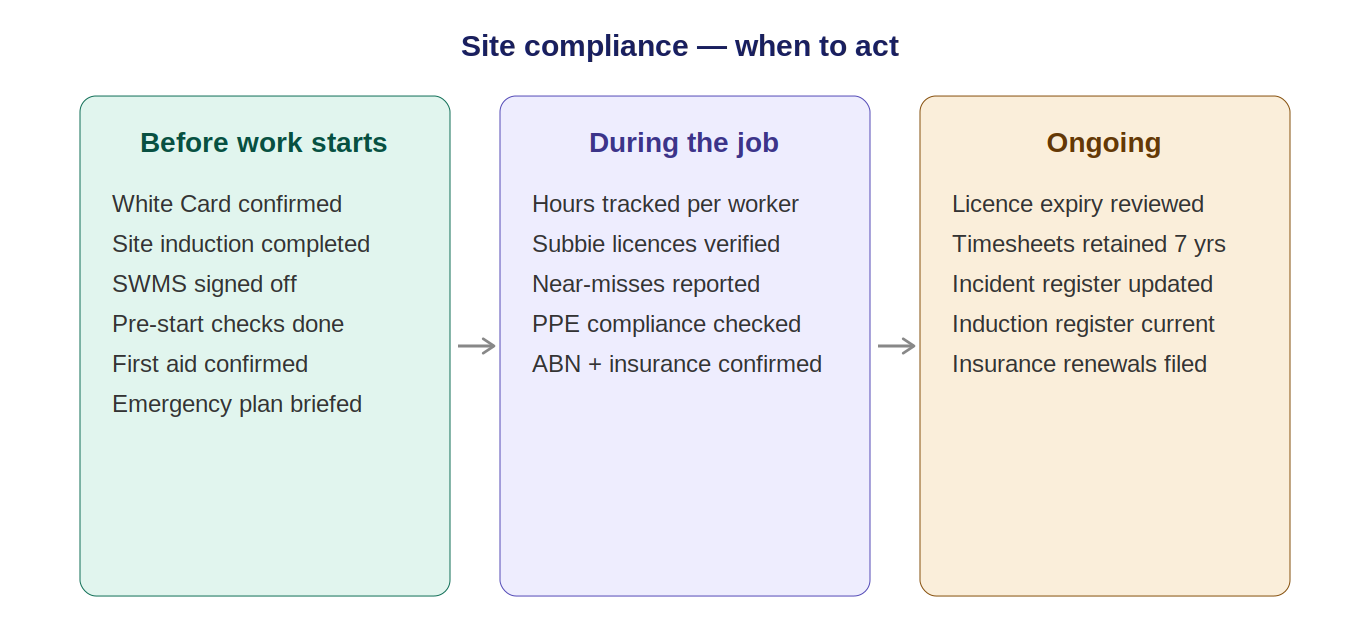
Before work starts
- [ ] All workers hold a current White Card (Construction Induction Card), verified against the issuing state’s register
- [ ] Site-specific induction completed and recorded for every worker
- [ ] SWMS reviewed and signed off for all high-risk work activities, with a JSA for the tasks the SWMS doesn’t cover (JSA vs SWMS vs Take 5 sorts out which form each job needs)
- [ ] Plant and equipment pre-start checks completed and documented
- [ ] First aid confirmed (first aider on site, kit stocked and accessible)
- [ ] Emergency procedures briefed to all site personnel
During the job
- [ ] Hours tracked per worker, with fatigue thresholds monitored
- [ ] Subcontractor licences and insurance verified before work commences
- [ ] Near-misses and incidents reported and recorded as they occur (not retrospectively)
- [ ] PPE compliance enforced and documented
- [ ] Contractor ABN and insurance currency confirmed
Ongoing (weekly/monthly)
- [ ] Licence and certification expiry dates reviewed, with alerts set for upcoming renewals
- [ ] Timesheet records verified and retained per Fair Work requirements (seven years)
- [ ] Incident and near-miss register reviewed, confirming every notifiable incident was notified to the regulator immediately and its record is kept for at least five years
- [ ] Induction register up to date for all current site personnel
- [ ] Subcontractor public liability insurance renewed and the certificate of currency on file
For businesses running a mix of direct employees and contractors, subcontractor management software puts licence tracking, insurance currency and ABN verification in one place instead of scattering it across spreadsheets and email.
What your compliance software should automate
This section is the construction-specific version of a wider question. For the category as a whole, including the test that separates a compliance register from a compliance gate, see WHS compliance software in Australia.
Spreadsheets, paper forms and email reminders don’t scale, and they don’t produce audit-ready records. Purpose-built software should be handling the following.
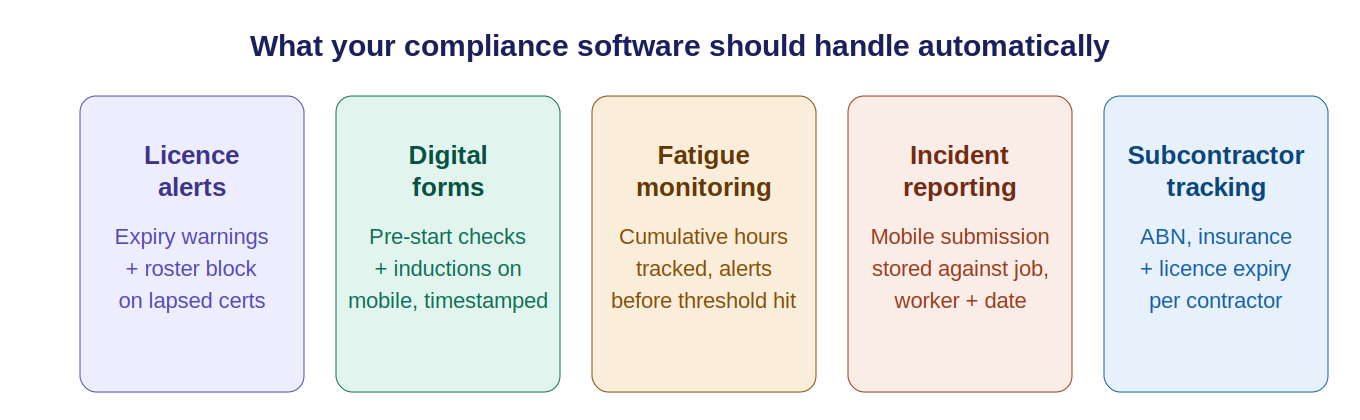
Licence and certification expiry alerts
The software should track every worker’s credentials and alert both the manager and the worker when a licence is approaching expiry. It should also block rostering for anyone whose credentials have lapsed.
Digital pre-start and induction forms
Workers complete pre-built or customisable digital forms on their phone before starting work. Every submission lands with a timestamp and GPS stamp, which gives you an audit trail without any filing. A flexible digital form builder for field teams lets you replicate any paper form you currently use, from SWMS sign-offs to toolbox talks. What a toolbox talk and a prestart meeting should cover, and what to record from each, has its own guide.
Fatigue threshold monitoring
The system should track cumulative hours across shifts and alert when a worker is approaching or has passed a safe work threshold. That’s the job of fatigue management software, and it matters most on sites running long shifts or overnight work.
Incident reporting
Workers and supervisors should be able to submit incident or near-miss reports from their mobile, with the report filed against the job, date, worker and site on the spot. No paper forms, no data entry delays.
Subcontractor compliance tracking
A contractor’s profile should hold their ABN, trade licences, insurance details and expiry dates, with alerts to the manager when anything lapses. This is exactly what a dedicated subcontractor management platform handles for you.
How Humanz handles compliance for field teams
Humanz is a workforce management platform with site compliance built in, designed for Australian field and construction teams. The forms builder lets you create pre-start checks, induction forms, incident reports and any other compliance documentation, completed by workers on mobile and stored against their record with timestamps.
Key compliance features in Humanz:
- Digital forms. Build any form and push it to workers’ phones, with submissions saved against the worker’s record as they come in
- Licence and cert tracking. Expiry alerts for every credential, and rostering blocked once something lapses
- Fatigue monitoring. Hours-worked alerts based on thresholds you set
- Subcontractor profiles. Licence, insurance and ABN tracked against each contractor
- Full audit trail. Every form submission, timesheet and approval timestamped and retrievable
Timesheet accuracy underpins all of it. If hours aren’t captured correctly, fatigue alerts won’t fire when they should. Our article on digital timesheets for tradies covers how to get that foundation right.
Frequently asked questions
What is the penalty for WHS non-compliance in Australia?
Penalties scale with severity across three categories. Category 1 covers reckless or negligent conduct exposing someone to risk of death or serious injury, Category 2 a failure to comply with a duty that exposes someone to that risk, and Category 3 a failure to comply with a duty. Maximum fines for a body corporate run into the millions for the most serious category, and officers carry separate personal exposure that can include imprisonment. The model WHS Act is a template rather than the law itself: each state and territory enacts its own maximums, several index them annually, and Victoria sits outside the model scheme entirely, so check the current figure with the regulator for your jurisdiction rather than relying on a national number.
What’s the difference between a site induction and a pre-start check?
A site induction qualifies the person. It happens before a worker’s first shift on that site and covers hazards, emergency procedures and site rules. A pre-start check clears the equipment, a daily documented inspection of plant before it’s used. Both produce records an auditor will ask for.
Do digital compliance records satisfy Australian regulators?
Yes. Australian WHS regulators accept digital records, provided they’re accurate, complete and accessible. Digital records are often more defensible than paper because they carry timestamps, user IDs and GPS data that paper can’t provide.
How long do I need to keep compliance records?
It depends on the type of record. Fair Work Act time and wages records must be kept for seven years. Under the WHS laws, a record of each notifiable incident must be kept for at least five years from the day the regulator was notified, and in Victoria a copy of the written incident record must be kept for at least five years. For induction records, the safe practice is the duration of the project plus seven years. When in doubt, retain longer.
What should be checked before a subcontractor starts work on site?
Their ABN, trade licences and public liability insurance, all verified as current before any work commences, plus a completed site induction and a White Card. Expiry dates matter as much as the documents, because an insurance certificate that lapses mid-job is a gap nobody notices until a claim arrives. Tracking currency with automatic alerts is the practical fix.
Do subcontractors need a White Card?
Yes. The White Card (Construction Induction Card) is required for any person carrying out construction work in Australia, including subcontractors, labour hire workers and self-employed tradespeople. There’s no exemption based on employment status.
Can one app handle all of this compliance tracking?
Purpose-built field workforce platforms like Humanz are designed to consolidate forms, licences, timesheets, fatigue tracking and subcontractor management in one place. Generic HR platforms typically cover only part of the picture, which is why construction-specific tools are worth considering.
Related articles
Ready to see Humanz on your own roster?
Free 30-minute walkthrough, we'll use your real crews, sites and shift patterns.