
 Login
Login 

Rostering & Scheduling
How to roster staff effectively for field and shift crews
By Duane Butler · 14 September 2026

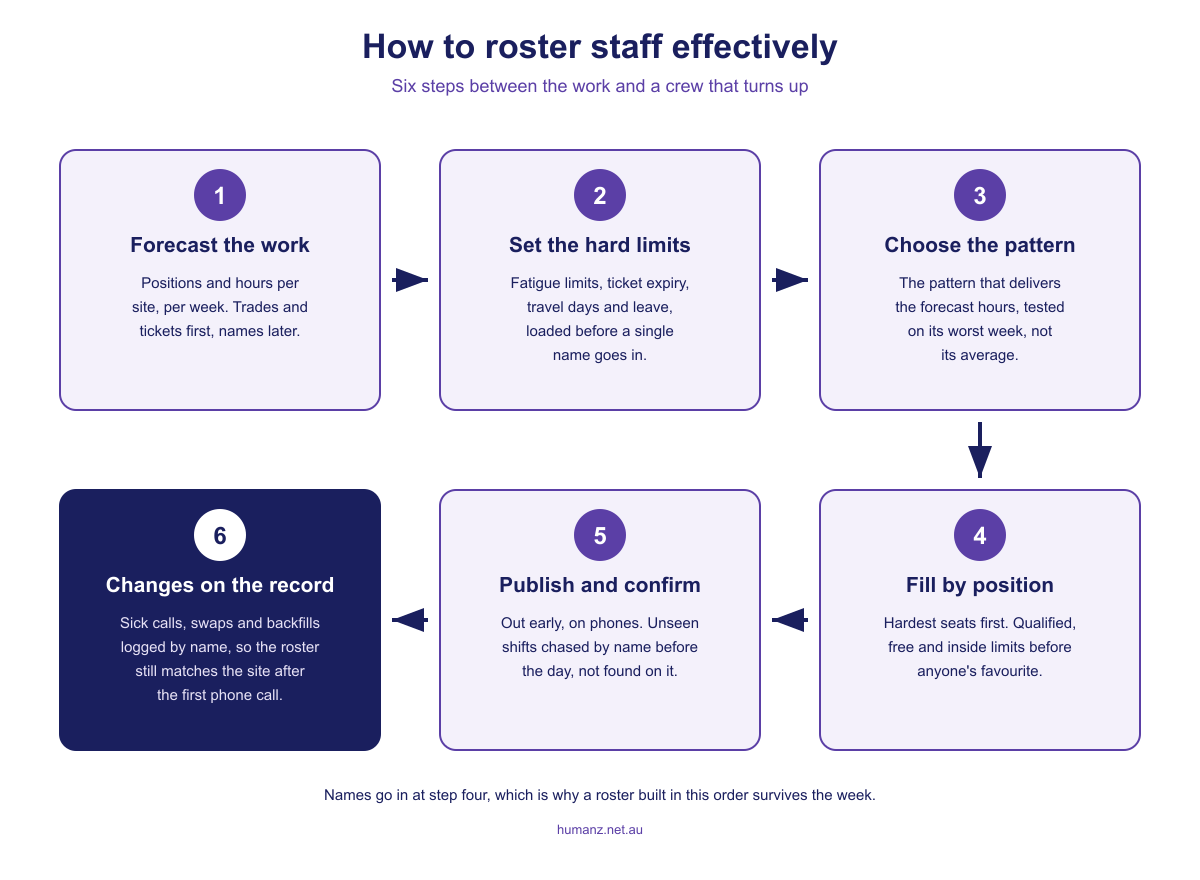
To roster staff effectively, work in this order: forecast the work as positions and hours per site, set the hard limits (fatigue, tickets, travel and leave), choose the shift pattern, fill by position and trade, publish early and track who has confirmed, then log every change and backfill. Names don’t go in until step four.
Most staff roster advice is written for a café, with one site and staff who go home every night. Field crews break that model before smoko on Monday. Fatigue limits have numbers on them, tickets expire, FIFO crews lose days to travel and half the crew may be subbies. What follows is the field version.
Why the order matters
A roster built name-first looks finished by Tuesday lunch. Then the checking starts. One regular is on a seventh straight day, another’s excavator VOC lapsed last week, and a third flies home on the Thursday you pencilled them in for nights. Each discovery pulls a name back out, usually with a phone call attached.
Availability is shakier than it looks. The ABS multiple job-holders release for June 2026 counted 1.0 million people working more than one job, a record high 6.9% of employed people, and notes that some labour hire workers may work for a number of businesses. Some of your crew are on somebody else’s roster too, and the two rosters don’t talk.
Working in order fixes most of that, because every name you place has already passed the checks.
Step 1: Forecast the work as positions and hours, not names
Start with what the work needs and leave people out of it. For each site, list the week’s positions, the tickets each one needs, the shifts and the hours. The result is position-hours per site per week, set down before anyone’s availability bends the picture.
Say you run a civil crew across three sites next week.
| Site | Positions | Each position needs | Days × hours each | Position-hours |
|---|---|---|---|---|
| Site A, road upgrade | 2 excavator operators | Site induction, excavator VOC | 5 days × 10 | 100 |
| Site A, road upgrade | 3 labourers | Site induction | 5 days × 10 | 150 |
| Site B, drainage | 2 pipelayers | Site induction | 5 days × 9 | 90 |
| Site B, drainage | 1 leading hand | Site induction, first aid | 5 days × 9 | 45 |
| Site C, night works | 2 traffic controllers | Site induction, traffic control ticket | 4 nights × 10 | 80 |
| Total | 10 positions | 465 |
Position-hours are positions × days × hours, so the two operators on 5 × 10 come to 100. A list of names would hide two things here. The hardest seats are the night-shift traffic controllers, so they get filled first. And the operators need a VOC the labourers don’t, so the pool for those two seats is smaller than your headcount suggests.
If a seat needs more hours than one person can work, the free crew coverage planner turns the coverage you need into headcount and crews. In Humanz, each client’s sites are set up once with their own default day and night shift times, and a job card shows the positions to fill and the trade each one demands.
Step 2: Set the hard limits before any name goes in
The forecast is demand. The limits decide supply, the hours each person can legally and safely take on, so they go in before anyone is placed.
The National Employment Standards cap the week. As the Fair Work Ombudsman puts it, an employee can work a maximum of 38 hours in a week unless their employer asks them to work reasonable extra hours. The example’s 10-hour days put the operators and labourers on 50 hours, so 12 of those hours have to be reasonable extra hours. Awards and registered agreements set the daily detail, such as maximum ordinary hours in a day, along with rest and meal breaks, and may set a minimum amount of time off between shifts. Our guide to the maximum hours you can work in a row shows how those layers stack.
Then comes fatigue. Safe Work Australia says businesses must eliminate or minimise the risk of fatigue so far as is reasonably practicable. Its model Code of Practice on managing the risk of fatigue at work, published in September 2025, sets out how, but a model code only carries legal weight where a state or territory approves it: Tasmania, New South Wales and the Northern Territory had done so by March 2026, while Western Australia and South Australia still use their own working hours codes. Safe Work Australia’s announcement says managing fatigue may mean changes to work hours and shift design, and sufficient breaks at work and between periods of work, and that employers must consult workers. On a roster, that becomes a written fatigue policy with numbers in it, worked out with the crew and tightened wherever a client’s site rules are stricter.
| Limit | Where the number comes from | Load before rostering |
|---|---|---|
| Weekly hours | National Employment Standards, then award or agreement | Hours already booked this week, across every site |
| Shift length, breaks and time between shifts | Award or agreement, then fatigue policy | The tightest figure for each crew |
| Consecutive shifts, nights and rolling totals | Fatigue policy, client site rules and some awards | Each worker’s recent shifts, not just this week’s |
| Tickets, inductions and VOCs | Site, client and plant | Expiry dates, checked against the shift date |
| Travel days and changeovers | Rotation and flight schedule | Who is in transit, and when |
| Leave and availability | Approved leave, rostered days off, worker updates | Blocked dates, before the roster opens |
A few rows catch people out. Check ticket expiry against the shift date, not today’s, because a ticket that lapses on Wednesday fails a Thursday shift. On a swing roster the flight out is part of the rotation, so a 5am departure after a night shift is not a day off, whatever the roster calls it. And leave and rostered days off go in as blocked dates before the roster opens, so nobody has to mention the fishing trip they booked in March.
The free fatigue hours checker tests up to 14 days of shifts against limits you set. In Humanz, each worker’s profile carries their qualifications and inductions with expiry dates, and fatigue limits are checked as shifts are placed, so a booking that would breach either is flagged before it’s confirmed.
Step 3: Choose the shift pattern that fits the hours
Only now pick the pattern. Its job is to deliver the forecast hours inside the limits, and two questions narrow the field. Does the work stop overnight? And do people go home, sleep in a camp or fly in?
A day-only civil job on a local 5-2 is a different animal from a processing plant running 12-hour nights. The shift roster patterns guide compares the common Australian patterns on hours, days at home, weekends off and fatigue exposure. If the work runs around the clock, the 24/7 headcount calculation shows why a four-crew roster needs closer to five people per seat once leave and absence are counted.
Test the pattern’s worst week against your fatigue policy, because the average week hides the stretch the policy is written to catch. Then save it as a roster template so the next cycle starts from the pattern instead of a blank grid. The roster templates guide covers what a good one holds, and in Humanz templates capture your repeating patterns while drag-and-drop handles the day-to-day changes.
Step 4: Fill by position and trade, not by favourite
Every supervisor has a favourite, the one who always answers the phone and never says no. That worker is also the most likely to be near their hours limit by Thursday, because everyone else rings them too.
Fill the hardest seats first (in the example, the night-shift traffic controllers, then the operators). For each position, work through four questions in order.
- Is the worker qualified for this site, with the position’s tickets and site induction current on the shift date?
- Are they free that day, and does the shift keep them inside every hours and fatigue limit?
- Did they work this site last week? They’ll start faster, and won’t spend the first hour looking for the crib room.
- Is the load fair, with nights and travel days spread across the crew instead of landing on the same few?
Preference only breaks a tie once all four have been answered.
Memory can’t run this on a blended crew. The ABS labour hire workers release counted 351,000 people with a job in labour supply services in December 2025, and found that in August 2024, 55.3% of labour hire workers had been in their current job for less than a year, against 20.8% of all employees. With that much churn, nobody’s memory of who holds which ticket stays current. Subbies go through the same questions, with a current certificate of currency checked before the booking stands.
Here’s where rostering software built for field crews pays for itself. Humanz shows employees and subcontractors in one view of who’s available, qualified and compliant, and checks qualifications and fatigue limits as each shift is placed, so a booking that fails the first two questions is flagged before it’s confirmed.
Step 5: Publish early and track who has confirmed
Publish as far ahead as the work is firm. The Fair Work Ombudsman notes that awards and registered agreements can set rules about how and when employees are given rosters, so check the instrument covering each crew. Field crews need extra lead time anyway, because flights and camp rooms get booked against the roster.
Publishing is only half the job. Shift confirmation is the other half, and it’s where no-shows get caught while there’s still time to act. Track every published shift through four states, whatever tool you use.
| Status | What it tells you | What to do |
|---|---|---|
| Sent, not seen | The worker hasn’t opened it | Message, then ring, two or three days out |
| Seen, not confirmed | They’ve looked but haven’t committed | Ask directly and treat the shift as open |
| Confirmed | They’ve committed to the shift | Nothing, unless the shift changes |
| Declined or flagged | They can’t do it, or something’s wrong | Refill now, while more people are still free |
In Humanz, shifts land on workers’ phones with confirmations tracked, and the Show Unseen filter narrows the schedule to the shifts workers haven’t seen. The follow-up routine is in our guide to seen and unseen shift tracking.
Step 6: Handle changes and backfill with a record
Rosters change, and how you change them has rules attached. Every modern award and enterprise agreement must include a consultation term, so for employees they cover, changing a regular roster or ordinary hours of work means discussing it with them first: giving them information about the change, inviting their views on its impact and considering those views. The same instrument can set extra rules about changing rosters, including how and when employees are given them.
Backfill is the change nobody plans, and the night-before ring-around has a legal wrinkle. The Fair Work Ombudsman is clear that contacting an off-duty employee isn’t unlawful, but under the right to disconnect they can refuse to read or respond unless that refusal is unreasonable, while someone on call can be required to answer. A backfill that depends on one person picking up is a weak plan anyway, so offer the shift to the group. Clear the absent worker’s shifts so the gap shows, push the open shift to everyone available, qualified and inside their limits, and let the first to accept take it, or pick from the acceptances using the fairness check from step four. Swaps belong in the roster too, where shift swap software puts the incoming worker through the same checks as the original booking.
Whatever the change, keep the record with the shift: who changed what, when and why, who was told and whether they confirmed. Then when a client asks who was on the crew at 3am on the 14th, the answer is a lookup, not an afternoon in text messages.
Humanz handles the mechanical parts. Entering sick leave takes one tick to clear every shift the worker held that day, so the gap shows immediately. An open shift can go to every available, qualified worker at once, and the first to accept on their phone gets the job. Shift responses come back dated and named, with a full history of who submitted what and when.
Doing the six steps in a spreadsheet or in software
A spreadsheet copes with steps one and three, because positions, hours and patterns come down to arithmetic and grids. Steps two, four, five and six run on data that changes by the hour, like expiry dates, hours already worked, who has seen which shift and who changed what, and that’s where it gives out. If you’re weighing up platforms, how to choose rostering software compares the three categories on the market.
Humanz supports those four steps with rules, not AI: rules-based automation, templates, live availability matching and compliance gates, so the same inputs give the same answer every time and the coordinator still makes the call. To see your own roster rebuilt in this order, walk through it with our team.
Frequently asked questions
How do you roster staff effectively?
Roster staff effectively by working through six steps in order: forecast the work as positions and hours per site, set the fatigue, ticket, travel and leave limits, choose the shift pattern, fill each position by trade, publish early and track confirmations, then record every change and backfill. The order matters because names placed before the limits are loaded usually get pulled out again, often by a lapsed ticket or a short rest gap.
What is a staff roster?
A staff roster, also called an employee roster, is the schedule of who works which shifts, where and when. The Fair Work Ombudsman describes a roster as a timetable showing the days and times employees are required to work. On field crews it also shows the site, the position, the tickets each shift needs and who has confirmed.
What should a staff roster include?
Each shift on a staff roster should show the site, the position and trade, start and finish times, breaks, the tickets or inductions required and the person filling it. Field rosters also need travel days, leave and each worker’s confirmation status. Check each person’s hours across their recent shifts, plus rest gaps and consecutive days, so fatigue breaches show up before the roster is published.
Should you build a roster by name or by position?
By position. List each site’s positions, the tickets each one needs and the hours, then fill the hardest seats first with workers who are qualified, free and inside their limits. Starting from names hides the seats with the smallest qualified pool, and those are the ones that fall over when someone is sick or a ticket lapses.
What limits should you set before building a roster?
Set weekly hours, shift length, breaks, time between shifts, consecutive shifts and nights, ticket and induction expiry, travel days and approved leave before any name goes in. Weekly hours come from the National Employment Standards and the award or agreement, and the fatigue numbers come from your fatigue policy and any stricter client site rules. Check expiry dates against the shift date rather than today’s, because a ticket that lapses midweek fails every shift after it.
How many hours can staff be rostered in a week in Australia?
Under the National Employment Standards, an employee can work a maximum of 38 hours in a week unless their employer asks them to work reasonable extra hours. Awards and registered agreements set the daily detail, such as maximum ordinary hours in a day. Employers also have to manage fatigue risk under work health and safety law, so a week that passes the hours test can still fail a fatigue policy.
How do you fill a shift when someone calls in sick?
Clear the absent worker’s shifts so the gap shows on the roster, then offer the open shift to everyone who is available, qualified for that site and inside their fatigue limits. Offering it to the whole group at once beats ringing down a list, and the first to accept takes the shift. Record who filled it and when, so the roster still matches what happened on site.
Related articles
Ready to see Humanz on your own roster?
Free 30-minute walkthrough, we'll use your real crews, sites and shift patterns.