
 Login
Login 

Rostering & Scheduling
What Does a Workforce Scheduler Do? A Day in the Life, by the Clock, Parked
By Duane Butler · 24 September 2026

A workforce scheduler decides who works where, when and on what, checks that every allocation passes the ticket, fatigue and cost limits, and then spends the rest of the day repairing that plan as sites, clients and the weather change it. Same job under five titles, and this is what it looks like by the clock, told from the car park where the job caught up with me. The car was parked the whole time.
Who is writing this, and where
I scheduled and managed large workforces before Humanz: mining services crews with varied requirements and a phone that did not respect the roster’s opinion of when the day ended. Before that I was a diesel mechanic and a parts interpreter, among other things, and both trades teach you to ask what the person on the other end actually needs. Now, as Director of Operations at Humanz, I run onboarding and company setup, which means my days are spent on the road with the businesses whose schedulers use the platform, testing new features between visits and keeping an eye on what changes.
The photos are from a car park in Perth, between two client visits, with the scheduler open on a monitor mounted on the dash and a headset on because a ring-around does not care what room you are in. People see a picture like that and assume the article is about working from a moving car. It is not. Nothing in this article happens while the car is in Drive, and there is a section further down on exactly that. What the photos show is the thing every scheduler already knows: the office is wherever the roster is open, and the roster is always open.
Five titles, one job
Search the job boards and the same role appears under five names, sorted mostly by industry. Rostering officer is the health, aged care and government title, and the official one: the ABS classifies the job as occupation 599232, Rostering Officer, with Roster Clerk and Workforce Planner as alternative titles and a task list that reads like a shift diary: assist in creating rosters, administer them to the enterprise agreement, backfill sick and bereavement leave, redeploy qualified staff, communicate roster changes, complete the paperwork. There is no standalone “scheduler” in the classification; the nearest is the maintenance scheduler filed under maintenance planner, which is a different trade. Jobs and Skills Australia counted 7,700 rostering officers at the 2021 Census, four in five full time and health care and social assistance the main employing industry, which tells you how much of the field version of the job is filed under other names. Roster coordinator is what mining services and labour hire businesses call it. Scheduling coordinator turns up in civil, transport and plant hire, allocator and dispatcher in transport and hire fleets, and roster manager is the seat above all of them, where the fatigue policy, the fill rate and the headcount argument live. Workforce scheduler is the term the software industry settled on, which is why it is the one people search for when they want to know what the job is.
The title changes the lanyard, not the loop. Whatever the business calls it, the person in the seat forecasts the positions a job needs, fills them inside the limits, publishes, chases confirmations, repairs the day, and closes it on the record. The field version of that loop is set out step by step in how to roster staff effectively; this article is about what it feels like to run it.
The loop, before the phone rings
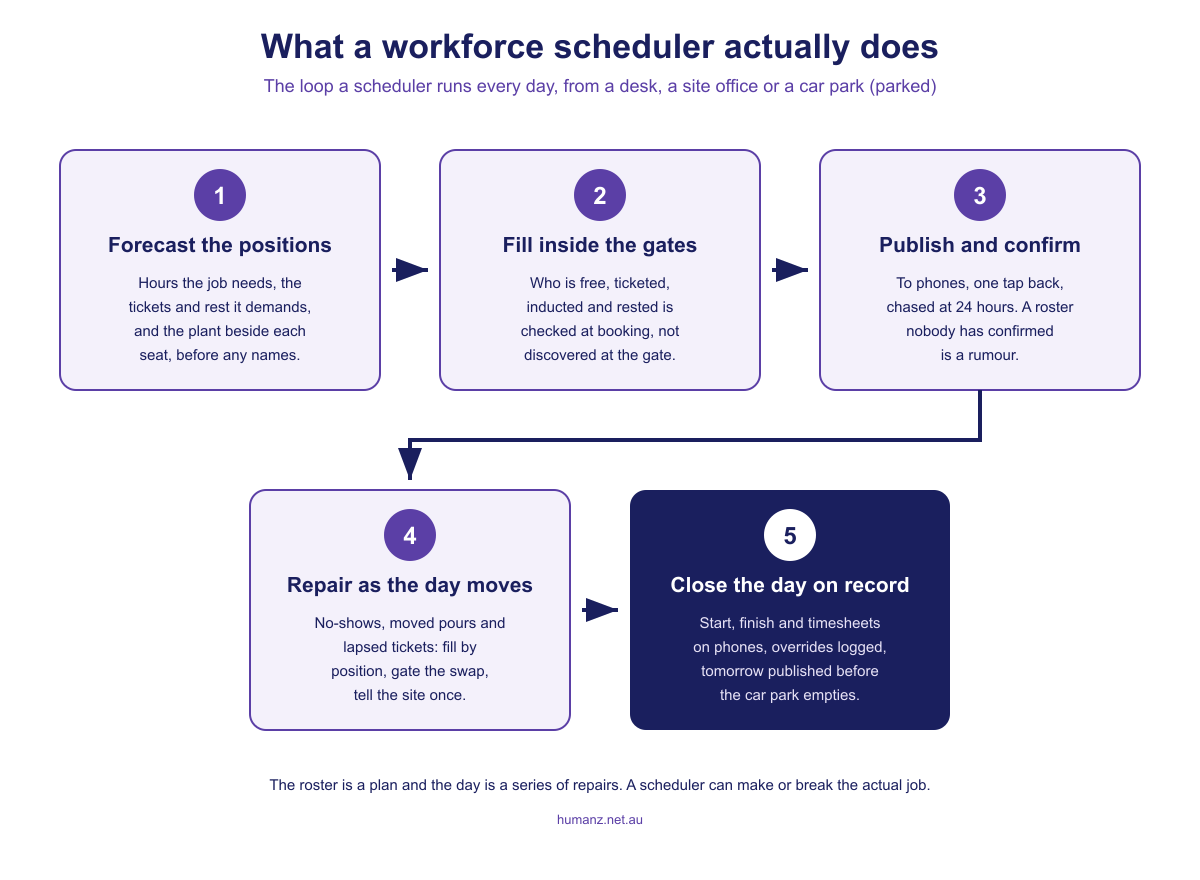
Positions first, names last. A tipper job needs two HR drivers and an operator for the excavator that arrives Wednesday, each seat with its own ticket and induction requirement, and the plant sits beside the seat it belongs to. Only then do names go in, and each one is checked as it goes: free, ticketed, inducted for that site, inside their hours. In Humanz that check runs as the shift is placed, so a name that fails it is flagged before the booking is confirmed rather than discovered at the gate at six in the morning.
Then it publishes to phones, and the second half of the job begins. A roster nobody has confirmed is a rumour. The scheduler’s day is mostly the distance between the roster as published and the roster as it will actually happen, closed one phone call at a time.
A day in the life, by the clock
Every scheduler’s day is different and every scheduler’s day is this one. The times are real, the crises are composites, and nobody in it is named.
5.10 am, the sick call. Kitchen bench. Car: in the driveway.
The first message is a sick call, forty minutes before a 6.00 am start. The old version of this is a ring-around: down the list, voicemail, next name, voicemail, and a supervisor told at 5.55 that someone is coming, probably. The current version is one tick to clear the worker’s shifts for the day, the gap visible on the roster immediately, and the open shift pushed to everyone who is free, holds the ticket and is cleared for that site. The first one to accept on their phone has the job, and the confirmation is logged with a time on it. The headset is the receptionist: it takes every call and puts none of them through until the coffee is made.
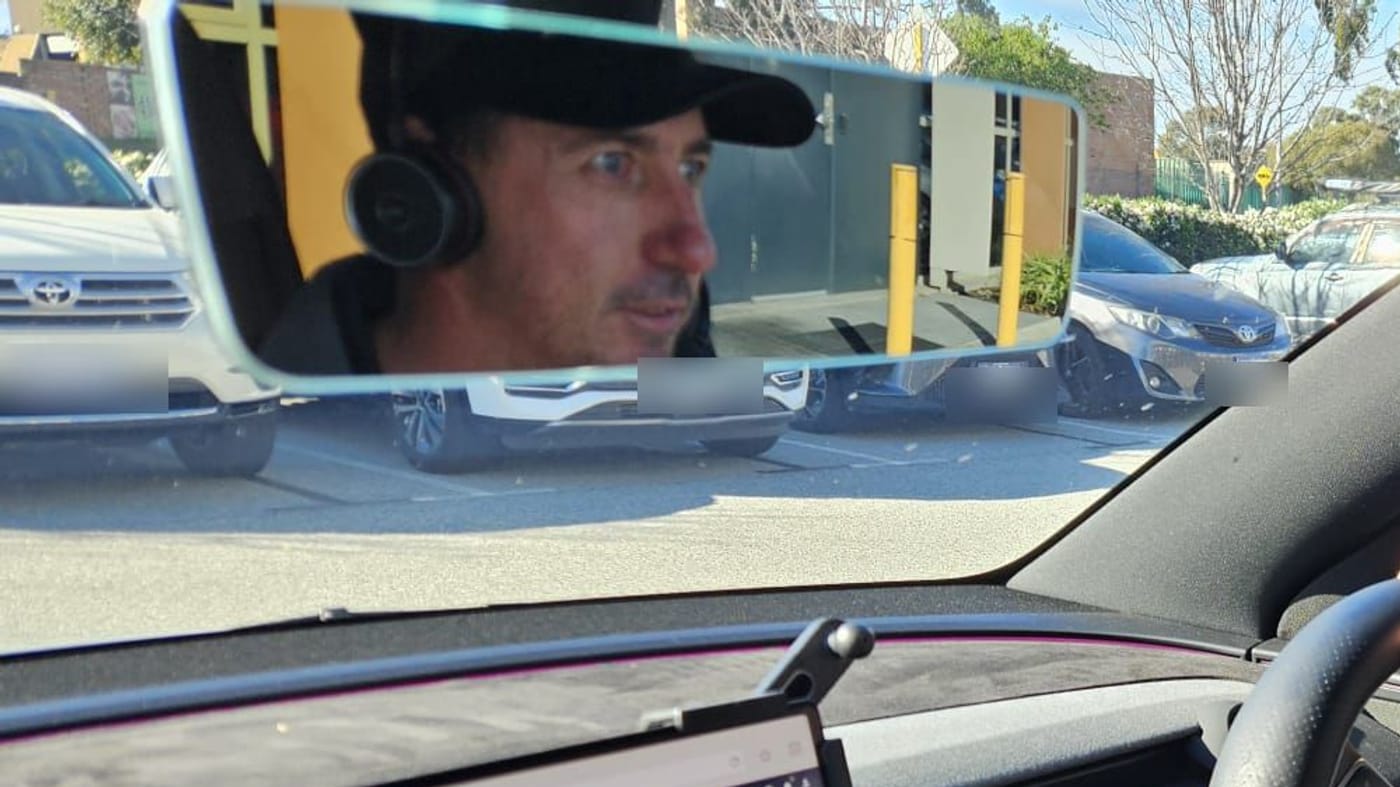
6.30 am, the board. Car park, bay 14. Car: parked.
The board. Every site and crew in one view, a week to three months out, grouped into teams the way the planner thinks (a crew, a panel, a trade) and filtered by client, site or job on top, with the plant beside its operator so a machine without a driver, or a driver without a machine, shows up as unallocated work with a reason code on it days early. The dash monitor is the corner office. It has the best view in the building and nobody else is allowed to touch it. This is also where I do the feature testing, because a parked car in a car park is the most reliable client site I have: no reception desk, no induction, and nobody needs the room at eight.
8.00 am, the pour moves. Bay 14, still. Car: parked.
A client rings: the pour has moved to Thursday. That is not one change, it is eleven. The concrete crew moves, the pump moves, the two labourers booked around it move, and the operator who was going to the other site on Thursday now has a clash. In a spreadsheet this is an hour of edits and a group chat that half the crew has muted. On a roster where the bookings hang off the job, the change goes on the job, every affected phone gets the update, and a change on one job is visible on every other job it touches, so the Thursday clash shows up as a clash rather than a surprise. The site is told once. Seen and unseen tracking shows who has actually looked, which is different from who was sent it.
9.40 am, the induction gate. A client’s reception desk. Car: parked outside.
The induction story from this week is mine. I arrived to help a customer with timesheets for shifts, got stuck at the reception desk because the induction for that office had not caught up with the visit, and stood there until a couple of the team noticed me through the glass and escorted me in. The compliance gate worked exactly as designed; it just happened to be pointed at me. It is a useful reminder of what the gate feels like from the outside. On the roster, the induction lives on the worker’s profile with an expiry date, and the scheduler filters each booking to the people whose credentials are current for that site, so the person standing at reception is the visitor, not the crew.
11.00 am, the fatigue gate. Bay 14. Car: parked.
The fatigue gate. This is the one the ad never mentions and the one that makes or breaks a scheduler’s week. A worker who is perfect for tomorrow’s shift is on their seventh straight day, or would be under the rest minimum after nights, or would tip a 14-day rolling ceiling that a client’s site policy sets tighter than the business default. The rule engine checks that as the shift is placed, shows the exact breach, and if an authorised coordinator decides to proceed for a genuine reason, the override is recorded with who accepted which risk and when. This week, for the record, nothing tripped. We were good to go. A gate that says nothing all week is not a gate that is broken; it is a roster that was built inside the limits, which is the whole point.
12.10 pm, the timesheet query. Bay 14. Car: parked.
Lunch is a timesheet query. The customer call that started my week was exactly this, someone wanting help with timesheets for shifts, and the reason it is a ten-minute answer rather than an afternoon is that the hours were captured on phones at site, prefilled from the roster, and sitting in an approval queue the supervisor can filter by client, site and job. When a client asks who was on the crew at 3 am on the 14th, the answer is a lookup, not an investigation.
2.00 pm, the board meeting. A boardroom. Car: parked.
The board meeting is four to eight people, usually with a few on Teams, and lately one of them dialled in from a car park. Nobody minded. The roster fill rate goes up on the screen, and the roster is a better witness than any of us.
3.00 pm, publishing tomorrow. Bay 14. Car: parked.
Tomorrow gets published. Confirmations are chased at 24 hours, the Show Unseen filter narrows the schedule to the shifts nobody has looked at, and the standby row I keep on the roster, the two people who agreed to be first call this week, gets its own reminder. The scheduler’s version of done is not a full roster. It is a full roster that has been seen.
5.30 pm, still on call. Home. Car: in the driveway.
The phone is still the phone. Most schedulers are on call in fact if not in name; the backfill mechanics that make the 5 am call survivable are in the real-time rostering guide. The honest version is that the person who rosters two hundred people is usually the one person nobody has rostered, and the businesses that get this right give the scheduler a rotation, a handover and a fatigue limit of their own.
The drive between sites: nothing happens, on purpose
The car in the photos has supervised self-driving, and the rule in it is simple: hands on the wheel, ready to take over at any time, and the roster closed before the car is in Drive. That is not just caution. Tesla’s own Australian page says the feature requires an attentive driver who must be ready to take immediate action at all times and that it does not make the vehicle autonomous, and the ABC reported at its launch that WA requires both hands on the wheel while it is engaged. The phone and screen rules sit beside that: Queensland’s road safety page says holding a phone is illegal even when stopped in traffic, Transport WA’s says reading or writing a message is banned even with the phone in a cradle, and rule 299 of the Australian Road Rules is titled television receivers and visual display units in motor vehicles for a reason. WA runs its own Road Traffic Code 2000 rather than the national rules, and regulation 264 of that code, on visual display units in a vehicle, says the same thing. A business that published a chain of responsibility guide this week does not get to make an exception for its own operations director.
My question, and I think it is a fair one, is what the job looks like when a car can genuinely carry a full passenger to the destination while they work: fully immersed, roster open, the drive between sites turned into an hour at the desk. That future is not here. The Department of Infrastructure’s automated vehicles page, read on 23 September 2026, says automated vehicles are being trialled but are not yet commercially available or in general use on Australian public roads, that current Australian law does not allow their use, and that driver-assistance systems do not make a vehicle automated. Supervised self-driving is not that, and this article does not pretend otherwise. Today the status line under the drive reads: Car: moving. Nothing happens for 14 minutes. The roster can wait.
The skills that matter, and the ones the ad asks for
Read six live Perth ads for scheduling and mobilisation roles in mining services, labour hire and transport and the same handful of phrases keeps turning up between them, and every one means something more specific than it says.
- “Liaise with clients, employees and project teams” means a dogman rings before your coffee to tell you the crane is not coming, and a client rings after it to ask why.
- “Manage competing priorities” means two clients want the same excavator on the same day and one of them is going to be told the truth by lunch.
- “High attention to detail” means noticing that a VOC expires on the 12th and the job starts on the 13th, before the gate notices for you.
- “Fast-paced environment” means the plan lasted six hours.
- “Fatigue day planning and hours monitoring” means the gate, and the ad that lists it is the honest one.
The skill that matters most is not on the list. When I interview a scheduler, I ask them to describe what they see on the board, and I am listening for whether they see people. A good scheduler feels for the person on the other end of the roster: the one trying to work out what is needed, where to go, who is with them and when they get home. That empathy is what turns a filled roster into a job that actually goes well. A scheduler can make or break the actual job, and the crews know within a week which one they have.
The interview exercise, if you want one: hand the candidate a 20-position roster with two expired tickets and a 14-day hours breach buried in it, and time them. The ones who start with the names are not ready. The ones who start with the positions and the limits usually are.
The numbers a scheduler is judged on
Ask a scheduler what numbers they are judged on and the honest answer is “nothing I can’t handle”, which is what every scheduler says, and why the numbers end up on a dashboard anyway. The six that matter, and that a roster platform can produce without anyone building a spreadsheet:
- Fill rate, positions filled against positions needed, by site and by day.
- Confirmation rate by a fixed hour, how much of tomorrow has been seen and confirmed by, say, 3 pm today.
- Unallocated work by reason code, so a shift that could not be filled says why: no accommodation, client cancellation, unable to supply.
- Fatigue alerts raised at booking, and how many were overridden, which is the number that separates a gate from a report.
- Compliance currency by site, the share of the crew whose tickets and inductions are in date today, and what is due to lapse next.
- No-show rate, the number the whole loop exists to drive down.
The scheduler filters, teams and reason codes guide covers how the third one gets built, and the free crew coverage planner turns coverage into headcount before anyone promises a client a number.
Pay and hours
Seek’s career pages put the typical salary at $80,000 for a rostering officer and $85,000 for a scheduler, read on 23 September 2026, and live Perth ads for people-scheduling roles ran from about $55,000 to $110,000 depending on the industry and the on-call expectation. The $130,000-plus “scheduler” ads are project schedulers running construction programs, a different trade with the same name. One mobilisation coordinator ad at $80,000 to $110,000 listed after-hours on-call rotating with the other member of an 8/6 team, which tells you as much about the hours as the money. Jobs and Skills Australia publishes no earnings figure for the occupation.
Hours are the part the ad understates. The roster’s day starts before the crew’s and ends after it, and a scheduler who covers a 24/7 operation without a rotation of their own is a fatigue risk the business has not rostered. The businesses that run fatigue gates on their crews should be able to say what their scheduler’s week looks like, and most cannot.
The kit, in one paragraph
A monitor on a mount that comes off before the car moves, a headset so the ring-around is hands-free and parked, USB-C power from the car rather than a battery that dies at 11, a hotspot for the sites past the last tower, and the rule about the screen. The roster on that screen is demo data, and even so it comes down before anyone walks past, because a scheduler’s board carries worker names and a public car park is a public place. Whatever is in the car leaves with you in summer. That is the whole fit-out, and it cost less than a chair.
One platform, the whole day
Every crisis in the day above was handled in the same system, which is the point of having one. The roster publishes to phones with one-tap confirmation and seen and unseen tracking. Live availability shows who is free, qualified and compliant right now, and an open shift goes to all of them at once. Each worker’s profile carries their tickets, inductions and medicals with expiry dates, and fatigue limits are checked as shifts are placed, with every override recorded. Plant is allocated beside its operator on the same board, timesheets prefill from the roster and come in from phones at site, prestarts and forms are completed on the phone against the job, and job-linked messages reach every affected worker without a group chat. Employees, labour hire and subcontractors sit on the one roster with the same gates and use the same app, and Microsoft single sign-on covers the web app and the mobile app for the crew as well as the office. That is what the rostering software page is about, and it is the reason a scheduler can run the day from a car park at all.
Setting it up is the part of my job the photos do not show. We configure Humanz around how a business already works, clients, sites, crews and rules, with the scheduler and the mobile app first and timesheets and forms after. The thing customers say most often about that process is that we are there to help all the way, and that we turn up in person rather than on a video call. It is a nicer way to spend a day than a car park, most days.
Humanz does not calculate pay or interpret awards, does not run on AI, does not track anyone’s location and does not decide whether a shift is safe; the coordinator still makes the call, and the platform makes sure it is made with the limits visible. If your scheduler is still doing this from three spreadsheets and a group chat, book a walkthrough and bring one of them. Parked, ideally.
Frequently asked questions
What does a workforce scheduler do?
A workforce scheduler decides which people, plant and hours go on which job, checks that every allocation meets the ticket, induction, fatigue and cost limits, publishes the roster and confirms it, then repairs it through the day as sick calls, client changes and site conditions arrive. In field businesses the job covers employees, labour hire and subcontractors across several sites at once, and it includes keeping the record of who worked where, which timesheets and clients rely on.
Is a scheduler the same as a roster coordinator or a rostering officer?
Yes, in substance. The core job is the same: put the right people on the right shifts and keep the roster true when things change. Rostering officer is the usual title in health, aged care and government, roster coordinator in mining services and labour hire, scheduling coordinator in civil, transport and plant hire, and roster manager is the senior seat that owns the fatigue policy, fill rate and headcount. Workforce scheduler is the general term the software industry uses.
What skills does a workforce scheduler need?
Arithmetic before names: forecasting positions and hours, then filling them inside fatigue, credential and cost limits. Attention to expiry dates and rolling hour totals. Calm on the phone at 5 am. Familiarity with rostering software, since the job now runs on live availability, confirmations and compliance gates rather than a spreadsheet. The skill that separates good schedulers is empathy for the people on the other end of the roster, who need to know what is needed, where to go and who is with them.
What does a workforce scheduler earn in Australia?
Seek’s career pages showed a typical salary of about $80,000 for a rostering officer and $85,000 for a scheduler in September 2026, and live ads for people-scheduling roles in Perth ranged from about $55,000 to $110,000 depending on industry and on-call expectations. Project schedulers who run construction programs are a different occupation with the same title and are paid more. Jobs and Skills Australia publishes no earnings figure for rostering officers.
What software do workforce schedulers use?
Rostering or workforce management software that shows live availability, publishes shifts to phones with confirmation tracking, checks credentials and fatigue limits as shifts are placed, and captures timesheets from the field. Field businesses need it to cover employees, labour hire and subcontractors on one roster across multiple sites. Spreadsheets and group chats still run many rosters, and they are where most no-shows and expired tickets come from.
Can a workforce scheduler work remotely or from the road?
Yes, as long as the roster, availability, confirmations and timesheets live in a system that works on a phone and a laptop rather than on an office server, and as long as nothing happens while a vehicle is moving. Many schedulers split the day between a site office, home and wherever they are parked between visits. The road rules on phones and screens apply whenever the vehicle is not parked, stopped at the lights included, so the roster closes before the car is in Drive.
What hours does a workforce scheduler work?
Earlier and later than the crews they roster. The day usually starts before the first shift, because that is when sick calls arrive, and ends after the last roster change for tomorrow is published and confirmed. Many schedulers are effectively on call outside those hours. Businesses that manage this well give the scheduler a rotation, a handover and a fatigue limit of their own, the same way they do for the crews.
Related articles
Ready to see Humanz on your own roster?
Free 30-minute walkthrough, we'll use your real crews, sites and shift patterns.