
 Login
Login 

Rostering & Scheduling
How Many People Do You Need to Cover a 24/7 Roster?
By Duane Butler · 29 August 2026 · Updated 14 September 2026

The question comes up whenever an operation goes continuous for the first time, or a client asks for round-the-clock coverage on a shutdown. How many people do we actually need? The short answer is about 4.8 people per seat on a four-crew 12-hour roster once leave and absence are priced in (4 before them), or about 5.3 full-time equivalents at 38 hours a week, and the rest of this guide shows where those numbers come from and when yours will be higher.
Most people answer it by counting shifts. Two twelve-hour shifts a day, seven days, so fourteen shifts a week, so we need four crews. That answer is arithmetically correct and operationally wrong, and the gap between the two is why so many continuous operations run permanently short and pay for it in overtime.
Here is the full calculation, including the part that gets left out.
Start with the hours, not the people
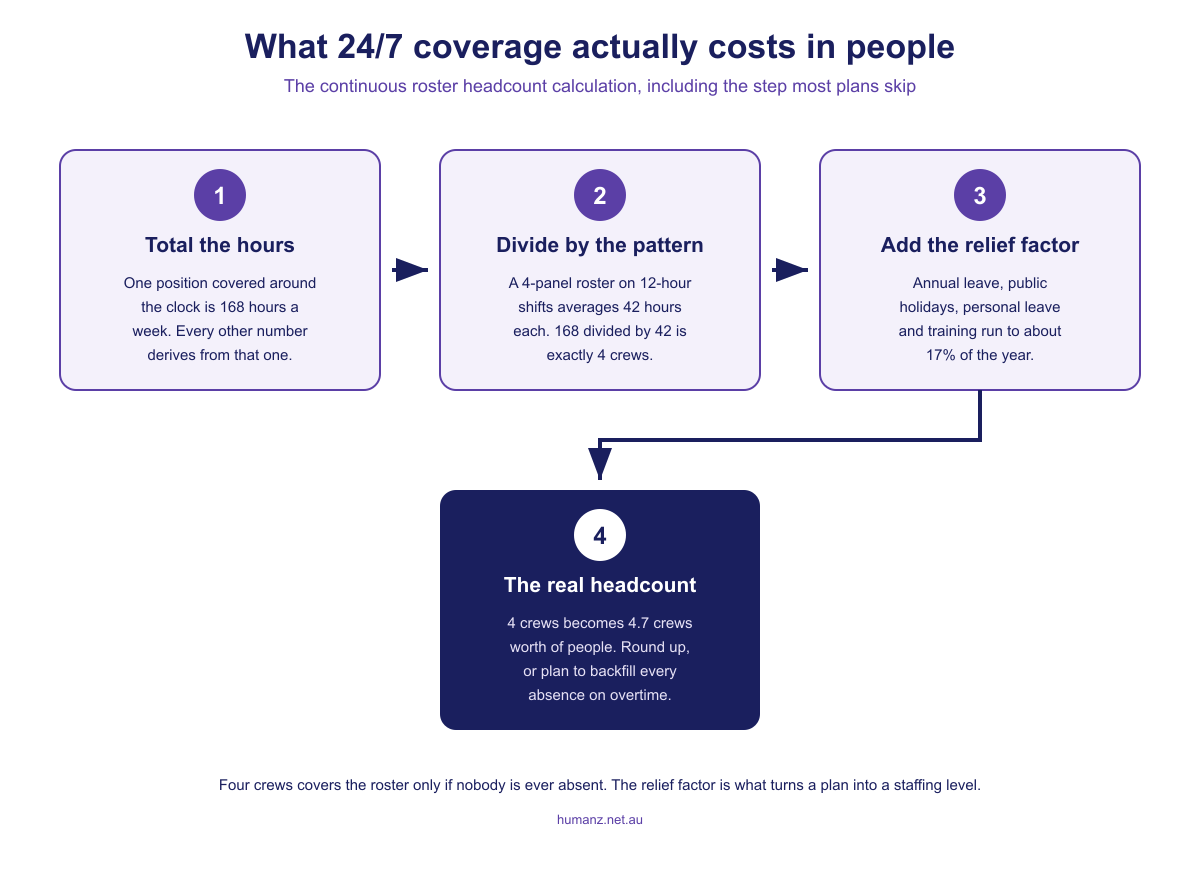
A single position covered 24 hours a day, 7 days a week, is 168 hours per week. That is the number everything else derives from.
Divide it by what one person actually contributes:
| Basis | Hours per person per week | People per position |
|---|---|---|
| 38 ordinary hours (the NES full-time standard) | 38 | 4.42 |
| 40 hours | 40 | 4.20 |
| 42 hours (typical 4-panel with 12-hour shifts) | 42 | 4.00 |
| 33.6 hours (typical 5-panel with 8-hour shifts) | 33.6 | 5.00 |
So before anything else, one position covered continuously needs somewhere between four and five people. Not three, and not “a couple of crews”.
That first row is worth sitting with. At the standard full-time week, continuous coverage of one seat costs you 4.42 full-time equivalents. Any structure that gives you exactly four people per position is, by construction, asking each of them to average more than 38 hours a week.
Why 12-hour shifts produce exactly four crews
The 4-panel structure is popular because the numbers land cleanly. Two 12-hour shifts per day covers 24 hours. Seven days gives fourteen shifts per week. Four crews rotating through those fourteen shifts means each crew averages 3.5 shifts per week, or 42 hours.
168 divided by 42 is exactly 4. No remainder, no awkward part-timer, and a pattern that repeats on a four-week cycle.
The catch is that 42-hour average. It sits four hours above the NES ordinary week, every week, forever. That is not unlawful, but it has to be handled deliberately: as overtime, as an annualised salary arrangement, or through an averaging provision in the applicable award or agreement. Operations that adopt a 4-panel roster without deciding which of those applies tend to discover the answer during a back-pay audit.
Eight-hour shifts avoid the overtime problem by needing five crews instead of four, at roughly 33.6 hours each. You pay for that in changeovers: three handovers a day instead of two, which on complex work is a real cost in lost continuity. We cover the trade-offs across common patterns in shift roster patterns in Australia.
The part everyone forgets: the relief factor
Here is where the four-crew answer breaks down.
Four crews covers the roster only if nobody is ever absent. Nobody takes annual leave, nobody gets sick, nobody attends training, nobody has a long service leave entitlement, and nobody resigns. Every one of those is guaranteed to happen, and the roster has no slack in it at all, because four crews were exactly enough.
The correction is called a relief factor, and it is a multiplier on your base crew number. Build it from the absences you can actually predict:
| Absence category | Typical allowance | As a share of the year |
|---|---|---|
| Annual leave (five weeks, see below) | 5 weeks | 9.6% |
| Public holidays | 10 to 12 days | ~4.2% |
| Personal and carer’s leave | 10 days | ~3.8% |
| Training, medicals, inductions | 2 to 5 days | ~1.2% |
| Total | ~19% |
The fifth week is the one people miss, and on a 24/7 roster it usually applies. Under the National Employment Standards a shift worker may be entitled to five weeks of annual leave rather than four, where they are regularly rostered on Sundays and public holidays. That describes most people on a continuous roster, which is the entire subject of this article. Check the definition against your award and your actual roster, because the difference is close to two points of relief factor and it compounds through every number below. Our guide to Fair Work compliance for shift workers covers the entitlement in more detail.
A 19% allowance gives a relief factor of about 1.19. Long service leave, parental leave and higher-than-average sick leave push it further. Operations in remote or high-turnover environments often work on 1.25 or more. If your workforce genuinely sits on four weeks, drop back to about 1.17 and carry that through consistently.
Apply that to the four crews and you get 4.8 crews’ worth of people to reliably staff a four-crew roster. You cannot roster 0.8 of a crew, so in practice this becomes either a fifth partial crew, a dedicated relief pool, or a standing acceptance that every absence is backfilled on overtime.
Most operations pick the third option by default, without ever deciding to. That is what “we are always short” actually means. It is also the national default. The ABS found 32% of employed people usually worked extra hours or overtime as at August 2024. Some of that is by design. A good share of it is a relief factor nobody calculated.
A worked example
A processing plant needs two operators on shift at all times, continuously.
Step 1. Total hours. Two positions, 168 hours each. That is 336 hours per week.
Step 2. Choose the pattern. A 4-panel roster on 12-hour shifts, averaging 42 hours per person per week.
Step 3. Base headcount. 336 divided by 42 equals 8 people. Four crews of two.
Step 4. Apply the relief factor. 8 multiplied by 1.19 equals 9.5 people.
Step 5. Decide how to round. Nine people means you are short in peak leave periods and will backfill on overtime through most of the year. Ten people means you are covered but carrying spare capacity some of the time.
Now run the version most businesses actually build: eight people, no relief allowance. The roster works perfectly on paper, and then someone takes their five weeks of annual leave. For those five weeks, seven people cover eight positions, which is roughly 52 shifts short across the period, every one of them filled by someone on their days off at overtime rates. Repeat for every employee’s leave, plus sick days, plus training.
The eight-person roster is not cheaper than the ten-person roster. It just moves the cost from base wages to overtime, and from a planned line item to an unplanned one.
If you want to run these numbers against your own shift length, coverage requirement and leave assumptions, the 24/7 crew coverage planner does the arithmetic including the relief factor.
Things that push the number higher
The calculation above is the floor. Several common conditions push real headcount above it.
Skill constraints. The maths assumes anyone can cover any shift. If only four of your ten people hold the ticket the night shift legally requires, your effective relief pool for nights is much smaller than the headline number suggests. Coverage has to be calculated per qualified role, not per body, the same way a staff roster gets filled by position and trade. This is where qualification and expiry tracking stops being administrative and starts being a planning input.
Fatigue limits. A relief pool that exists on paper cannot be used if calling those people in would breach a minimum break between shifts or a cap on consecutive days. Fatigue rules reduce usable relief capacity, particularly during the exact periods when you need it most, because a run of absences tends to concentrate overtime on whoever is available. The interaction between coverage and maximum hours worked in a row is the constraint that turns a staffing problem into a safety problem.
Geography. On FIFO and remote operations, relief is not a phone call. A backfill implies a flight and a camp bed, which means the relief factor has to be built into the mobilisation plan rather than solved on the day.
Turnover. A vacancy is a 100% absence for its whole duration. The national baseline is on record, with the ABS reporting that 7.2% of employed people, just over 1.0 million, changed employer or business in the year to February 2026, down from 7.7% the year before. Shift-heavy operations typically run well above either number. In an operation with 20% annual turnover and a two-month average time to fill, you carry roughly 3% permanent vacancy on top of everything else. Nor is the two-month fill assumption pessimism. In Jobs and Skills Australia’s July 2026 employer survey, 43% of those recruiting reported difficulty filling roles.
Coverage is a rostering problem, not a spreadsheet problem
The arithmetic here is simple enough to do once, by hand, on the back of an envelope. What is not simple is keeping it true.
Every leave request, resignation, ticket expiry and client change alters the coverage position. The static calculation you did in January describes a workforce that no longer exists by March. Operations that manage this well share three habits:
They roster against qualified availability, not headcount. The question is never “do we have ten people”, it is “do we have four people who can legally and safely work this shift, at this site, on this date”.
They see the shortfall before it happens. A forward roster that flags uncovered shifts weeks out converts an emergency into a scheduling decision. Rostering software built for continuous operations does this by evaluating coverage against the pattern rather than waiting for a gap to be noticed.
They measure what relief actually cost. The relief factor is an estimate. After a year of real data you know your actual absence rate, and it is rarely 17%. Businesses that track it stop guessing and start planning to their own number.
That last one is worth doing before your next enterprise agreement or client contract. Whether continuous coverage needs 4.4 or 5.3 people per position is a materially different cost base, and it is much easier to argue with twelve months of your own data than with an industry rule of thumb.
To model coverage against your real patterns, qualifications and leave profile rather than a generic example, walk through it with our team.
Frequently asked questions
How many staff do you need to cover a position 24 hours a day, 7 days a week?
Covering one position continuously requires 168 hours of work per week. Measured in full-time equivalents at the Australian standard of 38 ordinary hours, that is 4.42 FTE before any allowance for absence, or about 5.3 FTE once roughly 19% is added for leave, public holidays, personal leave and training. Measured in crews on a 4-panel roster averaging 42 hours, the same coverage is 4 crews before relief and about 4.8 after. The two figures describe the same operation on different bases, so always state which one you are quoting.
What is a relief factor in workforce planning?
A relief factor is a multiplier applied to base crew numbers to account for predictable absence. It is built from annual leave, public holidays, personal and carer’s leave, and training time. On a continuous roster, where shift workers are often entitled to five weeks of annual leave rather than four, those total around 19% of the year, giving a relief factor of about 1.19. Applied to a 4-panel roster averaging 42 hours, that means four crews needs roughly 4.8 crews’ worth of people to staff reliably.
Why do 12-hour shifts need four crews?
Two 12-hour shifts cover a full 24-hour day, giving fourteen shifts across a seven-day week. Four crews rotating through those fourteen shifts each average 3.5 shifts, or 42 hours per week. Since 168 divided by 42 is exactly four, the pattern divides cleanly, which is why 4-panel rosters are common in continuous operations.
How many crews do 8-hour shifts need for 24/7 coverage?
Five crews per position, at roughly 33.6 hours per person per week, against four crews on 12-hour shifts. Eight-hour shifts avoid the 42-hour average and the overtime question that comes with it, but you pay in changeovers: three handovers a day instead of two, which on complex work is a real cost in lost continuity.
Is it cheaper to run fewer crews and use overtime?
Usually not. Understaffing does not remove the hours that need covering, it moves them from ordinary rates to overtime rates and from planned cost to unplanned cost. It also concentrates additional hours on whoever is available, which increases fatigue exposure and turnover, both of which carry their own costs.
Why does a 4-panel 12-hour roster average more than 38 hours a week?
Because 168 hours of weekly coverage divided across four crews is 42 hours each by definition. That sits four hours above the National Employment Standards ordinary week, so the arrangement has to be handled deliberately through overtime, an annualised salary arrangement, or an averaging provision in the applicable award or agreement.
Do shift workers on a 24/7 roster get five weeks of annual leave?
Usually, yes. Under the National Employment Standards a shift worker regularly rostered on Sundays and public holidays may be entitled to five weeks of annual leave rather than four, and that describes most people on a continuous roster. Check the definition against your award and your actual roster, because the extra week is close to two points of relief factor and it compounds through every headcount number.
Related articles
Ready to see Humanz on your own roster?
Free 30-minute walkthrough, we'll use your real crews, sites and shift patterns.