
 Login
Login 

Compliance, Fatigue & Safety
How Many Hours Can You Legally Work in a Row in Australia?
By Christian Tietzel · 29 August 2026 · Updated 6 October 2026

There is no single legal maximum number of hours you can work in a row in Australia. The National Employment Standards cap ordinary hours at 38 a week plus reasonable additional hours, your award or agreement sets the daily shift limits, breaks and rest between shifts, WHS law requires fatigue to be managed whatever the award allows, and heavy vehicle drivers have hard limits of their own.
Someone asks this question about once a fortnight in every operations team in the country, usually at 4pm on a Friday when a crew has already done eleven hours and the job is not finished. The answer people expect is a number. A single legal maximum, printed somewhere on a government website, that settles the argument.
That number does not exist. Australia has no single national cap on how many hours you can work in one shift, or how many shifts you can work in a row. What it has instead is four separate systems that limit hours from different directions, and the one most people go looking for is the one that matters least in practice.
This guide covers what each system actually says, where the real limits come from, and how to make them hold in a roster rather than in a policy document nobody opens.
The short answer, before the detail
- No general legal maximum shift length applies across all Australian workplaces. A 14-hour shift is not automatically unlawful.
- The National Employment Standards cap ordinary hours at 38 per week plus “reasonable additional hours”. That is a weekly test, not a daily one, and “reasonable” is deliberately open.
- Your award or agreement is where daily limits usually live: maximum ordinary shift length, minimum breaks during a shift, and minimum rest between shifts.
- Work health and safety law is the real constraint. Fatigue is a hazard you have a duty to manage, and that duty applies regardless of what the award permits.
- Heavy vehicle drivers are the exception. They have hard, countable limits with numbers attached, because the law treats fatigued driving differently.
If you only take one thing from this article: the award tells you what you can roster, and WHS law tells you what you should. Those are different questions, and the second one is the one that gets tested after an incident.
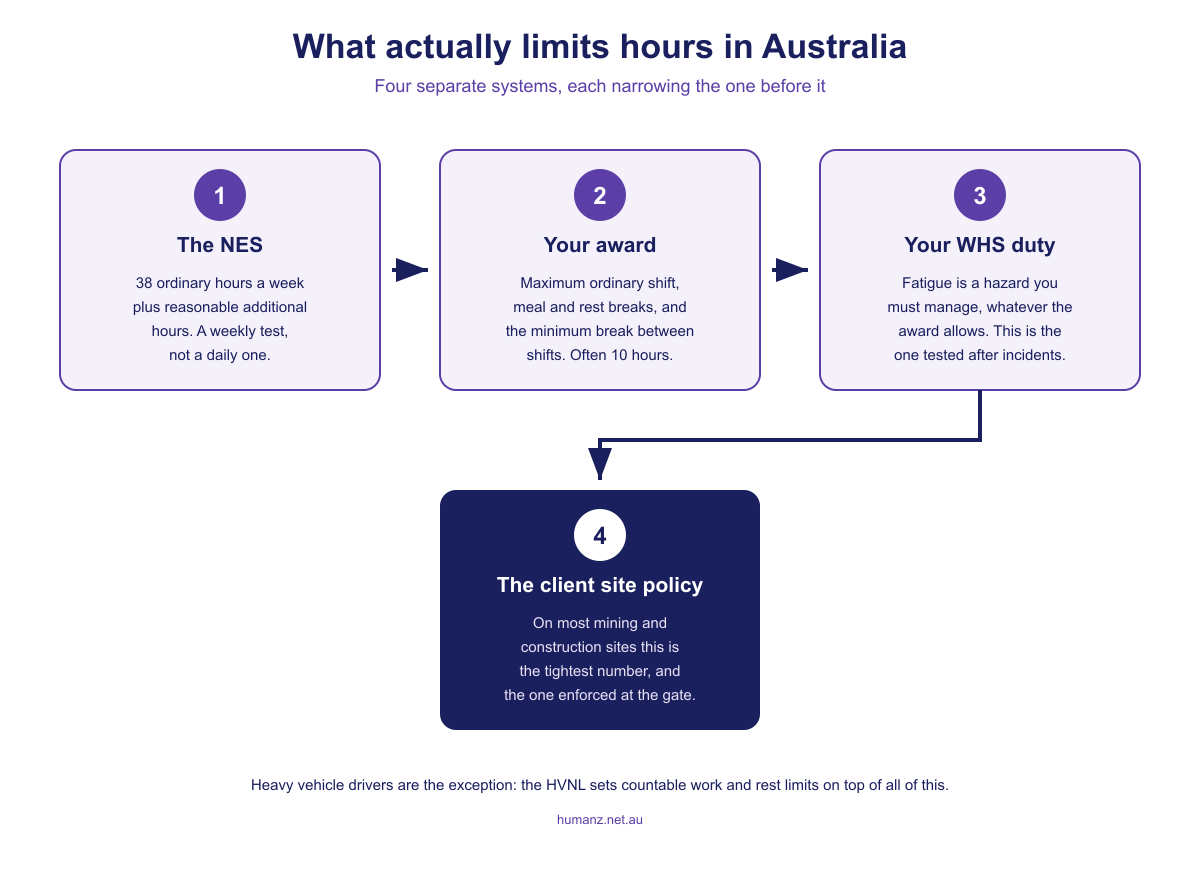
1. The National Employment Standards: a weekly test, not a daily one
The National Employment Standards set maximum weekly hours at 38 for a full-time employee, plus additional hours where those additional hours are reasonable. Part-time and casual employees are capped at the lesser of 38 hours or their ordinary weekly hours, plus reasonable additional hours.
Two things trip people up here.
It is a weekly figure. The NES does not say a shift must end at eight hours, or ten, or twelve. Four twelve-hour shifts in a week total 48 hours, which is more than 38, which puts you into “reasonable additional hours” territory. It does not put you into “unlawful” territory by itself.
“Reasonable” is a balancing test, not a threshold. The legislation lists the factors: risk to health and safety, the employee’s personal circumstances including family responsibilities, the operational requirements of the workplace, whether the employee is compensated for the extra hours, notice given, the employee’s role and level of responsibility, and industry custom. A 50-hour week on a shutdown with notice, penalty rates and a crew who signed up for it sits very differently from a 50-hour week sprung on a parent with school pickup at 3pm.
The practical read: the NES rarely settles a “can we roster this shift” argument on its own. It is the backstop, not the ruler.
2. Your award: where the daily numbers actually live
This is the layer most operations teams should be reading and most are not. Modern awards set the daily and weekly architecture, and they differ substantially between industries. The construction award, for one, averages its 38-hour week over a four-week cycle to build in a rostered day off. Some awards also let overtime be banked as time in lieu by written agreement, which changes how the overtime is compensated, not how many hours were worked.
Typical award provisions that bear on hours in a row:
| Provision | What it controls | Why it matters at 4pm on Friday |
|---|---|---|
| Maximum ordinary hours per shift | Often 8, 10 or 12 depending on the award and the shift arrangement | Hours beyond this are overtime, not ordinary time |
| Meal and rest breaks | Timing and length of unpaid meal breaks and paid rest breaks | A missed crib break can be a breach even on a legal-length shift |
| Minimum break between shifts | Commonly 10 hours, sometimes reducible to 8 by agreement | This is the one that quietly kills a late finish and an early start |
| Maximum consecutive days | Some awards cap days worked before a break | Relevant on shutdowns and swing rosters |
| Overtime and penalty triggers | When rates change | Cost, rather than legality, but it drives behaviour |
The break between shifts is the provision that catches out well-run businesses. A crew finishes at 11pm, and the roster has them back on at 6am. That is seven hours between shifts, which is inside almost nobody’s award. Nothing about that shift is individually too long. The problem is the gap, and the gap is invisible unless something is checking it.
Fair Work publishes the general position on hours of work, breaks and rosters and on breaks, but the binding detail is in your specific award. Read the one that covers your people, not a summary of awards in general.
3. WHS law: the limit that actually bites
Here is the part that reframes the whole question. Even where an award permits a 12-hour shift, and even where the employee has agreed to it, you retain a duty under work health and safety law to eliminate or minimise risks to health and safety so far as is reasonably practicable. Fatigue is one of those risks.
Safe Work Australia’s fatigue guidance treats work-related fatigue as a hazard to be managed like any other, and the factors it names are the ones a roster controls: shift length, timing of shifts, night work, consecutive shifts, breaks between shifts, and cumulative hours over days and weeks.
This is why “but the award allows it” is a weak position after an incident. The award sets industrial entitlements. WHS law sets a safety duty. A regulator investigating a 3am incident on the eleventh consecutive shift is not going to be satisfied by an award clause.
It is also why most large site owners impose fatigue rules well inside the award. On mining and major construction sites in particular, the client’s fatigue policy is usually the tightest number in the stack, and it is the one your crew will actually be held to at the gate.
4. Heavy vehicle drivers: the exception with real numbers
If your people drive a fatigue-regulated heavy vehicle, the picture changes completely. This is the one area of Australian work where the law does give you countable limits.
The Heavy Vehicle National Law sets maximum work times and minimum rest times across rolling periods, under three accreditation tiers: Standard Hours, Basic Fatigue Management and Advanced Fatigue Management. Each tier permits progressively more work time in exchange for progressively more rigorous management. The limits are counted over multiple overlapping windows at once, which is precisely why they are hard to check by eye.
The numbers are specific, they differ by tier and by solo or two-up operation, and they are revised from time to time, so the sensible move is to work from the source rather than from a table in a blog post. The NHVR publishes the current work and rest requirements in full.
Two practical notes. The HVNL applies in most states and territories but not in Western Australia or the Northern Territory, which run their own heavy vehicle fatigue arrangements. And these obligations sit on top of everything above, not instead of it: a driver is still an employee with an award and you still have a WHS duty.
We cover the operational side of this in fatigue risk management software for transport.
So what is the actual maximum?
For most Australian workplaces, the honest formulation is this: the maximum is whatever your award allows, reduced by whatever your WHS risk assessment says is safe for that work, that time of day and that point in the roster cycle, and reduced again by whatever your client’s site policy imposes.
That produces different answers for different crews in the same business on the same day, which is unsatisfying if you wanted a number, and completely correct.
A worked example. A civil crew on a standard day shift, well rested, doing low-risk work, might reasonably run a 12-hour day. The same crew, on their sixth consecutive 12-hour shift, on nights, operating plant, is a materially different risk even though every individual shift is the same length. Nothing in the award distinguishes those two situations. Your fatigue policy has to.
If you want to sanity check a pattern before you commit to it, the fatigue hours checker on this site runs a proposed set of shifts against common limits and shows where the breaches land.
Where the numbers should live
The recurring failure in all of this is not ignorance of the rules. Most operations managers know roughly what their award says. The failure is that the rules live in a document and the roster lives somewhere else, so the check depends on a human remembering the right number at the worst possible moment.
Three things make the difference in practice.
Put the limits in the roster, not in a policy. The moment of risk is the moment of allocation: the 9pm backfill of tomorrow’s shift, made by someone covering for the usual planner. A limit that is enforced when the booking is created never relies on recall. A limit written in a PDF always does.
Layer the policies and let the strictest win. Most operations have at least three sets of rules running at once: the award, the company standard, and the client site’s policy. They do not agree, and the applicable rule changes depending on which site the shift is at. Systems that only support one flat set of rules force planners to remember the exceptions, which defeats the point. Fatigue management software that evaluates layered policies at rostering time applies the tightest applicable rule automatically.
Count across the boundary, not inside it. Fatigue does not reset on Monday morning or at the end of a pay period. Rolling windows of 7, 14 and 28 days are the ones that catch cumulative overload, and they are the ones spreadsheets handle worst, because the calculation changes with every shift you move. The population this matters for is not small. The ABS Working Arrangements figures put 2.0 million employees, 17% of all of them, on hours that vary from week to week, and those are precisely the workers whose rolling totals nobody is adding up by hand.
There is a reporting benefit too, and it is not a small one. When a client, an insurer or a regulator asks how you knew a crew was inside their limits, “we checked at the time and here is the record” is a completely different conversation to reconstructing it afterwards from timesheets.
What to do this week
If you want to move from “we think we are fine” to “we can show we are fine”, the order that works is:
- Find your actual award and write down four numbers: maximum ordinary shift length, minimum break between shifts, meal break requirements, and any cap on consecutive days.
- Add your clients’ site policies next to them. On multi-client operations this is where the tightest numbers usually are.
- Check the last four weeks of real rosters against those numbers. Not the planned roster, the worked one. The gap between the two is the finding.
- Fix the enforcement point. If the check happens after the fact, it is reporting. If it happens at allocation, it is control.
Most businesses that run this exercise find the same thing: shift length was never really the problem. Breaks between shifts and cumulative days were.
If you want to see how layered fatigue rules behave against your own roster patterns rather than a demo dataset, walk through it with our team.
Frequently asked questions
Is there a legal maximum number of hours you can work in one shift in Australia?
There is no single national maximum shift length that applies to all Australian workplaces. Maximum ordinary hours per shift are set by the relevant modern award or enterprise agreement, and typically sit at 8, 10 or 12 hours depending on the industry and shift arrangement. Separately, work health and safety law requires employers to manage fatigue risk regardless of what the award permits.
How many days in a row can you legally work in Australia?
There’s no single national cap on consecutive days worked. Some modern awards limit days worked before a break, particularly relevant on shutdowns and swing rosters, and the exact provision depends on the award covering the employee. On top of that sits the WHS duty to manage fatigue, which treats consecutive shifts and cumulative hours as risks regardless of what the award technically permits, and most large site owners impose tighter fatigue rules of their own.
Is a 12-hour shift legal in Australia?
Generally yes, where the applicable award or enterprise agreement permits it. Many awards allow ordinary shifts of up to 12 hours under specific shift arrangements, and even longer shifts aren’t automatically unlawful. Legality isn’t the whole question, though, because the employer’s WHS duty to manage fatigue applies regardless, and a 12-hour shift at the end of a long run of them is a materially different risk even when every individual shift sits inside the award.
How many hours must you have off between shifts in Australia?
The minimum break between shifts is set by your award or agreement rather than by a single national rule. Ten hours is a common minimum in many modern awards, sometimes reducible to eight hours by agreement in defined circumstances. Because this is an award-level provision, the exact figure depends on which award covers the employee, so check the specific instrument rather than relying on a general figure.
What are reasonable additional hours under the National Employment Standards?
The National Employment Standards allow an employer to request additional hours beyond 38 per week where those hours are reasonable. Reasonableness is assessed against factors including health and safety risk, the employee’s personal circumstances and family responsibilities, operational requirements, whether extra compensation applies, the notice given, and the employee’s level of responsibility. It is a balancing test, so the same number of hours can be reasonable in one situation and unreasonable in another.
Do heavy vehicle drivers have different hours limits?
Yes. Drivers of fatigue-regulated heavy vehicles are subject to the Heavy Vehicle National Law, which sets specific maximum work times and minimum rest times across multiple rolling periods, varying by accreditation tier and whether the driver operates solo or two-up. As an anchor, the NHVR’s Standard Hours option caps a solo driver at 12 hours of work time in any 24-hour period and 72 hours in any seven days, with at least seven continuous hours of stationary rest. These limits apply in addition to award entitlements and work health and safety duties. Western Australia and the Northern Territory operate separate heavy vehicle fatigue arrangements.
Can an employee agree to work longer hours than the award allows?
Agreement does not remove an employer’s work health and safety duty to manage fatigue risk, and it cannot override entitlements that an award or the National Employment Standards guarantee. Some award provisions, such as reducing a break between shifts, can be varied by agreement in defined circumstances, but the scope to do so is set by the award itself. Consent is never a substitute for a fatigue risk assessment.
Related articles
Ready to see Humanz on your own roster?
Free 30-minute walkthrough, we'll use your real crews, sites and shift patterns.