
 Login
Login 

Compliance, Fatigue & Safety
How to write a fatigue management plan your crews will actually follow
By Christian Tietzel · 6 August 2026 · Updated 14 September 2026

Somewhere in your business there is probably a fatigue document. It was written for a tender a few years back, it mentions “adequate rest” several times, and nobody on a crew has read it since. That document is not a fatigue management plan. A fatigue management plan is the thing that decides, at 9pm on a Tuesday, whether the fitter who knocked off at 6pm can take the 4am callout. If your document can’t answer that question with a number, it’s decoration.
This guide covers what a real plan contains, the numbers in it, and how to roll it out so crews follow it. It’s written for Australian field and site businesses (mining services, civil, trades, labour hire, transport) where long shifts, nights and remote commutes are the job, not the exception.
What a fatigue management plan is, and who needs one
Under the model WHS laws, fatigue is a foreseeable hazard, and a business has a duty to manage the risk it creates so far as is reasonably practicable. Where that duty sits inside the wider compliance picture is covered in WHS compliance software in Australia. Safe Work Australia says businesses must eliminate or minimise the risk of fatigue so far as is reasonably practicable, and in September 2025 it published a model Code of Practice: Managing the risk of fatigue at work. A model code carries legal weight only where a jurisdiction approves it, and Tasmania, New South Wales and the Northern Territory had done so by March 2026. Elsewhere regulators assess you against the duty and the guidance, and mining and resources jurisdictions go further, with working-hours codes and legislated fatigue requirements. If your crews touch heavy vehicles, the NHVR’s fatigue management rules add prescriptive work and rest hours on top.
The second driver is commercial, and it usually bites first. Site owners and principal contractors ask for your fatigue management plan at prequalification, and “we have a policy” doesn’t pass. No plan, no start date.
Who actually needs one? Any business where shifts run past ten hours, anyone works nights, the commute is long enough to matter (a 90-minute drive each way is three hours the roster can’t see), or tired people operate plant, drive vehicles or work at height. If that’s your operation, the question isn’t whether you need a plan; it’s whether the one you have does anything.
A plan, a policy and an FRMS are three different documents
These terms get used interchangeably, which is how businesses end up with the wrong one.
| Document | What it is | Length | Who needs it |
|---|---|---|---|
| Fatigue policy | A statement of commitment: we recognise the risk, we’ll manage it, here’s who’s responsible | 1–2 pages | Everyone. It’s the cover sheet, not the substance |
| Fatigue management plan | The operational document: limits with numbers, controls at rostering and on the day, escalation triggers, individual assessment, records | 5–15 pages | Any business with shift work, nights, long hours or long commutes |
| FRMS (fatigue risk management system) | A full management system: governance, data, training, audit and continuous improvement wrapped around the plan | A system, not a document | Large or safety-critical operations; required for NHVR advanced fatigue accreditation |
Most businesses shopping for an FRMS need a plan; most with a plan need one that works. The policy takes an afternoon; the plan is the rest of this article.
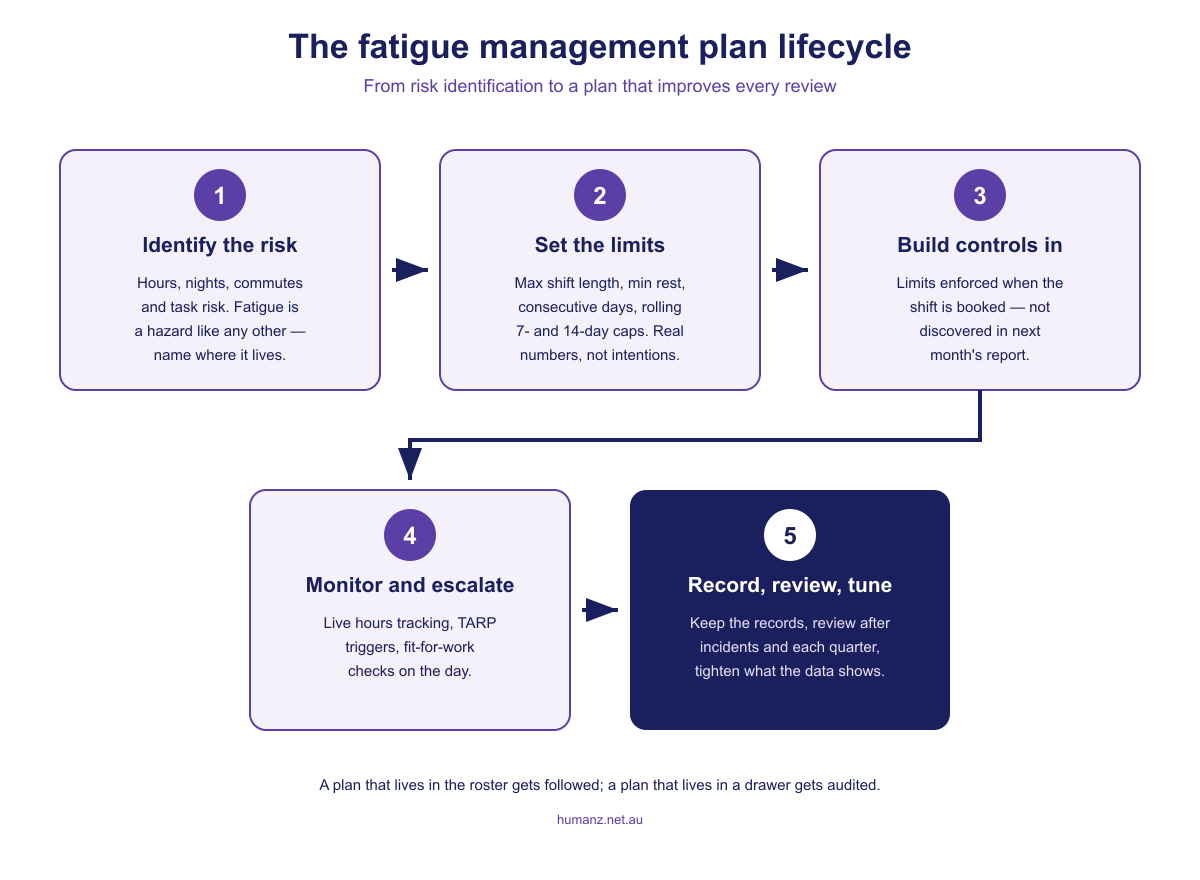
What goes in the plan
Start with your actual risks, not a template
Searching “fatigue management plan template” gets you headings. Headings are fine (the sections below are that template), but the plan’s value is the numbers, and the numbers come from your operation. Before writing limits, spend an honest hour on four questions:
- Hours. Find your longest real days: not the rostered 10, but the 10 plus the breakdown that pushed it to 13. Pull six months of timesheets and look at the top decile, not the average.
- Nights. Who works them, in what runs, and how do crews rotate back to days? The body clock doesn’t care that the roster looked fine on paper.
- Commutes. Drive-in drive-out distances, FIFO travel days, the ute hours either side of shift. A compliant 12-hour shift with a 2-hour drive each end is a 16-hour day ending with the most dangerous drive of the week.
- Task risk. An hour of fatigue in an excavator cab, behind the wheel or on a rope is not an hour of fatigue in the site office. Your controls should know the difference.
The output is a short list of genuinely risky combinations (night shift plus callout eligibility, shutdown overtime plus DIDO commutes) that the rest of the plan exists to control.
The limits, with numbers attached
This is the heart of the plan and the part most documents dodge. “Workers should obtain adequate rest” is not a limit. A limit is a number a supervisor can check at 9pm without interpreting anything. Here’s the shape of a sensible set for a 12-hour site operation:
| Limit | Example number | Why it exists |
|---|---|---|
| Maximum shift length | 12 hours, extendable to 14 once with documented approval | Error rates climb steeply past 12; two 14s in a row is how incidents happen |
| Maximum door-to-door day | 14 hours including commute | The roster can’t see the drive unless you count it |
| Minimum break between shifts | 10 hours, 12 after the final night of a run | Ten hours off is about seven hours of sleep after the drive, dinner and life |
| Maximum consecutive shifts | 7 days; 5 nights | Sleep debt compounds; nights compound faster |
| Rolling hours cap | 60 hours in any 7 days (10-hour ops) or 84 (12-hour swing ops) | Catches the death-by-overtime pattern that per-shift limits miss |
| Night-to-day turnaround | Minimum 48 hours off after the last night before the first day shift | Flipping the body clock takes more than a sleep-in |
Two things make limits survive contact with reality. First, an approved-exception path: a hard “never” that gets broken weekly teaches crews the whole plan is optional, so better a 12-hour limit with a documented 14-hour exception than one everyone ignores. Second, plurality: your baseline plus each client’s stricter overlay, because Client A’s site rules don’t apply at Client B’s. How to layer those without maintaining five contradictory documents is covered in our guide to layered fatigue policies and expiry alerts.
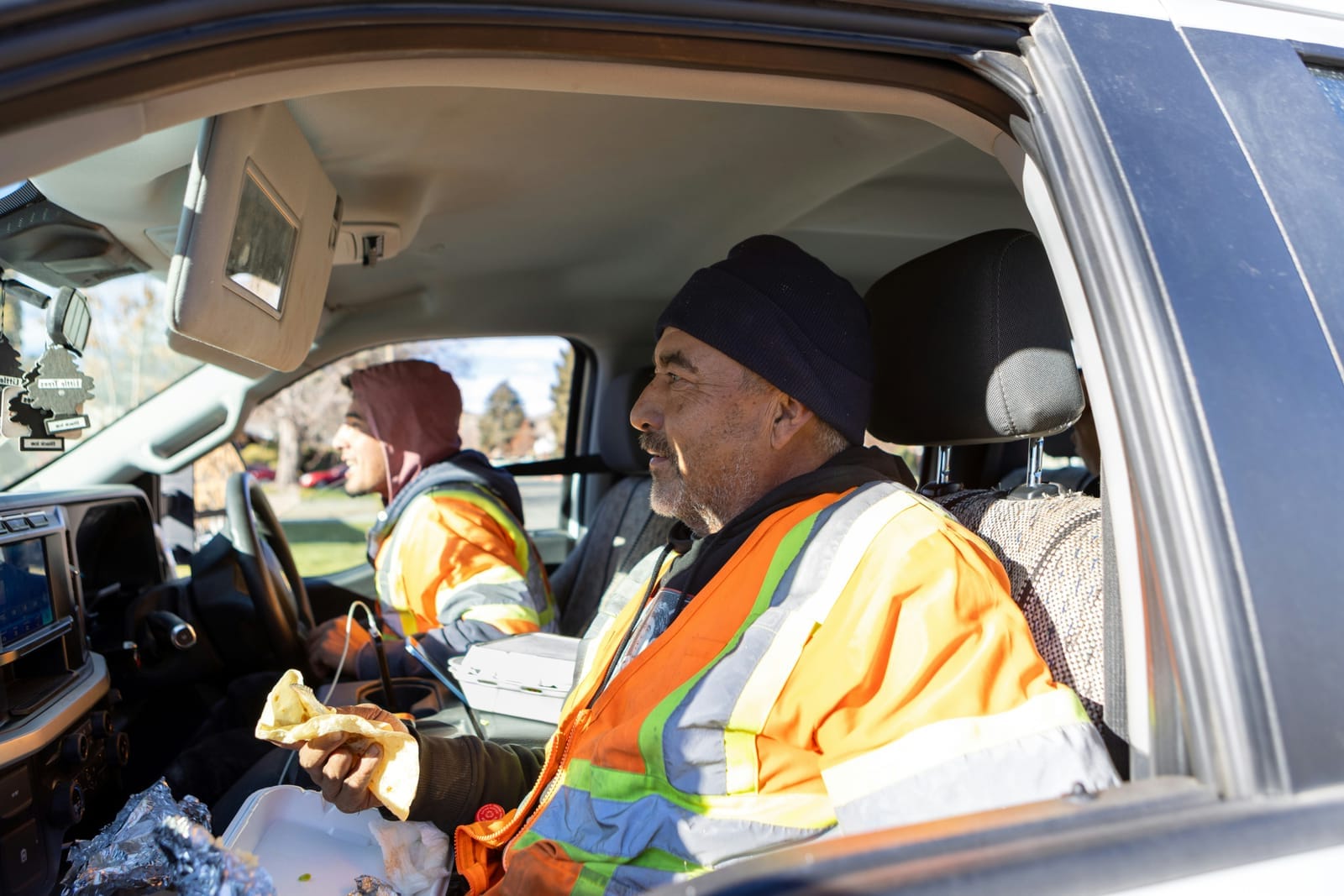
To pressure-test numbers before committing, the free fatigue hours checker runs 14 days of shifts against limits you set and shows what breaches.
Controls at rostering time versus on the day
A good plan separates two moments, because different people hold the controls at each.
At rostering time, the planner controls roster pattern design: build rosters that fit inside the limits by construction, rotate nights forward (days, then afternoons, then nights), avoid quick returns where an evening finish meets a morning start, and place travel days so a FIFO worker’s first shift doesn’t start six hours after wheels-down. Ninety per cent of fatigue management is won or lost here, quietly, before anyone is tired.
On the day, the supervisor controls the exceptions: the breakdown that stretches a shift, the sick call that tempts a double, the 4am callout. The plan needs an extension-approval rule (who can authorise past 12 hours and what they check first), callout logic (a callout counts toward hours, and the minimum break applies after it), and a journey rule (past a threshold, say a 14-hour day, the worker doesn’t drive home; a swag, a room or a lift is cheaper than the alternative). The journey rule has numbers behind it. Fatigue accounts for around 20% of road deaths in NSW each year on Transport for NSW’s figures, and a fatigue-related crash is twice as likely to be fatal. The riskiest part of a stretched shift is often the drive at the end of it.
Paper plans usually cover the first moment and abandon the supervisor at the second, and the 9pm decision is the one that needed the plan.
TARP-style escalation: what happens when a trigger trips
Borrow the structure mining already uses for everything else: a TARP, or trigger action response plan. Instead of “manage fatigue”, a TARP defines levels, the triggers between them, and the role that acts at each:
- Green: normal operations. Rostered and actual hours inside all limits; no action needed.
- Amber: trigger tripped. A shift is heading past 12 hours, a break fell below 10, or a worker reports poor sleep at pre-start. Action: the supervisor does a documented assessment and applies controls, such as moving the worker off high-risk tasks, pairing them up, scheduling a break or bringing the finish forward. Work continues, modified.
- Red: hard limit breached or worker unfit. Sixteen-plus hours awake, a rolling cap exceeded, or a worker who’s clearly not right. Action: stop safety-critical work for that person, rest before any driving, managed transport if needed, and a record of what happened and why.
The discipline of a TARP is that every level names a role. If your escalation says “notify management”, nobody will. If it says “the shift supervisor stands the worker down and notifies the project manager before the next shift is confirmed”, someone will.
Fit for work: the individual layer
A roster can be fully compliant and a worker still dangerously fatigued: the new baby, the second job, the flu, the camp room next to the generator. So the plan needs an individual layer, a fit-for-work check that catches what the roster can’t see. The gap is wider than most plans assume. The Sleep Health Foundation estimated in its 2016-17 Asleep on the Job report that 39.8% of Australian adults experience some form of inadequate sleep. On a crew of ten, that’s roughly four people who didn’t sleep properly, whatever the roster allowed.
The standard approach is a pre-start self-assessment with a sleep threshold, kept simple enough to actually happen: fewer than 5 hours’ sleep in the last 24, or fewer than 12 in the last 48, triggers the amber response above (a conversation and modified duties, not an inquisition). Supervisors back it up with observation, because the person most impaired by fatigue is reliably the worst judge of it. And the whole layer only works if reporting fatigue is cost-free: no docked hours, no quiet reputation damage, no “harden up”. One sarcastic response at pre-start will buy you years of confident nods from exhausted people.
Records and review
If it isn’t written down, it didn’t happen, and in an incident investigation, it happened the worst possible way. The plan should name what gets kept: rostered versus actual hours, extension approvals with who signed them, TARP activations and what was done, fit-for-work declarations, and the link from any incident to the hours worked beforehand. Comcare’s fatigue guidance makes the underlying point: fatigue is more than feeling tired. It’s a state of exhaustion that erodes safe performance well before anyone reports it, which is exactly why records matter more than recollections.
Set a review cadence in the plan itself: annually as a floor, plus after any fatigue-related incident or near miss, any roster pattern change, and any new client whose site rules differ from yours. A plan with a version number and a review date reads like a living document. A plan whose only date is 2021 reads like what it is.
The template question
Most people land on this topic hunting for a fatigue management plan template, so here’s the straight answer on what a template is worth. The structure transfers. The content doesn’t.
A good template saves you inventing the skeleton: purpose, scope, risk assessment, limits, controls, escalation, fit-for-work, records, review. Every plan needs those sections and there’s no prize for rediscovering them. What a template cannot supply is the part an auditor actually reads. Your operations’ real risks, your sites’ real patterns, limits with numbers your rosters can genuinely hold, and an escalation path naming people who exist. A downloaded plan with another industry’s assumptions still inside it is arguably worse than no plan, because it documents that fatigue was considered and then ignored.
So use a template the way you’d use formwork. Borrow the shape, pour your own numbers, and strip anything you can’t defend in a conversation with a regulator. If a section survives from the template word for word, that’s usually the section that hasn’t been thought about yet.
Rolling it out without the eye-rolls
Crews can smell a compliance artefact at fifty metres. A few things separate the plans that get followed:
Consult before you finalise. WHS consultation duties aside, your crews know exactly where the fatigue risk lives (which callout patterns hurt, which camp rooms nobody sleeps in), and a plan that reflects that knowledge gets defended by the people who contributed to it.
Keep the crew-facing version to one card. The full plan can run fifteen pages for the auditors. The crew version is five or six rules on a pocket card or a phone screen: the shift cap, the break minimum, the consecutive-days limit, the sleep threshold, who to tell. Nobody follows page eleven.
Apply it to supervisors first. The fastest way to kill a fatigue plan is a supervisor doing 16-hour days while enforcing 12s on everyone else. If leadership hours are visibly inside the limits, the argument is over before it starts.
Explain the why with one number. Seventeen hours awake produces impairment comparable to a blood alcohol content of 0.05, a level at which nobody on your crew would be allowed to drive the ute, let alone operate the excavator. That comparison does more work in a pre-start brief than any policy paragraph.
Brief it, don’t attach it. A plan launched as a PDF in an email has a readership of zero. Ten minutes at pre-start, the card, and the first visible instance of a supervisor actually applying the amber response: that’s a rollout.
Where software enforces it, and paper doesn’t
Here’s the structural problem with even a well-written paper plan: it depends on someone remembering the limits at the moment of allocation, and the moment of allocation is 9pm, on a phone, while backfilling tomorrow’s night shift.
Fatigue management software moves the plan into the roster. The limits become policies configured once: your baseline, plus each client’s stricter overlay applied to their sites. Every booking is checked against the applicable policy as it’s made, whether the person on it is an employee or one of the subcontractors working to your fatigue policy, so the non-compliant shift gets flagged before it’s confirmed instead of discovered in next month’s report. Extension approvals become a workflow with a name and timestamp attached. And the records section of your plan largely writes itself, because hours, breaches and approvals accumulate as a by-product of running the roster, not as a separate admin job that stops happening in a busy fortnight.
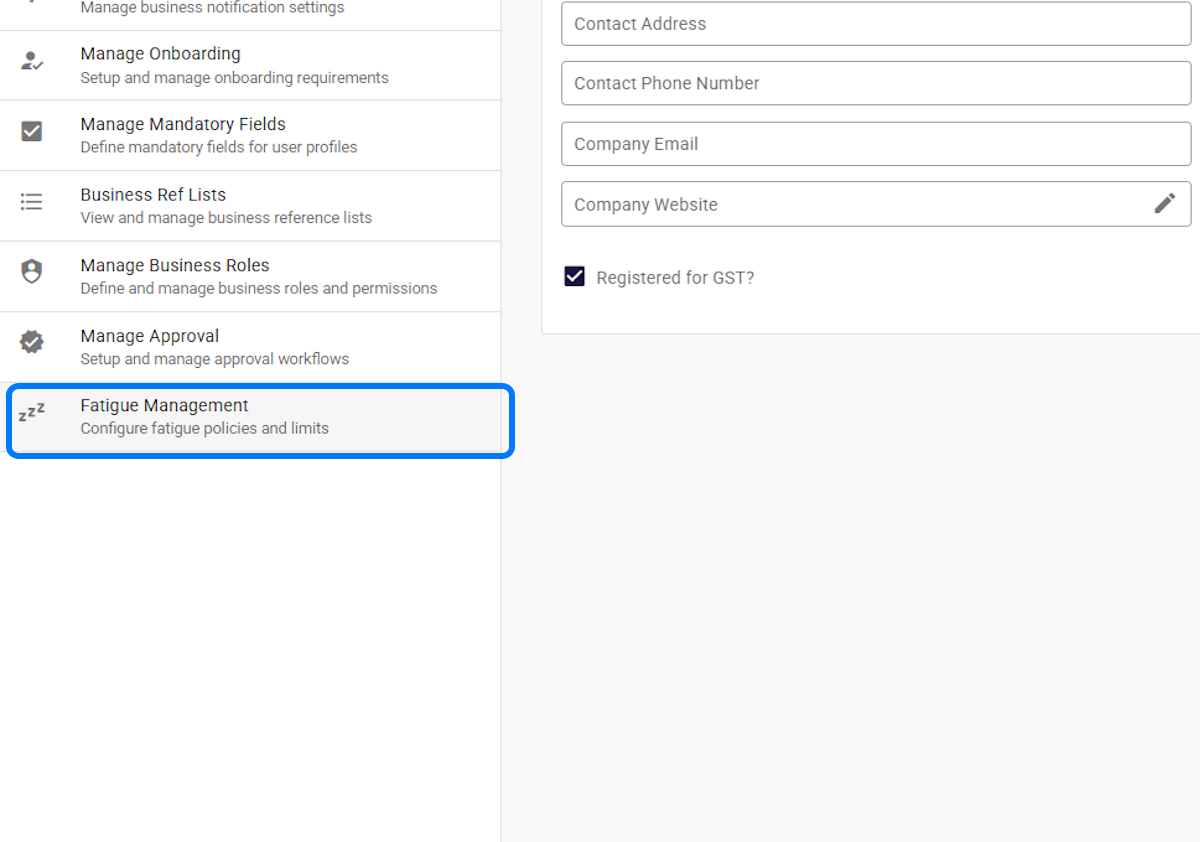
In practice the plan-to-software translation is a configuration screen rather than a project. Fatigue management sits in the business settings beside onboarding and approvals, and the policies configured there are the same numbers your plan already contains, entered once and applied everywhere.
None of that replaces the plan. You still need the document, the risk assessment, the TARP and the consultation. What software replaces is the assumption that humans will run compliance checks reliably at the worst possible moments. The full enforcement picture is in our guide to fatigue management software in Australia; if you run heavy vehicles under NHVR work and rest hours, see fatigue risk management software for transport.
The honest summary: a paper plan is better than no plan, and a plan enforced at rostering time is better than both, by roughly the distance between “we have a document” and “we don’t roster breaches”.
Frequently asked questions
What is a fatigue management plan?
A fatigue management plan is an operational document setting out how a business manages the safety risk of worker fatigue: the hour and rest limits, the controls at rostering time and during shifts, escalation steps when limits are approached, individual fitness-for-work assessment, and the records kept. It sits between a short fatigue policy and a full fatigue risk management system, and it’s the document clients and regulators actually ask to see.
Is a fatigue management plan a legal requirement in Australia?
The model WHS laws don’t name a specific document, but they require businesses to manage fatigue as a foreseeable risk, and a written plan is the practical evidence that you do. Mining and resources regulators expect documented fatigue management, and heavy vehicle operations are subject to prescriptive NHVR work and rest requirements. In practice, client prequalification makes a written plan effectively mandatory for most site businesses anyway.
What should the limits in a fatigue management plan be?
They should come from your own risk assessment, but common starting points for Australian site work are a 12-hour maximum shift, a 10-hour minimum break, around 7 consecutive shifts with fewer for nights, and rolling caps on hours over 7 and 14 days. Count commute time in the daily total, and include a documented exception process; a limit that gets silently broken teaches crews the plan is optional.
Should commute time count towards fatigue limits?
Yes. A compliant 12-hour shift with a two-hour drive at each end is a 16-hour day, ending with the most dangerous drive of the week, and the roster can’t see any of it unless the plan counts it. A door-to-door daily limit that includes the commute is the practical fix, alongside a journey rule so that past a set threshold the worker doesn’t drive home.
What’s the difference between a fatigue management plan and a fatigue policy?
A policy is one or two pages stating that the business recognises fatigue as a risk and commits to managing it. The plan is the working document underneath: the actual numbers, rostering controls, escalation triggers, fit-for-work checks and record-keeping. Most businesses have the policy; the gap that audits and incidents expose is almost always the plan.
Is a fatigue management plan template worth using?
For the structure, yes. The section headings transfer between businesses, and there’s no prize for reinventing them. What a template can’t supply is the content an auditor actually reads: your operation’s real risks, limits your rosters can genuinely hold, and an escalation path naming people who exist. A downloaded plan with another industry’s assumptions still inside it is arguably worse than no plan at all.
How often should a fatigue management plan be reviewed?
Annually at minimum, and immediately after any fatigue-related incident or near miss, any significant change to roster patterns or shift lengths, and any new client or site whose fatigue rules differ from yours. Reviews should look at actual hours, breaches, exceptions and TARP activations, not just re-read the document.
Related articles
Ready to see Humanz on your own roster?
Free 30-minute walkthrough, we'll use your real crews, sites and shift patterns.