
 Login
Login 

Safety Systems & Forms
Toolbox Talks and Prestart Meetings: What to Cover, How to Record Them, and a Free Planner
By Christian Tietzel · 23 September 2026

A toolbox talk is a short safety meeting, usually five to ten minutes, held with a crew on site about one hazard and the controls for it, with attendance recorded. A prestart meeting (or pre-start) is the daily version: the supervisor runs the crew through today’s tasks, the hazards of each, the permits, the plant and who is on site, before work starts. No Australian WHS law requires either by name. What the law requires is consultation with workers and suitable instruction, and both meetings are how most crews do it.
This guide covers what each meeting is for, what the model WHS laws actually ask, a ten-minute structure that works standing up, a topic calendar tied to real site risks and the Australian seasons, the heat rules, and what to record. It ends with a free toolbox talk planner and printable templates on our tools page. It is general information, not safety advice for a specific site. Confirm the rules with the WHS regulator where the work happens and with your principal contractor.
Toolbox talk, prestart and site induction: three different jobs
| Site induction | Prestart meeting | Toolbox talk | |
|---|---|---|---|
| When | Once, before a person starts on the site | Daily, before work starts | Regularly, often weekly, or when a risk changes |
| Who runs it | The principal contractor or site manager | The supervisor of the crew | A supervisor, leading hand or safety adviser |
| What it covers | This site’s rules, hazards, emergency plan and who is who | Today’s tasks, hazards, permits, plant, weather, new starters, fit for work | One topic in depth: a hazard, a recent incident, a season, a rule change |
| Length | As long as the site needs | Five to ten minutes | Five to ten minutes, fifteen at most |
| The record | Induction register and the worker’s signed acknowledgement | Prestart sheet with attendees | Topic, points, questions, actions, attendees |
The induction is separate from the other two, and for construction it has two layers. Before any construction work, a worker must have completed general construction induction training, the White Card; Safe Work Australia is explicit that it is required before starting on a construction site. The site-specific induction then covers this site: WorkSafe ACT treats it as the thing that happens before a person enters an operational construction zone, and lists toolbox talks only as one way to deliver some of its content. Our construction compliance checklist answers what separates a site induction from a pre-start check in its FAQ.
What the law requires, and what it does not
The model WHS Act, adopted in every jurisdiction except Victoria, does not contain the words “toolbox” or “prestart”. Two duties do the work instead. The primary duty in section 19 includes providing any information, training, instruction or supervision necessary to protect people from the risks of the work, and regulation 39 requires that the information, training and instruction be suitable and adequate for the work, its risks and its controls, and provided in a way that is readily understandable. Then sections 47 to 49 set the consultation duty: a business must consult, so far as is reasonably practicable, with the workers directly affected by a health and safety matter, and consultation means sharing the relevant information, giving workers a reasonable opportunity to express their views and raise issues, taking those views into account, and telling them the outcome. It applies when identifying hazards, deciding controls, proposing changes, and deciding how information and training will be provided.
Regulators across the country name toolbox talks as an accepted way to do that. Safe Work Australia’s consultation page says there is no set way that consultation must occur and that it can happen through usual communications like team meetings and toolbox talks. SafeWork NSW’s duty to consult page describes regular meetings of all staff, “sometimes called toolbox talks”, and adds that consultation must be regular and ongoing. WorkSafe Victoria, under its own OHS Act, lists tool box talks among the meetings an employer can use to consult. Comcare defines a tool box talk as an informal safety meeting on the specific job’s hazards, normally short and held at the job site before the job or shift starts.
Three things follow. First, a toolbox talk is not a legal requirement, so a vendor page that says it is, or that one is required daily or before every shift, is wrong, unless it is describing a principal contractor’s site rules or a contract, which can and often do make a daily prestart mandatory on that site; a business that consults and instructs some other way is compliant with the law. Second, a toolbox talk only discharges the consultation duty if the crew gets to speak: a supervisor reading a sheet at a silent crew has given instruction, not consultation. Third, the record is what proves either happened. On construction projects worth $250,000 or more, where the WHS Regulation requires a written WHS management plan with the arrangements for consultation, cooperation and coordination in it (SafeWork NSW sets out what goes in one), WorkSafe ACT says those arrangements can include pre-start briefings and toolbox talks, and that records should show the topics discussed, the dates and the names of the people attending.
The ten-minute toolbox talk
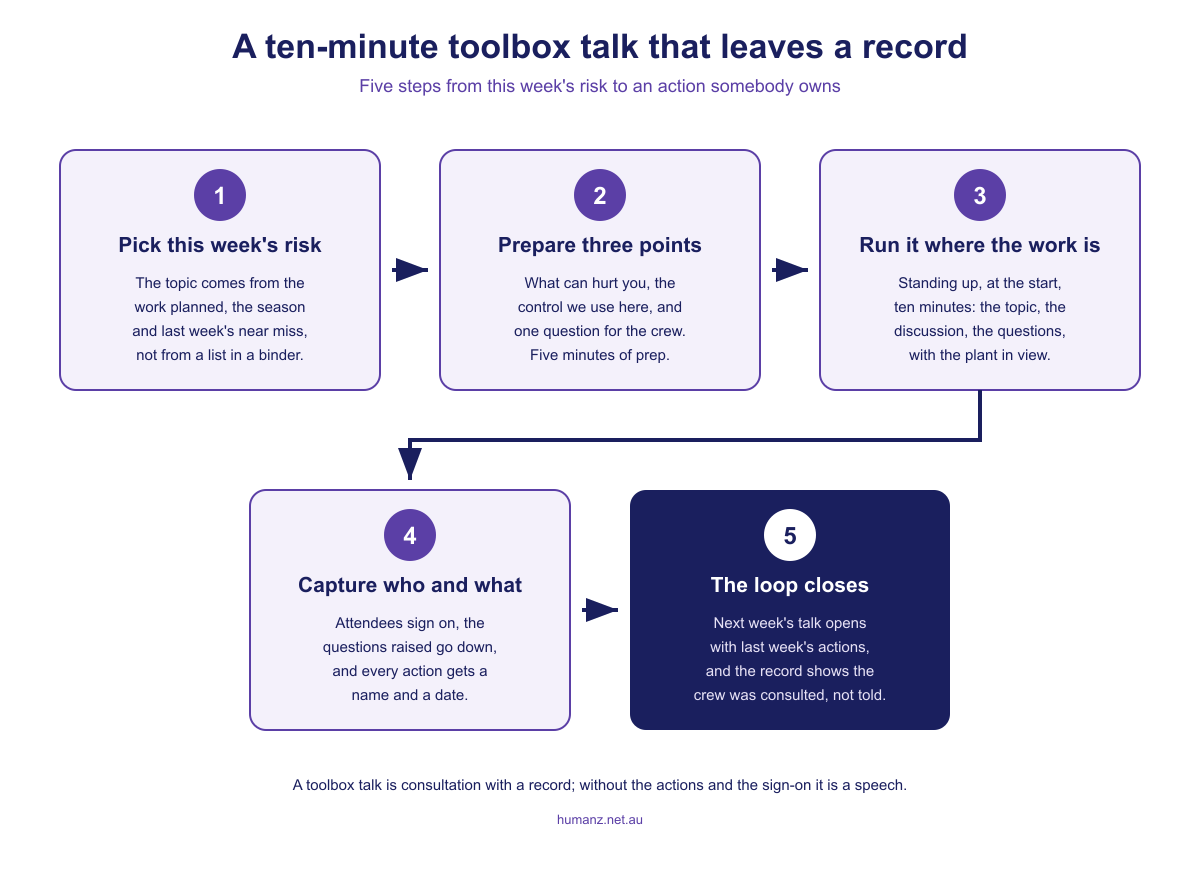
WorkSafe WA’s guidance for small business describes the talk most crews actually run: about five to ten minutes, before the workday or the shift or at a break, attendance compulsory, a signed log for each session, and a request for ideas and feedback from the people in it. The structure that fits that time:
- Pick the risk that is real this week. The topic comes from the work planned, the season, last week’s near miss or a client’s new rule, not from a binder in alphabetical order. A talk about ladders on a week of trenching is a talk nobody remembers.
- Prepare three points and one question. What can hurt you, the control this site uses, and one real example, ideally from this crew’s own history. The question is what makes it consultation.
- Run it where the work is. Standing up, at the start, with the plant or the edge in view. Ten minutes: two for the topic, five for the discussion, three for the questions and the actions.
- Capture who and what. Attendees sign on, the questions and concerns raised go down in the words they were said, and every action gets a name and a date.
- Close the loop. Next week’s talk opens with last week’s actions. SafeWork SA, which publishes free talk packs built around a scenario and questions, puts it plainly: record who attended and any suggestions, and follow up the actions at the next talk. Skip that and the crew learns that raising hazards changes nothing, and the next talk is quieter; an action with a name and a date on it is a thing someone gets asked about.
What the prestart meeting covers
The prestart is shorter and broader. The Ai Group’s daily prestart form (the form itself sits behind a member login; its description is public) is a good picture of the convention: all site employees plus the contractors’ supervisors, the day’s tasks, incidents and reports since the last meeting, and the interactions between crews. A prestart that does its job runs through:
- Since yesterday. Incidents, near misses and hazards reported, open actions, and what changed on site overnight: ground conditions, plant, access, another contractor’s work.
- Today. Tasks by area and the hazards of each; the permits needed (hot work, confined space, excavation, heights, isolation); the plant on site and whether its prestart checks are done; the interfaces with other crews, the public, live traffic and services; and the heat or weather plan for the day.
- People. New starters, visitors and inductions outstanding; anyone working alone today and their check-in arrangement; and the fit-for-work question, asked of everyone and answered honestly.
- Emergency. The first aider today, where the kit and extinguishers are, the muster point, and the site address said out loud for a 000 call.
- Sign-on. Attendees and the supervisor.
The prestart meeting is not the same thing as a plant prestart check, which is the operator’s walk-around and function check of a machine before use. Both are called prestarts, both are records, and a search for a “prestart checklist template” mostly returns the plant version. Our planner page has a printable template for each.
A topic calendar tied to the site and the season
Most published topic lists are alphabetical and international. A better calendar has two properties: the core topics come from this site’s risks, and the seasonal ones land in the right months. On a civil crew in Western Australia that means mobile plant, excavation, services and traffic all year, heat and UV from November to March, storms through summer, and wet ground in winter; on a Queensland or Territory site the wet season and cyclone season move the dates. The planner builds the calendar from your industry, your region, your start date and the hazards you tick, and puts the seasonal topics where they belong. Thirty-odd topics are enough for a year if each one is done properly, and the list is worth reading against your own incident register before you trust it.
| Theme | Topics that earn their place on a field crew |
|---|---|
| Mobile plant and traffic | Exclusion zones and spotters, reversing and blind spots, dropped objects and load restraint, traffic management near live roads |
| Working at heights | Fall prevention and edge protection, ladders as access not workplaces, scaffold checks |
| Ground and services | Excavation and trench support, locating and exposing services, isolation and lockout |
| Health hazards | Silica dust from cutting and grinding, noise, hazardous chemicals and SDS, welding fumes |
| People | Fit for work (fatigue, alcohol, drugs), mental health and psychosocial hazards, new starters and apprentices, speaking up and stopping the job |
| Remote and driving | Lone work check-ins, journey management, driving after long shifts |
| Seasonal | Heat and hydration, UV, storms and high winds, wet weather and mud, bushfire season, snakes and insects |
| Systems | Incident and near-miss reporting, permits and SWMS, emergency response, PPE, housekeeping |
Two gaps in most lists are worth naming. Silica appears on almost none of the vendor topic pages even though dry cutting concrete, brick and stone is a daily event on civil sites and the rules on engineered stone and silica have tightened. And lone work is missing from nearly all of them, despite being the situation in which a hazard has no one else to notice it.
Heat: the topic that has to land in November
Safe Work Australia’s working in heat FAQ answers the question every crew asks, “Is there a maximum temperature where workers are required to stop work?”, with “No.” The duty is to manage the risk of working in heat so far as is reasonably practicable. Its general answer runs down the hierarchy of controls, starting with cancelling outdoor work when temperatures are high, and its heatwave answer lists the controls a site will actually run: scheduling work to cooler parts of the day, minimising physical effort, performing work in safer locations, and cool drinking water, fans or air-conditioning, or shade. Enterprise agreements and principal contractors’ site rules can set a stop-work temperature on top of that (35 degrees is common on union construction sites), and those still apply. SafeWork NSW adds acclimatisation, easing new workers into a hot workplace gradually with extra breaks and a slowly increasing workload, frequent breaks in cool areas, and rotating workers through the hot jobs. WorkSafe Victoria says the same thing under its own Act: no maximum temperature, and reschedule the hot tasks.
The heat toolbox talk therefore has three jobs: the controls the site will run (water, shade, when heavy work happens), the signs of heat illness and what to do about them, and the change to the roster that “cooler parts of the day” implies, which is a decision made the week before, not on the morning. SafeWork NSW cites 13 Australian workers who died from working in extreme environmental heat between 2001 and 2013, twelve of them outdoors. The talk lands in November because the first hot week is when the acclimatisation control is needed most, and by January it is too late to be new information.
What to record, and where it lives
The regulators agree on the minimum: the topic, the date, who attended and what was raised. Add the presenter, the questions in the crew’s own words, and each action with a name and a date, and the record is complete. Keep the same fields on every sheet so a year of talks can be read as a register rather than a pile.
Where the record lives decides whether it survives. A sheet in a ute’s glovebox is complete until the ute is sold. A form completed on a phone, timestamped and stored against the job, is the version an inspector, a principal contractor or a tender assessor can be shown in an afternoon, and it is the version a supervisor can open at this week’s prestart and read last week’s actions from, instead of relying on someone to carry them over from a clipboard. Our guide to digital forms for field teams covers the prestart and toolbox acknowledgement forms in that context, and the WHS compliance software guide covers where “the toolbox talk happened and was never recorded” sits among the ways compliance actually fails.
How Humanz fits
In Humanz, your admin builds the toolbox talk record and the daily prestart as custom forms, with mandatory questions, conditional sections, and photo and signature capture, and crews complete them on their phones at the start of the shift, offline if there is no signal. Every submission is timestamped and stored against the job, so the attendance, the actions and the questions raised are on the record the moment the talk ends, and the site brief and any job-linked messages the supervisor sends sit against the same job. That is the part of the problem Humanz takes on: attendance and sign-on captured on phones as a custom form against the job. It lives inside the workforce management platform alongside the roster, and the civil and construction page covers how prestarts and inductions connect to credentials and timesheets on site.
Humanz does not write your talk, pick your topics, or judge whether a hazard was controlled. The topic calendar and the printable templates on our tools page are free and work with any system, paper included. If your prestart still lives on a clipboard, book a walkthrough and bring it; we will rebuild it as a phone form on the call.
Frequently asked questions
Are toolbox talks a legal requirement in Australia?
Not by name. The model WHS Act requires a business to consult workers on health and safety matters and to provide suitable information, training and instruction, and regulators across the country name toolbox talks as an accepted way to do both. No law sets a frequency or a length, though a principal contractor’s site rules or a contract can require a daily prestart on that site. Victoria’s OHS Act carries an equivalent consultation duty and WorkSafe Victoria accepts tool box talks as a consultation method.
How often should you hold a toolbox talk?
As often as the risk changes, which on most field crews means a short daily prestart and a weekly toolbox talk, with an extra talk when a new hazard, a near miss, a new rule or a change of season arrives. No Australian law sets a frequency. SafeWork NSW says consultation must be regular and ongoing, and the record of the talks is what shows it was.
How long should a toolbox talk be?
Five to ten minutes is the convention regulators describe, and up to fifteen if the crew has a lot to say. One topic, three points, one question for the crew, the actions agreed, and the sign-on. A talk that runs past fifteen minutes has usually become a training session, which is a different thing with a different record.
What is the difference between a toolbox talk and a prestart meeting?
A prestart meeting is daily and broad: today’s tasks, their hazards, permits, plant, weather, new starters and fit for work, in five to ten minutes before work starts. A toolbox talk is a deeper session on one topic, held regularly or when a risk changes. Many sites use the names interchangeably, and a plant prestart check is a third thing again: the operator’s inspection of a machine before use. Outside site safety, a prestart meeting can also mean a council meeting before development works or a home builder’s selection appointment, which is not what this guide covers.
What should a toolbox talk record include?
The topic, the date, the presenter, the names and signatures of everyone who attended, the questions or concerns raised, and the actions agreed with a person and a due date on each. Regulators describe the minimum as topics, dates and names attending; the actions and their follow-up are what turn the record into consultation rather than attendance.
Is there a maximum temperature for working outside in Australia?
Not in WHS law. Safe Work Australia’s working in heat guidance says there is no maximum temperature at which workers must stop work, and WorkSafe Victoria says the same under its own Act. Some enterprise agreements and principal contractors’ site rules do set a stop-work temperature (35 degrees is common on union construction sites), and those still apply. The duty is to manage the risk, and the controls run from cancelling or rescheduling heavy work to cooler parts of the day through water, shade, breaks, acclimatisation for new workers and rotation through hot jobs.
Related articles
Ready to see Humanz on your own roster?
Free 30-minute walkthrough, we'll use your real crews, sites and shift patterns.