
 Login
Login 

Safety Systems & Forms
JSA vs SWMS vs Take 5: Which Safety Form the Job Actually Needs
By Christian Tietzel · 14 September 2026

A SWMS (safe work method statement) is the document the law requires before high risk construction work starts. A JSA (job safety analysis) breaks any task into steps, hazards and controls, and no regulation requires one by name. A Take 5 is a worker’s quick check before starting, set by the company or site rather than by law.
On a civil job you can meet all three before smoko: the SWMS in the site box, the JSA on the tailgate, the Take 5 in a shirt pocket. This is general information, not safety advice for a specific job. The rules differ between states and territories, so confirm them with the WHS regulator where the work happens, and check your principal contractor’s requirements.
JSA vs SWMS vs Take 5 at a glance
| JSA | SWMS | Take 5 | |
|---|---|---|---|
| Purpose | Plans one task: steps, hazards and controls | Sets out high risk construction work, its hazards and risks, and the controls | Makes one worker stop and check the work area before starting |
| Who writes it | The supervisor, with the crew doing the task | The business doing the high risk work, with its workers | The worker about to start |
| When | Before the task, usually on the day | Before the high risk construction work starts | Just before starting, and again when something changes |
| Legal status | No regulation requires one by name | Required by law for high risk construction work | A company or site rule, not a legal form |
| Typical length | Short: one table of steps, hazards and controls | Short. NT WorkSafe says no more than 6 pages | A pocket card or a single phone screen |
| When it’s reviewed | When the ground, crew, plant or method changes | When its control measures are revised | Each task gets a fresh one |
The quick way to pick: work on the high risk construction work list below needs a SWMS before anyone starts. A JSA suits any task that is new, unusual or not covered by a procedure the crew knows, including the day’s detail on a job that already has a SWMS. A Take 5 happens wherever your company or site says it does.
What is a JSA?
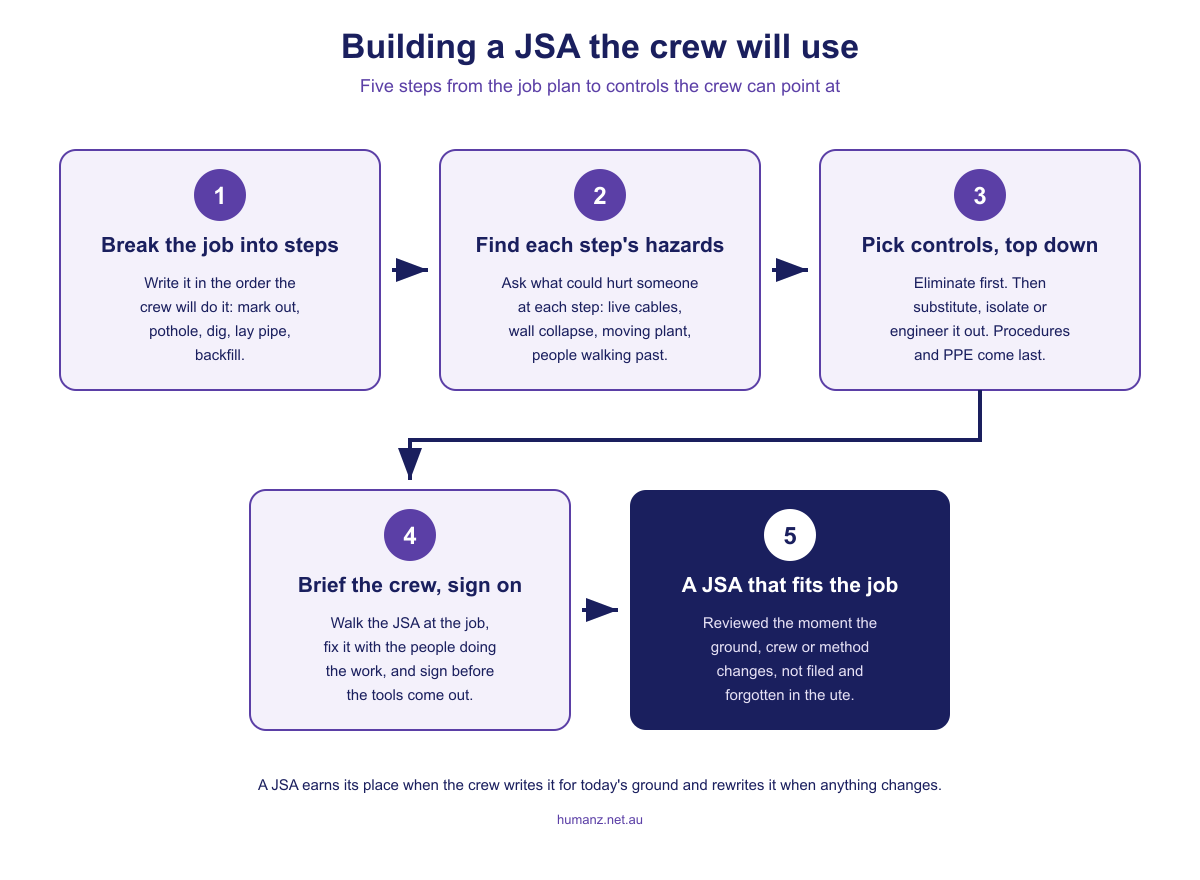
A JSA, or job safety analysis, is a short written breakdown of one task into its steps, the hazards at each step and the controls for each. Some sites call it a JHA (job hazard analysis) or a JSEA (job safety and environmental analysis). Same idea, different letterhead.
No regulation asks for a JSA by name. WorkSafe Victoria’s SWMS guidance says plainly that risk assessments and JSAs “are not required under legislation”, while noting they can be useful for identifying hazards and assessing risks, including for work that isn’t high risk construction work.
What the law does require is the thinking a JSA writes down. Section 17 of the model WHS Act requires duty holders to eliminate risks so far as is reasonably practicable and, where they can’t, to minimise them so far as is reasonably practicable. Where the regulations set a specific duty to manage a risk, such as falls (regulation 78) or excavation work (regulation 305), regulations 34 to 38 set the method: identify reasonably foreseeable hazards, eliminate or minimise the risks, and review the controls. A JSA is one practical record that this happened for one task.
What is a SWMS, and when is one required?
A safe work method statement (SWMS) sets out high risk construction work, its hazards and risks, and the measures that control them. Under regulation 299 of the model WHS Regulations, a business carrying out high risk construction work must make sure a SWMS is prepared, or has already been prepared by someone else, before the work starts. Safe Work Australia says the model laws have been implemented in every jurisdiction except Victoria, each through its own WHS Act and Regulations, and some have made variations. The regulation numbers in this guide are the model ones. State and territory regulations mostly use the same numbers, but the detail can differ, as the fall heights below show.
The 18 categories of high risk construction work
Regulation 291 of the model WHS Regulations lists 18 categories. In plain English, construction work is high risk construction work if it is:
- work with a risk of a person falling more than 2 metres
- work on a telecommunication tower
- demolition of a load-bearing element, or one related to the structure’s physical integrity
- work that disturbs asbestos, or is likely to
- structural alterations or repairs that need temporary support to prevent collapse
- work in or near a confined space
- work in or near a shaft or trench deeper than 1.5 metres, or a tunnel
- work involving explosives
- work on or near pressurised gas distribution mains or piping
- work on or near chemical, fuel or refrigerant lines
- work on or near energised electrical installations or services
- work in an area that may have a contaminated or flammable atmosphere
- tilt-up or precast concrete work
- work on, in or next to a road, railway, shipping lane or other traffic corridor in use by traffic other than pedestrians
- work in an area with any movement of powered mobile plant
- work in an area with artificial extremes of temperature
- work in or near water or other liquid with a risk of drowning
- diving work
Safe Work Australia’s high risk construction work page sets them out in plain English. Victoria’s Occupational Health and Safety Regulations 2017 require employers and self-employed people to prepare a SWMS before high risk construction work. WorkSafe Victoria lists 19 types: trenches and tunnels count separately, and some wording differs from the model list, such as demolition in general rather than only structural elements, and roadways or railways rather than any traffic corridor.
The fall height is the threshold that moves. From 1 July 2026, amendments to South Australia’s WHS Regulations lowered the fall height for high risk construction work from more than 3 metres to more than 2. SafeWork SA points to 149 falls from over two metres in the state between 2020 and 2022, more than 100 of them in residential construction. The Northern Territory went the other way: NT WorkSafe says that from 17 July 2026 the SWMS fall height on residential construction sites rose from 2 metres to 3, though businesses must still identify, assess and control fall risks below that. Falls are why it matters: Safe Work Australia’s Key Work Health and Safety Statistics Australia 2025 counts 188 workers killed at work in 2024. Falls from a height caused 24 of those deaths across all industries, and 37 of the 188 were in construction.
What a SWMS must contain
Regulation 299 sets four content requirements. A SWMS must identify the high risk construction work, specify the hazards and their risks, describe the control measures, and describe how those controls will be implemented, monitored and reviewed. It must also take account of conditions at the workplace (and, on a construction project, the WHS management plan) and be set out so the people using it can understand it.
Shorter is better. NT WorkSafe says a SWMS should not be more than 6 pages, and a generic SWMS used across sites may not meet the law unless it’s reviewed and amended for that workplace. WorkSafe Queensland warns against lines that leave the decision to supervisors or workers, giving ‘use appropriate PPE’ as the example.
Following, keeping and reviewing a SWMS
If the work isn’t being done in line with the SWMS, regulation 300 requires it to stop immediately or as soon as it’s safe, and restart only in line with the statement. On a construction project (construction work worth $250,000 or more under the model regulations, and $1 million in the NT), a copy goes to the principal contractor before the work starts (regulation 301), and the principal contractor must take all reasonable steps to get one (regulation 312). That’s why the SWMS is on every subcontractor onboarding checklist worth the name.
Regulation 303 says keep the SWMS until the high risk construction work is finished and, if a notifiable incident happens in connection with that work, for at least 2 years after the incident. For that whole period a copy must be readily accessible to the workers doing the work and available for inspection. Regulation 302 requires a review whenever the relevant control measures are revised under regulation 38, which calls for controls to be reviewed when, for example, one isn’t working or before a change at the workplace. Victoria keeps it simpler: retain the SWMS for the duration of the work, and review it whenever the work changes or there’s a sign the risks aren’t controlled.
What is a Take 5?
A Take 5 is a personal risk check a worker does in the minutes before starting a task. It lives in a pocket booklet or an app, and catches what has changed since the morning brief.
There’s no official version, so the steps vary by company. A typical wording runs:
- Stop and look over the work area.
- Think through the task.
- Spot the hazards, including anything new since the JSA or prestart.
- Control them, or get help if you can’t.
- Start, and stop again if something changes.
Like a JSA, a Take 5 is a company or site requirement rather than a legal one, and it can’t stand in for the other two because a quick personal check can’t plan a task. A Take 5 pre-filled at the smoko table is a signature, not a check.
A worked JSA: trenching beside live underground services
This example is illustrative: it shows the method, not a JSA to copy. Say a civil crew is laying a stormwater line in a 1.8-metre trench along a suburban verge, beside a live underground power cable shown on the service plans.
The legal layer comes first. A trench deeper than 1.5 metres, work near an energised electrical service, moving powered mobile plant and work next to a road in use by traffic are four separate categories of high risk construction work, so this job needs a SWMS that identifies all four before anyone digs. The JSA sits underneath it and deals with today’s ground, crew and plant.
Two more regulations shape the controls. Regulation 304 requires whoever manages or controls the workplace to take all reasonable steps to get current underground essential services information, including location and depth, before excavation starts, and to pass it to whoever does the digging. Regulation 306 requires a trench at least 1.5 metres deep to be secured from unauthorised access, with its sides supported by shoring, benching or battering unless a geotechnical engineer advises in writing that they’re safe from collapse.
Controls come from the top of the hierarchy down. Eliminate the risk where that’s reasonably practicable, then under regulation 36 substitute, isolate or engineer it out, then add administrative controls, then PPE.
| Step | Hazards | Controls, highest order first |
|---|---|---|
| 1. Locate and mark services | Hitting the cable, or a service missing from the plans | Move the trench line away from the cable if the design allows (eliminate). Current Before You Dig Australia plans, services marked on the ground, permit to work if the site uses one (administrative) |
| 2. Expose the cable | Contact with a live cable, hand and back strain | Ask the asset owner whether the cable can be de-energised (eliminate). Vacuum excavation or careful hand digging in the cable zone instead of the bucket (substitute). Spotter on the marked zone (administrative) |
| 3. Excavate the trench | Bucket striking the cable, wall collapse, plant hitting workers on foot, falls into the trench | Barricades and an exclusion zone (isolate). Every side supported as the dig advances: benched or battered where there’s room, shielded or shored where there isn’t (engineering). Bucket kept out of the cable zone, spoil kept back from the edge (administrative) |
| 4. Lay pipe in the trench | Trench collapse, falling objects, loads overhead | Trench shield or shoring in place before anyone enters (engineering). Nobody works outside the shield or under pipe being lowered, ladder access inside the shield (administrative). Hard hats, gloves, boots and hi-vis (PPE) |
| 5. Backfill and pull the shield | Collapse as supports come out, compaction plant, traffic | Barriers and an exclusion zone kept around the trench and plant until the ground is level (isolate). Supports removed in reverse order of installation, only once the trench is ready for backfill, with nobody in the trench while they come out, and traffic controllers and signs kept in place (administrative) |
The paper controls sit at the bottom of each cell, where they belong. NT WorkSafe classes a SWMS itself as an administrative control, there to support higher-order controls rather than replace them. A JSA listing only spotters, signs and PPE hasn’t finished the analysis.
On the morning, the supervisor walks the crew through the JSA at the toolbox talk, the crew fixes whatever the office got wrong and signs on, and each worker does a Take 5 before climbing down the ladder. If rain softens the ground overnight, or the cable turns up somewhere the plans didn’t show, the JSA gets rewritten before work carries on.
Running all three on a phone without the tick-box
Moving the forms onto a phone doesn’t fix the problem by itself. When Safe Work Australia launched its interactive SWMS tool in January 2024, it said a review had found SWMS are often not used as intended, with many people seeing them as unnecessary paperwork. A PDF on a screen is the same paperwork with a battery.
What changes the outcome is how the form asks its questions.
- Ask for specifics, not ticks. “Hazards identified: yes or no” gets a yes. “Where is the cable, and how was it located?” gets an answer a supervisor can check.
- Put the signature after the walk-through, so it records that the crew heard the controls.
- Make the Take 5 ask what’s different from yesterday. That one question beats five boxes ticked on autopilot.
- Keep the SWMS where the crew can reach it. The model regulations require a copy to be readily accessible to the workers doing the work, and NT WorkSafe confirms a SWMS can be kept electronically.
That’s the job for a workforce management platform with custom forms. In Humanz, your admin builds your own JSA, SWMS sign-on and Take 5 as custom forms, with conditional sections, mandatory questions, and photo and signature capture. Crews complete them on their phones, and every submission is timestamped and stored against the job, so Tuesday’s JSA belongs to Tuesday’s trench instead of a ute’s glovebox. The civil construction page shows how the same job carries the crew’s ticket and induction checks and its approved hours.
Related guides: digital forms for field teams, WHS compliance software, the construction site compliance checklist and incident, hazard and near-miss reports for when a Take 5 turns up a hazard, or something goes wrong anyway.
One honest limit. Software can store and timestamp the paperwork, but it doesn’t know whether a trench shield suits your ground. That judgement stays with the people at the edge of the hole. To see your own JSA or Take 5 rebuilt as a form crews fill in on their phones, walk through it with our team.
Frequently asked questions
What does JSA mean in safety?
JSA stands for job safety analysis. It’s a short written breakdown of a task into its steps, the hazards at each step and the controls that make each step safe, done before the work starts. Some sites call it a JHA (job hazard analysis) or a JSEA.
What is a Take 5 in safety?
A Take 5 is a quick personal risk check a worker does in the minutes before starting a task. It usually runs through five steps: stop and look, think through the task, spot the hazards, control them, then start and watch for changes. The wording varies by company, and it’s a company or site requirement rather than a legal document.
What is the difference between a JSA and a SWMS?
A SWMS is required by law before high risk construction work starts, while a JSA is a planning tool that no regulation requires by name. A JSA can cover any task, including the day’s specifics on a job that already has a SWMS.
What should a Take 5 checklist include?
A Take 5 checklist should get the worker to stop, look over the work area, think through the task, identify the hazards and confirm controls are in place before starting. The best versions also ask what has changed since the prestart or JSA.
Is a JSA a legal requirement in Australia?
No. WorkSafe Victoria’s guidance states that risk assessments and JSAs are not required under legislation, though they are useful for identifying hazards. The legal duty is to eliminate or minimise risks so far as is reasonably practicable, and a JSA is one practical way to show that was done.
When is a SWMS required?
A SWMS is required before any high risk construction work starts. The model WHS Regulations list 18 categories, including a risk of falling more than 2 metres, trenches deeper than 1.5 metres and work near energised electrical services. Victoria lists 19 types, and since 17 July 2026 the Northern Territory has used 3 metres rather than 2 on residential construction sites, so check with the regulator where the work happens.
Can a SWMS or JSA be kept on a phone?
Yes. NT WorkSafe’s guidance confirms a SWMS can be kept electronically, and because a JSA or Take 5 isn’t a legal form, nothing ties either to paper. What matters is that the workers doing the job can get to the SWMS and understand it, and that it’s available for inspection for as long as it must be kept.
Related articles
Ready to see Humanz on your own roster?
Free 30-minute walkthrough, we'll use your real crews, sites and shift patterns.