
 Login
Login 

Timesheets & Payroll
Digital Timesheets for Tradies: Ditch Paper and Stay Fair Work Compliant
By Heather · 14 May 2026 · Updated 3 September 2026

If you’re still running paper timesheets on your jobs, you’re doing payroll the hard way. Sheets get lost, filled in from memory, or quietly forgotten at knock-off. They slow payroll down, feed disputes, and leave you exposed if a Fair Work audit ever comes knocking. (Our guide to time and attendance software covers the record-keeping rules in detail.)
For Australian construction and trades businesses running field workers across multiple sites, switching to a mobile timesheet app is one of the highest-ROI admin changes you can make. This article covers why paper fails, what the law actually requires, and what to look for in a timesheet app for a trade business.
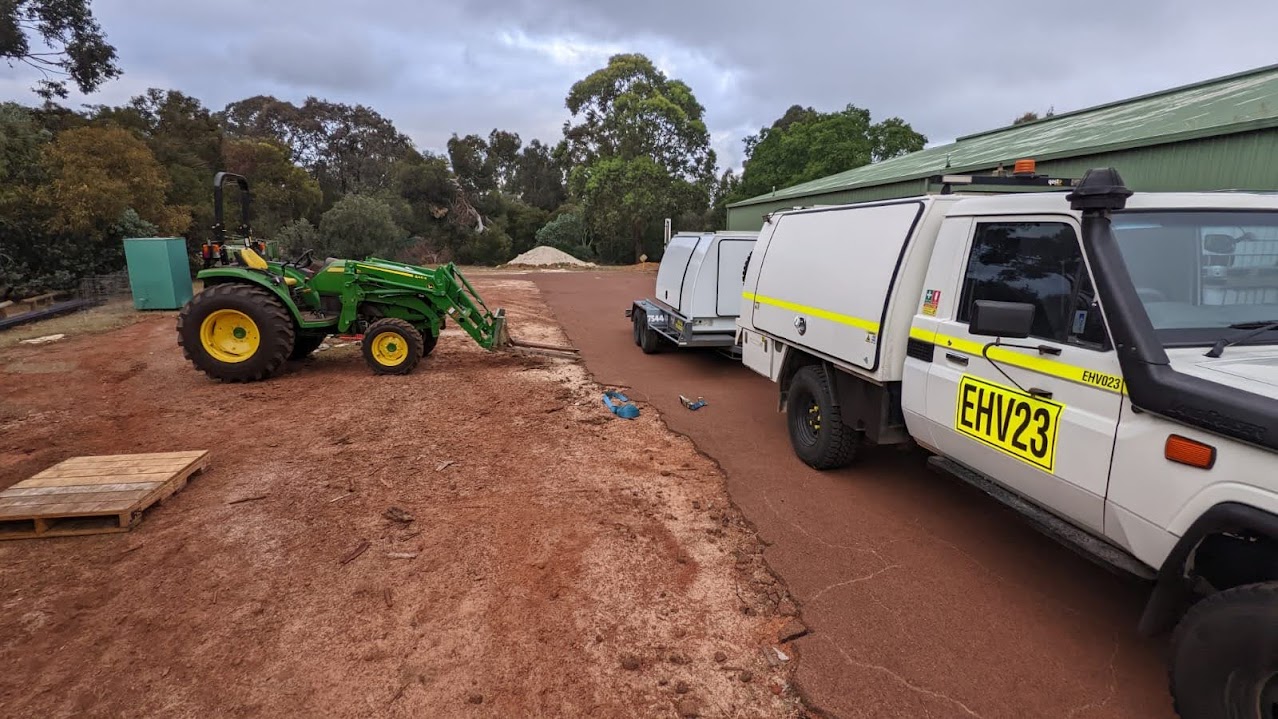
The problem with paper timesheets on the job site
Paper timesheets seem simple until they’re not. Here’s what goes wrong:
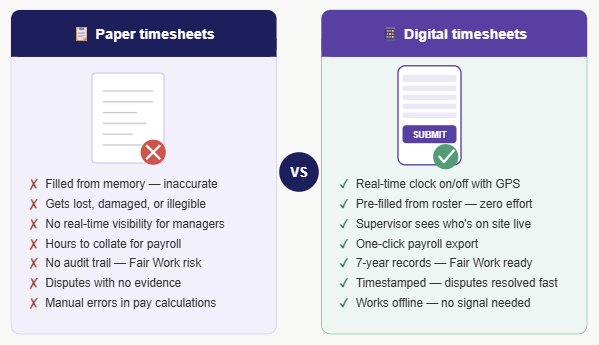
- Workers fill them in from memory at the end of the week, not in real time
- Illegible handwriting leads to payroll errors and time wasted chasing workers
- Sheets get left on site, in utes, or lost outright
- There’s no way to verify when a worker started or finished
- Site supervisors spend Friday afternoons compiling hours instead of managing the job
- Disputes about hours worked have no record to fall back on
For a business running 10 or more field workers across different sites, these problems compound fast. The time lost to manual timesheet admin in a construction business is estimated at several hours per week, hours that could go straight back to the job. The free cost calculator will put a dollar figure on it for your crew size.
What Australian law requires for timesheet records
This is where it gets serious. Under Australian employment law, keeping accurate time and wage records isn’t optional.
Fair Work record-keeping obligations
Under the Fair Work Act 2009, employers must keep accurate records of hours worked for every employee. The full list of what you must keep, and for how long, is set out in employee records you must keep in Australia. The Fair Work Ombudsman’s record-keeping rules require that time records:
- Show the hours worked each day
- Be kept for a minimum of 7 years
- Be accessible for inspection if requested
- Show overtime hours separately where applicable
The penalties are specific and large. The Fair Work Ombudsman’s current penalty figures run to $21,840 per contravention for an individual, $109,200 for a company with fewer than 15 employees, and for a company with 15 or more employees the greater of $546,000 or 3 times the underpayment. Serious contraventions, a category that expressly includes record-keeping and pay slip requirements, lift those maximums to $218,400, $1,092,000 and $5,460,000 per contravention. Paper timesheets that are incomplete, inaccurate or missing create real legal exposure.
Nor are these shelf numbers. The FWO’s 2024-25 annual report records 743 infringement notices, the on-the-spot fines, issued for record-keeping or pay slip breaches that year, with $838,000 in penalties paid. Building and construction is also on the regulator’s named priority list for 2025-26, so the inspector asking for time records is more likely to turn up at a site like yours than an office tower.
The ATO also has requirements around payroll records that align with Fair Work obligations. Your timesheet records feed directly into your STP (Single Touch Payroll) reporting, so errors upstream cause problems downstream.
Note: Most construction and trades workers sit under a Modern Award, and the award may add record-keeping requirements of its own. Check your applicable award on the Fair Work website. Keep in mind who the strictest hours rules attach to as well. The ABS counted 141,000 casual employees in Australian construction at August 2025, up from 126,400 a year earlier, and a casual paid by time worked is exactly the worker whose daily hours must be on the record.
Benefits of switching to digital timesheets
Accuracy and dispute prevention
Digital timesheets captured in real time beat retrospective paper entries every day of the week. When a worker clocks on and off from their mobile, the system records the exact time. If a dispute arises, you have an objective record.
Some platforms also capture location at clock-on, an extra layer of proof that the worker was on site.
Faster payroll processing
When timesheets flow from the mobile app straight into your payroll or admin system, the manual data entry step disappears. Hours are already totalled, overtime is flagged, and the data is ready to export. For more on connecting these systems, see our guide to payroll integration for workforce management.
For businesses running weekly payroll across 20+ workers, that’s several hours back every week.
Super now runs on the same clock
Since 1 July 2026, the speed argument stopped being about convenience. Under payday super, the super guarantee has to reach each worker’s fund within 7 business days of payday, and the pay run can’t start until the hours are approved. Every day a paper timesheet spends in a ute is now a day carved off a legislated deadline, with the super guarantee charge waiting on the other side. We’ve covered what payday super means for your timesheet deadline in full, but the short version is simple. Chase-and-decipher timesheet processes were annoying under quarterly super. Under payday super they’re a recurring compliance risk, 52 times a year.
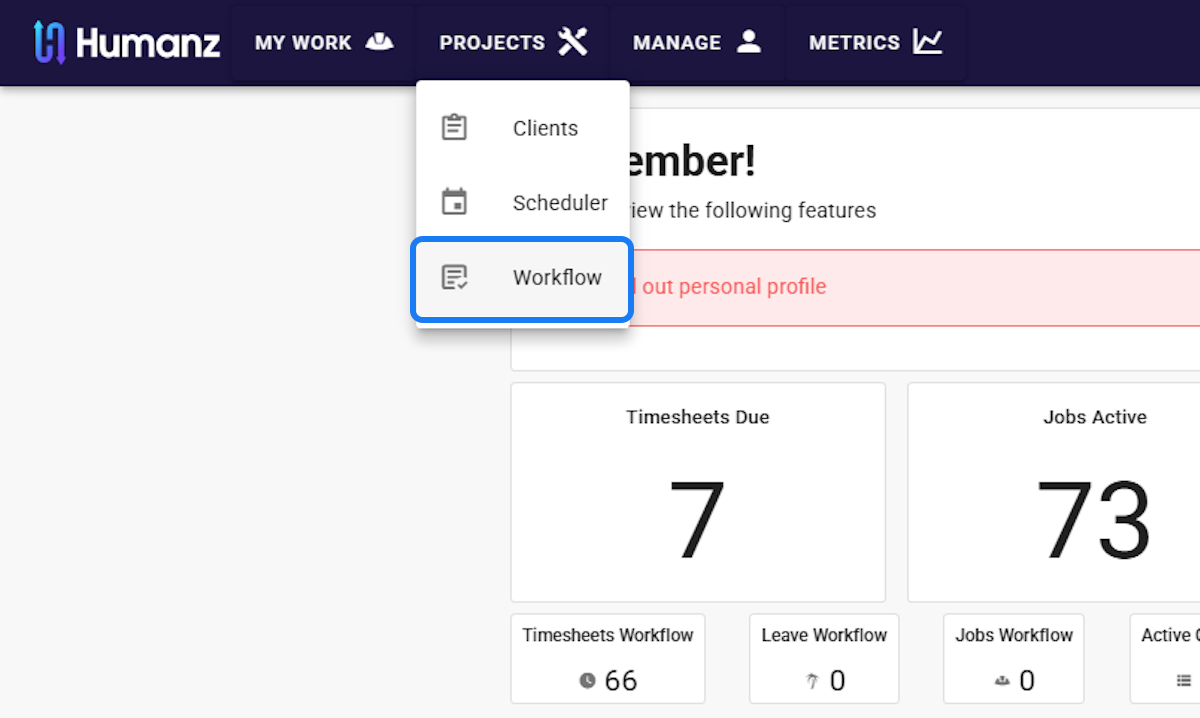
A live workflow view is what replaces the chase. When the dashboard shows exactly how many timesheets are due and where they sit, payday morning stops being a hunt.
Real-time visibility for site managers
With online timesheets for tradies, a site manager can see right now who’s clocked on, who’s late, and who hasn’t shown up. No phone calls, no guessing. You can act early, before a no-show becomes a project delay.
Electronic timesheets help with job costing too. When you can see hours per worker per job in real time, you know where labour costs are tracking against budget.
What to look for in a tradie timesheet app
Not every timesheet app is built for field-based trades work. Here’s what matters for construction and trades businesses:
- Mobile-first. It has to work on Android and iOS, including in patchy coverage. Workers shouldn’t need a desktop to submit hours, and timesheets are only one job of a good employee management app.
- Location capture at clock-on and off. Accountability without being intrusive.
- Offline mode. Crews lose signal underground, in remote country and inside large structures. The app must record timesheets offline and sync when coverage returns.
- Pre-filled timesheets. Auto-populating from rostered shifts cuts worker admin to a confirm-and-submit.
- Approval workflows. Supervisors should review, adjust and approve in the app, not through email chains. We’ve broken down what good looks like in our timesheet approval workflow guide.
- Payroll integration or export. The data needs to land somewhere useful, whether that’s a payroll platform or a CSV for your bookkeeper.
- Compliance-ready records. The system should retain records for the required 7 years and produce audit-ready reports on request.
The HIA (Housing Industry Association) publishes guidance on running efficient trade businesses, including managing time records. Worth a look if you’re in residential construction.
Accurate timesheets are also the foundation of good fatigue management software in Australia. Without reliable hours data, automated fatigue alerts can’t work. The same hours sit under the safety figures a tender asks for: the total recordable injury frequency rate (TRIFR) is recordable injuries per million hours worked, so a guess on the timesheet becomes a guess in the rate.
How Humanz timesheets work in the field
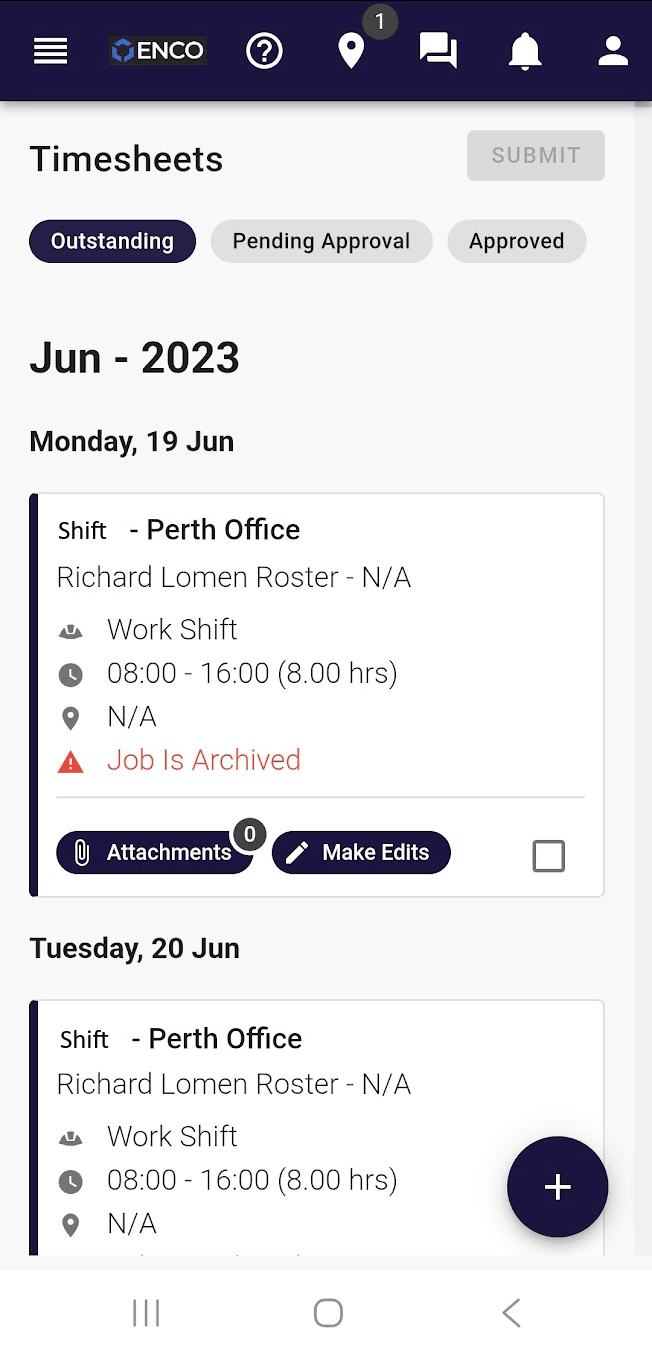
Humanz is a field workforce management platform built for trades and construction teams, not office workers. The timesheet module reflects that:
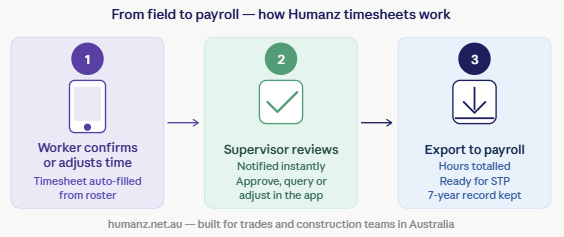
- Workers clock on and off from their mobile
- Timesheets are pre-filled from the roster, so workers confirm and submit
- Supervisors get notified of submissions and can approve or query from the app
- Hours roll up against jobs and projects for labour cost tracking
- Records are stored and retrievable for Fair Work compliance
- Everything works offline, which matters on remote sites and underground
For businesses that have been managing timesheets through spreadsheets or WhatsApp, the change is typically measured in hours saved per week.
Humanz timesheets connect directly with the rostering module, so shifts, leave and hours stay in one place with no duplicate data entry, and those hours feed fatigue monitoring that runs off real worked time rather than the roster’s best guess. And if you run subbies alongside direct employees, subcontractor management software tracks their hours and compliance in the same platform.
Frequently asked questions
Are digital timesheets legally valid in Australia?
Yes. The Fair Work Act doesn’t specify a format for records, only that they’re accurate, complete and kept for 7 years. A digital timesheet from a mobile app satisfies those requirements, and it’s generally more defensible than a handwritten paper record.
Do digital timesheets help with Fair Work audits?
Significantly. If Fair Work investigates a wage underpayment claim, you need to produce accurate time records going back up to 6 years. A digital system with complete, timestamped records is far easier to audit than boxes of paper timesheets, assuming the paper still exists.
How long does it take to set up a digital timesheet system?
For most small-to-medium trades businesses, initial setup in a platform like Humanz takes a few hours to a couple of days. Workers adapt fast. Clocking on with a phone beats filling out a paper form.
Do digital timesheets work for job costing as well as payroll?
Yes. When workers clock on against a job, hours roll up per worker per job in real time, so you can see where labour costs sit against budget while the work is still running. Paper timesheets only give you that picture weeks later, if the sheets survive.
What if a worker forgets to clock off?
Most platforms, Humanz included, let supervisors adjust timesheets manually and send workers a reminder when a clock-off is missing. The app flags the anomaly rather than silently recording wrong hours.
Do digital timesheets track a worker’s location all day?
No. Platforms that use location generally capture it at clock-on and clock-off, as proof the worker was on site, rather than tracking anyone through the day. That gives you an accountable record without being intrusive about it.
Can workers submit timesheets from remote sites with no signal?
With the right app, yes. Humanz and several other mobile timesheet apps support offline mode. Timesheets save locally on the device and sync once coverage returns.
Related articles
Ready to see Humanz on your own roster?
Free 30-minute walkthrough, we'll use your real crews, sites and shift patterns.