
 Login
Login 

Safety Systems & Forms
Incident, Hazard and Near-Miss Reports: What to Record and When to Notify the Regulator
By Christian Tietzel · 14 September 2026 · Updated 16 September 2026

A notifiable incident is a death, a serious injury or illness, or a dangerous incident arising out of the conduct of a business, and the regulator must be told immediately. Every incident, notifiable or not, and every near miss also needs your own report: who was involved, what happened, injuries and treatment, witnesses, photos and the follow-up controls.
The legal line only catches the top of the pile. Under it sits an ordinary month on site: a rolled ankle in the laydown yard, a frayed sling found at prestart, a loader that reversed a metre too close to a spotter. Most of that never reaches a regulator, and all of it tells you where the next serious incident is coming from.
This is general information, not legal advice. The details differ between jurisdictions, so check with the regulator in the state or territory where the work happens.
What is a notifiable incident?
Incident notification is Part 3 of the model WHS Act, sections 35 to 39 in the Commonwealth Act. A notifiable incident can involve anyone, from a worker to a member of the public, as long as it arises out of the conduct of the business or undertaking. Section 35 lists three kinds.
| Category | What the Act counts | Site examples |
|---|---|---|
| Death | The death of a person | A worker, subbie or passer-by killed as a result of the work |
| Serious injury or illness (section 36) | Immediate treatment as a hospital in-patient. Immediate treatment for an amputation, a serious head or eye injury, a serious burn, degloving or scalping, a spinal injury, loss of a bodily function or serious lacerations. Medical treatment within 48 hours of exposure to a substance. Plus any illness the regulations add, such as some work-related infections | An operator admitted to hospital after falling from a truck deck. A fitter who loses a fingertip in a pinch point |
| Dangerous incident (section 37) | A serious risk from immediate or imminent exposure to hazards such as an uncontrolled escape of a substance or gas, an uncontrolled explosion or fire, electric shock, something falling from height, or the collapse of a structure or an excavation | A crane drops a load a few metres from the dogman. A trench wall collapses while a labourer is still climbing out |
A dangerous incident is notifiable even if no one is injured. WorkSafe WA’s definition of a serious injury or illness also covers an injury or illness in a remote location that needed urgent transfer to a medical facility, and one a doctor considers likely to keep the person from their normal work for at least 10 days, even if they can do light duties.
The model Act has changed, but not everywhere yet
Safe Work Australia has published amendments to the model WHS Act that widen the notification duty. Once adopted, they add:
- dangerous incidents involving the fall of a person, electrical hazards and mobile plant
- serious brain injuries, serious crush injuries and serious bone fractures
- violent incidents, including sexual assault, that expose a person to a serious risk of psychological harm
- work-related suicide or attempted suicide of a worker, and of other people in specific settings
- a worker’s absence, or likely absence, of 15 or more consecutive calendar days from a work-related physical or psychological injury or illness
None of it applies until your jurisdiction adopts it, on a timeline each jurisdiction sets, and the ACT has already started. Since 19 November 2025, WorkSafe ACT counts serious falls of a person, electrical incidents such as arc flashes and mobile plant incidents as dangerous incidents, and spinal injuries, bone fractures, serious crush injuries and serious blows to the head as serious injuries. Sexual assault has been notifiable in the ACT since June 2023. The suicide and extended absence notifications aren’t in WorkSafe ACT’s list of changes, so check with your regulator before assuming any of this applies where you work.
Two of the additions, falls of a person and mobile plant, sit close to where workers die. Safe Work Australia’s Key Work Health and Safety Statistics Australia 2025 counts 188 workers killed by traumatic injuries in 2024, with vehicle incidents behind 42% of those deaths and falls from a height behind 13%. If you’re rebuilding an incident form anyway, add questions on falls, mobile plant, time off work and psychological harm now, so the details are there when the rules change where you work.
Who notifies, how fast, and what to keep
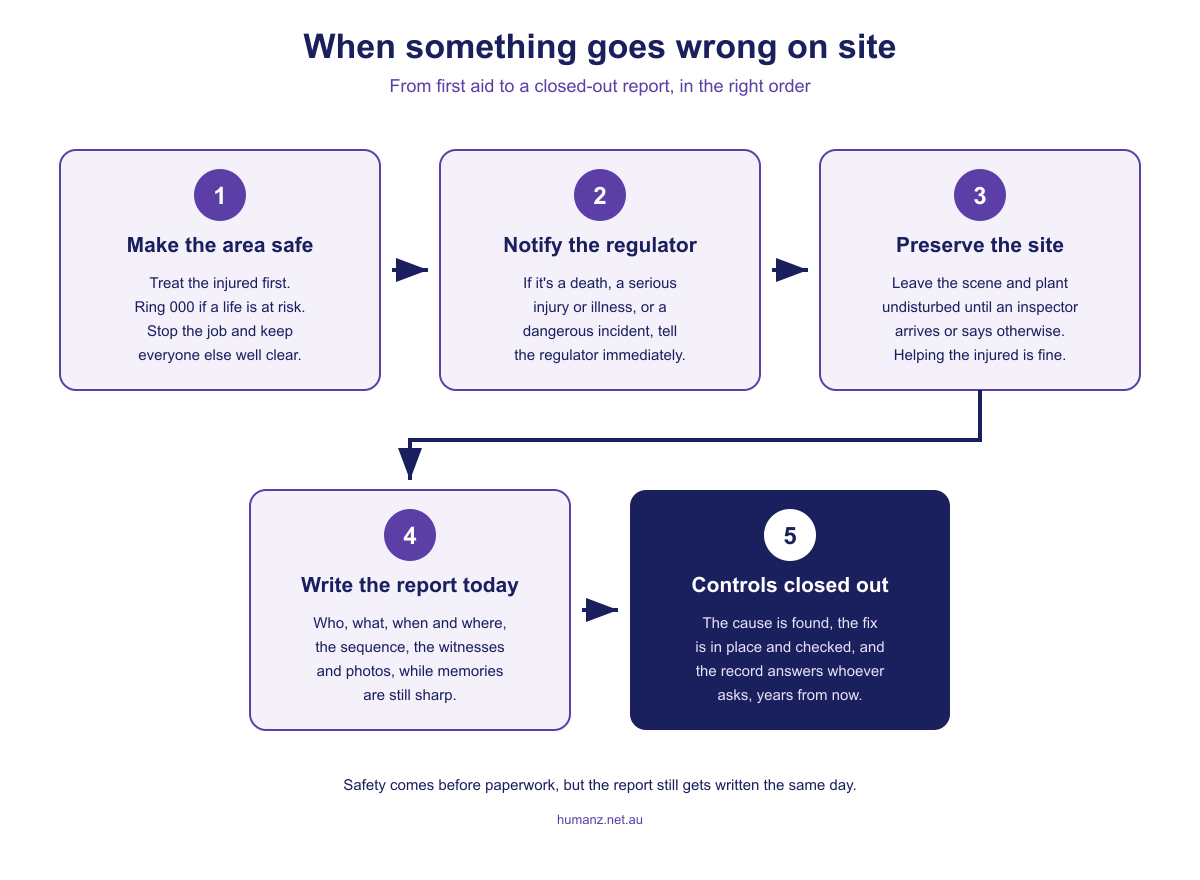
Section 38 puts the duty on the person conducting the business or undertaking, the PCBU. It must make sure the regulator is notified immediately after it becomes aware of a notifiable incident, by the fastest possible means. That can be a phone call or a written notice, and email counts as writing. Notice goes to your state, territory or Commonwealth regulator, not to Safe Work Australia.
Safe Work Australia says a worker who witnesses a notifiable incident should make sure the PCBU knows. On a site with a principal contractor, labour hire and three subbies, agree before the day who makes the call, and check it was made. In the ACT, businesses sharing a workplace must now also tell each other about a notifiable incident.
If you phone it in, the regulator can require a written notice within 48 hours of asking. SafeWork NSW’s questions on the call cover what happened and where, anyone injured and their treatment, what was done to make the site safe, and what will stop it happening again.
Section 38 also requires a record of each notifiable incident to be kept for at least five years from the day notice was given, a different clock from the seven years Fair Work sets for time and wages records. On construction work, Safe Work Australia adds that after a notifiable incident the PCBU must keep a copy of the risk assessment, WHS management plan or safe work method statement for two years, so it pays to know which of the JSA, SWMS and Take 5 the law requires.
Preserving the site, and what you can still touch
Section 39 requires the person with management or control of the workplace to ensure, so far as is reasonably practicable, that the site isn’t disturbed until an inspector arrives or directs otherwise. The site includes any plant, substance, structure or thing associated with the incident. You can still help an injured person, remove a deceased person, do what’s essential to make the site safe or minimise the risk of another notifiable incident, take action associated with a police investigation, or do what an inspector or the regulator permits. Victoria’s list is shorter: protecting someone’s health or safety, helping an injured person, or essential action to make the site safe or prevent another incident. In the ACT, the site stays preserved, so far as is reasonably practicable, until a WorkSafe ACT inspector releases it, including evidence such as digital records and witness details.
In practice, barricade it and photograph everything before it moves. Don’t reset the machine or drive the elevated work platform back to the compound so the job can carry on.
Who to notify in each state and territory
Each regulator runs its own incident line, and the numbers below are the ones on each regulator’s own page as read on 16 September 2026. Safe Work Australia’s contact table lists different numbers for Victoria and WA, because it gives their advisory lines rather than their incident lines, and for South Australia it gives only the business-hours line, so go by the regulator’s page. Check it again before you rely on this table, because numbers and lists change.
| Jurisdiction | Regulator and incident line | What its page adds |
|---|---|---|
| NSW | SafeWork NSW, 13 10 50, 24 hours a day, 7 days a week | Phone is the only method on its page. Tell your workers compensation insurer within 48 hours too. Mines notify the NSW Resources Regulator on 1300 814 609 |
| Queensland | Workplace Health and Safety Queensland, 1300 362 128, or its online form | No written notice is needed if you notified by phone. Serious electrical incidents and dangerous electrical events go to the Electrical Safety Office, on the same number. Mines notify Resources Safety and Health Queensland on 1300 312 339 |
| Victoria | WorkSafe Victoria, 13 23 60, 24 hours a day, 7 days a week | A written report within 48 hours every time, through the online form WorkSafe emails after the call. More types of plant, including tractors, forklifts and earthmoving machinery, were added to the list from 1 July 2024 |
| WA | WorkSafe WA, 1800 678 198, 24 hours | Deaths and life-threatening dangerous incidents by phone. Serious injuries by phone or online. Other dangerous incidents online. Mines and petroleum operations lodge online as well as phoning, mines in the Safety Regulation System |
| SA | SafeWork SA, 1800 777 209, 24 hours, for a death or life-threatening injury; 1300 365 255 or the online form otherwise | Prescribed infections and zoonoses are notifiable. The December 2025 model amendments don’t apply until SA adopts them |
| Tasmania | WorkSafe Tasmania, 1300 366 322, or (03) 6166 4600 from interstate | After hours the call diverts to a duty officer. Written follow-up within 48 hours if requested. Insurer within 3 days |
| ACT | WorkSafe ACT, 13 22 81 in daytime hours seven days a week, with an after-hours mobile on its page, or the online portal | A wider list since 19 November 2025: serious falls, mobile plant and electrical incidents, fractures and crush injuries. Sexual assault has been notifiable since 9 June 2023 |
| NT | NT WorkSafe, 1800 019 115, or the online form | Written notice within 48 hours if asked. NT WorkSafe says it has not adopted the December 2025 model amendments |
Two patterns fall out of the table. Every regulator except Queensland says to phone first for a death or a life-threatening incident (Queensland’s page treats phone, online form and email alike), and the written notice rules differ: Victoria always, the model states only when asked, and Queensland not at all after a phone call. And the list of what counts is no longer the same everywhere, because the ACT has already legislated most of the new categories and the NT has said it hasn’t adopted them, so a national incident form needs a state field.
Victoria words it differently
Victoria runs its own Occupational Health and Safety Act 2004. WorkSafe Victoria puts the duty on an employer or self-employed person with management and control of the workplace, and describes two types of notifiable incident: those involving a death or a serious injury needing specific treatment, such as hospital admission or immediate treatment for an amputation, and those that expose a person to a serious risk to their health and safety. Its own example of the second type is a near miss.
WorkSafe Victoria also says to notify immediately and provide written notification within 48 hours, where the model Act only requires written notice if the regulator asks, and to keep a copy for at least five years. Our guide to WHS compliance software covers crews that work both sides of the Murray.
Mines report more than other workplaces
WorkSafe WA says mines have an additional requirement to notify reportable incidents under the Work Health and Safety (Mines) Regulations 2022. Check first whether an incident is notifiable, and if it isn’t, whether it’s reportable. The list includes injuries needing medical treatment, losing control of a vehicle or plant, fly rock landing near a person, and a workplace incident that could have caused serious harm to a person, plant or structure. Data on reportable incidents must go into the quarterly work health and safety report to the regulator.
That last item is a serious near miss by another name. At a WA mine, a near miss that could have caused serious harm is a reportable incident, and its data goes to the regulator in the quarterly report.
Queensland coal mines, and mineral mines and quarries under their own Act, have to report high potential incidents to the mines inspectorate. Resources Safety and Health Queensland describes a high potential incident, defined in section 17 of the Coal Mining Safety and Health Act 1999, as an event or series of events that causes or has the potential to cause a significant adverse effect on a person’s safety or health.
Incident, near miss or hazard: three reports with different jobs
Most sites treat these as one form. They answer different questions.
| Report | What happened | Example | What it’s for |
|---|---|---|---|
| Incident | Someone was hurt or made ill, or plant or property was damaged | A rigger’s hand crushed between a load and a column | Treatment, notification where required, and finding the cause |
| Near miss | Nothing was hurt or damaged, but it easily could have been | A pallet slides off the tines where someone stood a minute earlier | Learning the lesson without paying for it, and notifying the regulator if it was a dangerous incident |
| Hazard | Nothing has happened yet, but a condition could cause harm | A missing handrail on a stair tower, spotted at prestart | Fixing the condition before it becomes one of the other two |
Part 3 of the WHS Act never uses the words “near miss”. One that exposed someone to a serious risk from immediate or imminent exposure to a section 37 hazard is a dangerous incident, and it gets notified like one. And a hazard fixed on the spot still deserves a report, because the fix is the part worth keeping.
What should an incident report form include?
Build the form for two readers: the regulator on the phone and whoever investigates later. Our construction site compliance checklist gives incident reporting a couple of tick boxes. Behind it, a good form captures:
- The people involved, their roles and who employs them.
- Date, time, site and exact location, the task under way and any plant ID.
- The sequence of events in plain words, starting before anything went wrong.
- Injuries and treatment, including whether the person saw a doctor or was admitted to hospital, and how long they are expected to be off work.
- Witnesses, each account taken separately and in their own words.
- Immediate actions, including first aid, making the site safe, and when the regulator was notified and by whom.
- Photos taken before anything moves.
- What could reasonably have happened, as well as what did.
- Follow-up controls, each with an owner, a due date and a close-out date.
Items four and eight together show whether you might be dealing with a notifiable incident, because a dangerous incident is notifiable even when nobody is hurt, so make both mandatory. Item eight also stops a serious near miss being filed as nothing much. Write it the same day. Once witnesses have talked it over at smoko, they start telling one story instead of their own.
Why near misses go unreported on site
Nobody lies on a near-miss report. They just don’t fill one in. The forklift missed, so it doesn’t feel like an incident. The form lives in the site office. Writing it up feels like dobbing in a mate, or yourself. And the last three reports about that broken step went nowhere.
Compulsory reporting doesn’t fix it on its own. In a bulletin dated 7 October 2021, Resources Safety and Health Queensland said high potential incidents reported by Queensland coal mines fell 25.7% in 2020/21 on the previous year, and the reporting frequency rate dropped 22%. Inspectors who went through internal incident data from 20% of coal mines found events that the evidence suggested were high potential incidents but were never reported, some rated in the mine’s own system as a potential single fatality. The unreported event types included collision near misses and microsleeps on mobile plant.
Those mines had reporting systems, and the events were in them. What failed was the decision to send them on.
What gets crews reporting
- Make it quicker than the walk to the site office. A phone, a photo and a few mandatory fields will do.
- Read last week’s near misses out at the next prestart and say what changed.
- Keep discipline out of the report form. People stop writing things down the first time a report comes back as a warning.
- A rising near-miss count after you push reporting is usually a good sign. A crew that reports nothing isn’t necessarily safe, just quiet.
How Humanz handles incident, hazard and near-miss reports
Humanz doesn’t decide whether an incident is notifiable, notify the regulator for you, investigate incidents or give safety advice. Notification is the PCBU’s duty, whatever software you run. What Humanz does is make the report quick to fill in on the day, from a phone, with the questions that matter made mandatory.
Your team builds incident, hazard and near-miss forms in the custom form builder in our workforce management platform, with drag-and-drop fields, conditional sections, mandatory questions, and photo and signature capture. Conditional sections mean a yes to hospital admission, or to anyone being exposed to a falling load or a collapsing trench, can open the notification questions. Crews complete forms in the mobile app, offline if the signal drops. Incident reports are timestamped and stored against the job, so when an inspector asks, the evidence for that shift comes up in minutes instead of out of a glovebox. Our form builder guide covers the rollout.
If your incident form still lives on paper, book a walkthrough and bring it along. We’ll rebuild it as a live digital form on the call.
Frequently asked questions
What details go on an incident report form?
An incident report form should record who was involved, when and where it happened, the sequence of events, injuries and treatment, witnesses, immediate actions, photos and follow-up controls. It should also ask what could reasonably have happened, not only what did. Make the questions on injuries, treatment and whether anyone was exposed to a serious risk mandatory, because together they show whether the incident may need to be notified.
What counts as a notifiable incident?
A notifiable incident is the death of a person, a serious injury or illness, or a dangerous incident arising out of the conduct of a business or undertaking. Under the model WHS laws, serious injuries include those needing immediate treatment as a hospital in-patient, or immediate treatment for injuries such as an amputation. A dangerous incident is notifiable even if no one is injured, and the exact categories differ between states and territories, so check with the regulator where the work happens.
How quickly must a notifiable incident be reported?
A notifiable incident must be reported to the regulator immediately after the business becomes aware of it, by the fastest possible means. Under the model WHS laws, notice can be given by phone or in writing, and if the regulator asks for a written notice after a phone call, it must be given within 48 hours. In Victoria, a written record must go to WorkSafe within 48 hours every time, whether or not WorkSafe asks.
What is a notifiable incident in Queensland?
In Queensland a notifiable incident is a death, a serious injury or illness, or a dangerous incident arising out of the business, the same three categories as the model WHS Act, plus a serious electrical incident or dangerous electrical event under the state’s electrical safety laws. Notify Workplace Health and Safety Queensland immediately on 1300 362 128 or through its online form, and if you notify by phone no written notice is required. Mines notify Resources Safety and Health Queensland on 1300 312 339 instead.
What is a notifiable incident in NSW?
In NSW a notifiable incident is the death of a person, a serious injury or illness, or a dangerous incident, and SafeWork NSW must be told immediately on 13 10 50, 24 hours a day. Failing to notify carries a maximum penalty of $50,000 for a body corporate and $10,000 for an individual, and the scene must be left undisturbed until an inspector arrives or gives a direction. You must also tell your workers compensation insurer within 48 hours, and mines notify the NSW Resources Regulator on 1300 814 609.
Who do you notify about a workplace incident in each state?
The WHS regulator where the work happens, never Safe Work Australia, which takes no notifications. The incident lines on each regulator’s own page as at September 2026 are SafeWork NSW 13 10 50, Workplace Health and Safety Queensland 1300 362 128, WorkSafe Victoria 13 23 60, WorkSafe WA 1800 678 198, SafeWork SA 1800 777 209 for a death or life-threatening injury, WorkSafe Tasmania 1300 366 322, WorkSafe ACT 13 22 81 and NT WorkSafe 1800 019 115. Mines in NSW, Queensland and WA have their own mines regulator or portal on top.
What is the difference between a hazard report and a near-miss report?
A hazard report records a condition that could cause harm before anything has happened, while a near-miss report records an event that could have hurt someone but didn’t. A missing handrail is a hazard, and a load landing where someone stood a minute earlier is a near miss.
Is a near miss a notifiable incident?
Sometimes. A near miss is notifiable under WHS laws when it counts as a dangerous incident, meaning it exposed someone to a serious risk from hazards such as a collapsing excavation or something falling from height. In Victoria, WorkSafe gives a near miss as its example of an incident that exposes a person to serious risk.
How long must notifiable incident records be kept?
Records of each notifiable incident must be kept for at least five years from the day notice was given to the regulator, under section 38 of the WHS Act. WorkSafe Victoria also says to keep a copy of the written notification for at least five years.
Can anything be moved at an incident site before an inspector arrives?
Yes, but only for a few reasons, and the list depends on where the work is. Under the model WHS laws you can help an injured person, remove a deceased person, do what’s essential to make the site safe or minimise the risk of another notifiable incident, take action associated with a police investigation, or act with an inspector’s or the regulator’s permission. Victoria’s OHS Act allows the site to be disturbed only to protect someone’s health or safety, help an injured person, or take essential action to make it safe or prevent another incident. Otherwise leave the site undisturbed until an inspector arrives or directs otherwise, and in the ACT preserve evidence such as digital records and witness details too.
Related articles
Ready to see Humanz on your own roster?
Free 30-minute walkthrough, we'll use your real crews, sites and shift patterns.