
 Login
Login 

Subcontractors
What Is a Principal Contractor? WHS Duties on Construction Projects, State by State
By Christian Tietzel · 23 September 2026

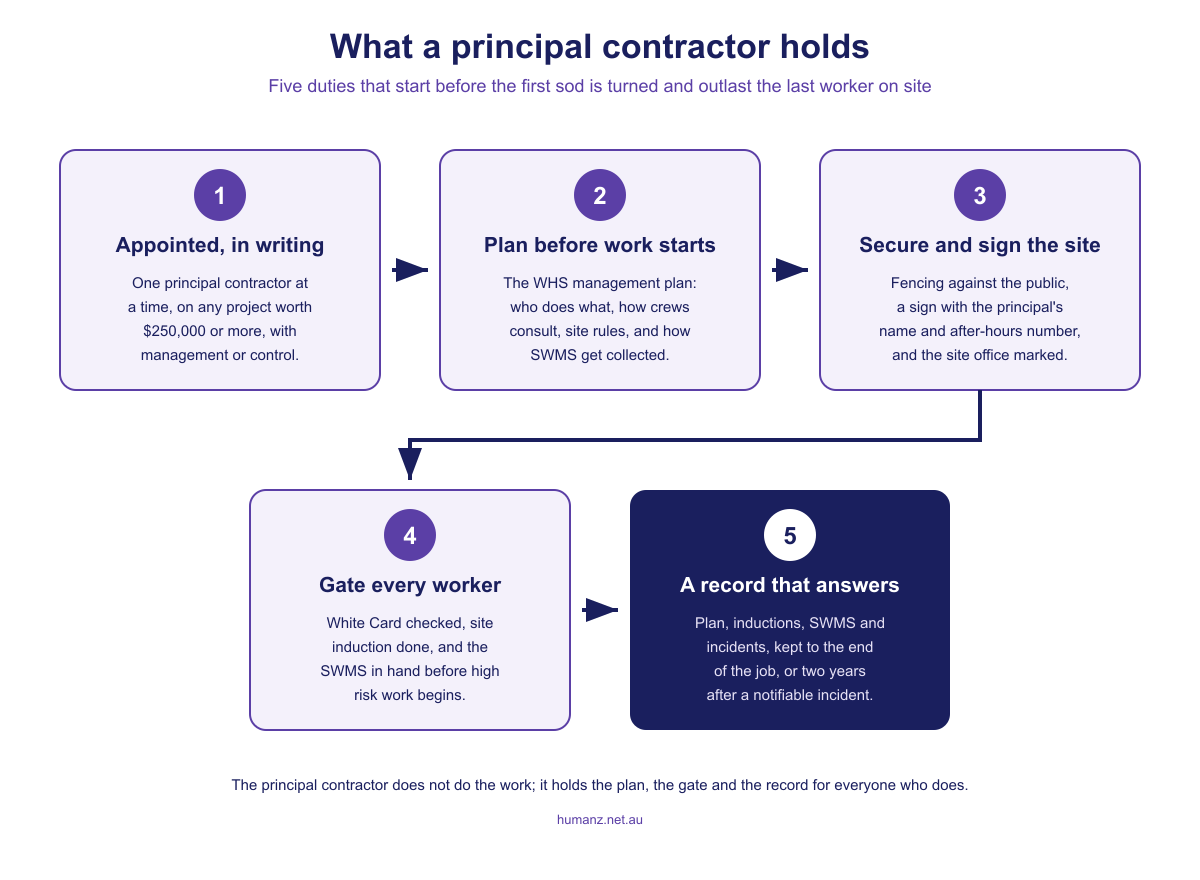
A principal contractor is the business with management or control of a construction project. Under the model WHS Regulations there must be one, and only one at a time, on any project where the construction work costs $250,000 or more. By default it is the client that commissions the work, which can appoint another business, usually the head contractor, by authorising it to have management or control of the site. Its duties are specific: a sign, a written WHS management plan before work starts, a secured site, inductions, SWMS before high risk work, and the records to prove it.
This guide covers who the principal contractor is and how the role is appointed, where the trigger value differs by state, the duties in the order they bite, what they mean for a subcontractor working under one, the contractor induction, and the record set a principal is asked to produce. It is general information, not legal advice. The regulation numbers below are the model WHS Regulations as adopted in Queensland, NSW, the ACT and elsewhere; Victoria runs its own scheme, and the regulator’s page for the state where the work happens is the authority.
Who the principal contractor is
The role is statutory, not a job title. WorkSafe Queensland puts the default plainly: the business that commissions construction work valued at $250,000 or more, often referred to as the client, is the principal contractor. The client can appoint another business as principal contractor by authorising it to have management or control of the workplace, and Queensland recommends that authorisation be documented and signed by both parties. SafeWork NSW says the same from the client’s side: you are the principal contractor unless you appoint one with authority to have management or control of the workplace and discharge the duties. Safe Work Australia adds the rule that trips people up on staged and multi-contract jobs: each construction project must have a principal contractor, and there can only be one at any one time.
Three consequences follow. First, “head contractor” and “builder” are commercial descriptions and “principal contractor” is a legal one; on most projects they land on the same company, but only because the client’s contract appointed it, not because the label carries the role. A construction manager, a developer or the client itself can hold it. Second, a principal contractor cannot be another principal contractor’s subcontractor: Queensland says each principal contractor must be in a contract directly with the client, so a subcontractor that runs a whole separable stage does not become one unless the client appoints it. Third, the appointment should be in writing, in the contract, with the authority to have management or control spelled out, because that authority is what the regulator will look for after an incident.
Homeowners are the exception. An individual who commissions work on their own home is not a person conducting a business or undertaking, so the WHS duties do not sit with them; Queensland’s owner-builder guidance says a home buyer, owner or occupier commissioning work on their home has no duties under the Act, and an owner-builder managing trades carries only the duties of a business. On a residential build over the trigger value, the regulations fill the gap themselves: where the owner of residential premises is an individual, the business they engage is the principal contractor if it has management or control of the workplace (model reg 293(3)), which on a housing site is the licensed builder.
Below the trigger value there is no construction project and no principal contractor. WorkSafe Queensland says a principal contractor cannot be appointed for work under $250,000, and SafeWork SA says a contractor given management or control of a sub-threshold site does not inherit the additional duties. What remains is everything else: the primary duty of every business on the site, and the duty in section 20 of the WHS Act on whoever has management or control of the workplace to ensure, so far as is reasonably practicable, that the workplace, the means of entering and leaving it and anything arising from it are without risks to anyone’s health and safety. A small job is not a duty-free job; it is a job without the extra layer.
The trigger value, state by state
Most published explainers give one figure. The states do not.
| Jurisdiction | Trigger for a construction project | Notes |
|---|---|---|
| NSW, Queensland, ACT, Tasmania, Commonwealth | Construction work costing $250,000 or more | Model WHS Regulations. NSW remade its regulation as the WHS Regulation 2025 on 22 August 2025, and its provisions are now called sections rather than clauses |
| South Australia | $450,000 or more | SafeWork SA’s page; the same appointment rules |
| Northern Territory | $1 million or more | Raised from $500,000 on 28 May 2026, per NT WorkSafe’s amendments summary; the older figure is still on plenty of pages |
| Victoria | $350,000 or more, under the OHS Regulations 2017 | The owner is the principal contractor unless it appoints one; the document is a health and safety coordination plan, prepared before construction begins and kept up to date |
| Western Australia | Five or more people working, or likely to be working, at the same time on the site | A headcount test, not a dollar value, under the WHS (General) Regulations 2022; one principal contractor at a time |
WorkSafe Victoria’s glossary carries the Victorian definition: if the cost of a construction project is $350,000 or more, the owner is the principal contractor unless it appoints one and authorises it to manage or control the workplace. WorkSafe WA states the five-person test and the one-at-a-time rule. NT WorkSafe’s amendments summary records the Territory’s figure rising to $500,000 on 4 April 2016 and to $1 million on 28 May 2026; its news item on the 2016 change gives the earlier figure as $250,000. A contractor working across borders therefore needs the appointment checked per project, not per company: a $300,000 job is a construction project in Brisbane, not in Adelaide or Darwin, and in Perth the question is how many people are on site at once.
The duties, in the order they bite
The principal contractor’s additional duties sit in Part 6.4 of the model regulations (regs 307 to 315), on top of the duties every business on the site already has. The list below runs them in the order a project meets them, and folds in the Part 6.3 and 6.5 duties around site security, SWMS and induction that reach the principal contractor as the business with management or control of the site:
- Signage (reg 308). A sign visible from outside the site with the principal contractor’s name, telephone contact details including after hours, and the location of the site office. The regulation sets no deadline; in practice it goes up before the first worker arrives.
- The WHS management plan (reg 309). Written before work on the project starts. SafeWork NSW and WorkSafe Queensland list the same contents: the names, positions and health and safety responsibilities of everyone with a specific WHS role on the site; the arrangements for consultation, cooperation and coordination between the businesses on the site; the arrangements for managing incidents; the site-specific health and safety rules and how people will be told about them; and the arrangements for collecting, assessing, monitoring and reviewing safe work method statements. Queensland adds that the plan should be easy to understand, and signed and dated by the principal contractor.
- Inform, review, keep (regs 310, 311 and 313). Everyone working on the project is made aware of the plan’s content and their right to inspect it before they start; Queensland says work cannot start until the plan has been discussed with, or a copy given to, everyone relevant. The plan is reviewed and revised whenever the arrangements change, and a copy of it and every revision is kept, available for inspection, until the project is completed, or for at least two years after any notifiable incident.
- Site security (reg 298). The person with management or control of the workplace, which on a construction project is the principal contractor, secures it from unauthorised access so far as is reasonably practicable: fencing, gates, and the signs on this article’s cover. WorkSafe WA’s compliance focus on unauthorised access cites the same regulation number under its 2022 regulations.
- SWMS for high risk construction work (regs 299 to 303 and 312). The business doing the high risk work prepares the SWMS and gives a copy to the principal contractor before the work starts; the principal contractor takes all reasonable steps to obtain it. Queensland expects the principal to sign and date each SWMS received, keep it with the plan and monitor that it is being followed. Our guide to JSAs, SWMS and Take 5s lists the eighteen categories of high risk construction work and what a SWMS has to contain.
- Induction (regs 316 and 317, and the site’s own). No business may direct or allow a worker to carry out construction work without general construction induction training, the White Card, and a card becomes void once its holder has gone two consecutive years without doing construction work. The site-specific induction is separate, and is covered below.
- The site as a whole. WorkSafe Queensland’s duty list rounds out with arrangements for facilities and amenities, and managing the risks that come with construction materials and waste, plant, traffic and essential services, because those belong to nobody’s SWMS in particular and to the site as a whole.
None of that displaces the other businesses’ duties. Safe Work Australia’s construction duties page says a person cannot eliminate their health and safety duties by subcontracting all or part of the work to another business, and that more than one person can have the same duty at the same time. The principal contractor holds the site; the subcontractor still holds its own workers and its own work.
What it means for a subcontractor
Working under a principal contractor changes what you are asked for, not what you owe. Your primary duty to your own workers, your duty to prepare a SWMS for your own high risk work and to work to it, and your duty to consult are all yours. What the principal adds is the gate: a set of documents and checks it needs from you to discharge its own duties, and which its WHS management plan says it will collect.
The list is remarkably consistent across principals and the prequalification schemes that front for them:
- Current insurances, as certificates of currency for public liability at the limit the contract specifies and for workers’ compensation, and the certificate of currency checked rather than filed.
- Licences and tickets for every worker: White Cards, high risk work licences, plant tickets, verifications of competency.
- A SWMS for every high risk construction work activity, submitted and reviewed before the work starts, and updated when the controls change.
- A safety management plan or system, a WHS policy, a risk register, and sometimes a training matrix.
- Evidence of inductions: the general construction induction card, and completion of the principal’s site induction.
- Drug and alcohol, fitness for work and incident reporting arrangements that match the site rules.
Then the contract adds its own layer, which is where “the law does not require it” stops being an answer. A principal contractor’s site rules can and often do require a daily prestart, a stop-work temperature, sign-in at the gate, and a defined notification path for incidents. They apply because you signed the contract, and the principal’s plan is where they are written down. Our subcontractor onboarding checklist covers assembling the pack once so it can be produced for every principal.
Two cautions. Reviewing a subcontractor’s SWMS does not move the subcontractor’s duty to the principal, because duties are held concurrently, and it does not make the principal the author of the method; the review is a check that a SWMS exists and addresses the hazards of the work as it will actually be done. And the principal’s duty to take all reasonable steps to obtain a SWMS before high risk work starts is its own, whether or not the subcontractor volunteered one.
Contractor induction: the White Card is not the site induction
The White Card proves general construction induction training, once, for the whole industry. The site induction covers this site, and it is the one a principal contractor runs and records. WorkSafe WA says it directly: the training required by the regulations is not designed to take the place of work site or task specific instruction, training or supervision. WorkSafe Queensland goes further and requires a site-specific induction before construction work other than housing construction work, provided by the principal contractor and covering the nature of the work, the risks and the controls. WorkSafe ACT says a workplace-specific induction should be given before work starts or before a person enters an operational construction zone. South Australia does not make it compulsory on residential building work, but says that where no site-specific induction is given it is important to communicate the contents of the WHS management plan or site safety plan, by phone or email if need be.
A site induction that does its job covers the site rules and the plan, the hazards specific to the site and its stage, the emergency plan, first aid and the muster point, the sign-in and sign-out arrangement, permits, PPE, who the supervisors and health and safety representatives are, and how to report a hazard or an incident. It is repeated per site and per principal: a subcontractor cleared on one principal’s site is not cleared on the next, and our guide to onboarding field workers covers how that repetition gets managed without a filing cabinet. The record is the worker’s name, the date, what was covered and their acknowledgement, and it is the first thing an inspector asks a principal for after an incident, because it shows who was told what before they started.
The record set a principal contractor is asked for
After an incident the questions arrive in a predictable order, and the answers are all records. The WHS management plan and every revision, with the dates. The induction register, with each worker’s acknowledgement. The SWMS register for the high risk work, with the version the crew signed on to. The incident, hazard and near-miss reports. The prestart and toolbox talk records that show the consultation arrangements in the plan were actually run. The credential and insurance evidence for every subcontractor on site. The site diary.
The plan and its revisions are kept until the project is completed, or for at least two years after a notifiable incident, and the rest is kept for as long as it might be asked for, which in practice means at least as long. The cost of not having it is visible in the regulators’ prosecution pages. On 30 April 2026 the District Court of NSW fined Acon Projects Pty Ltd $480,000 and its director $20,000 over a worker’s fall of about three metres on a site where the company was engaged as principal contractor. Queensland’s court summaries include a 2019 case in which the principal contractor and builder in control of a Balmoral housing site was fined $110,000 under the management-or-control duty after a subcontractor’s worker fell into an unbarricaded trench beside the only access path; the only people on site that day were the subcontractor’s. Construction recorded 37 of Australia’s 188 worker deaths in 2024, a rate of 2.8 per 100,000 workers against 1.3 across all industries, according to Safe Work Australia’s Key Work Health and Safety Statistics.
How Humanz fits
Humanz holds the workforce half of the record. Every worker, whether employee, labour hire or subcontractor, carries a compliance profile with their White Card, high risk work licences, tickets, VOCs and site inductions and their expiry dates, and every subcontractor entity carries its ABN, insurances and licences beside them. The scheduler checks those at engagement and again at every booking, so a worker without the induction for that site, or a subcontractor whose certificate of currency lapsed on Friday, is flagged or blocked before the shift confirms rather than discovered at the gate, and the compliance rules are set per client and per site, because clearance on one principal’s project does not carry to the next. Site inductions, prestarts, SWMS sign-ons and incident reports are completed on phones as custom forms, timestamped and stored against the job, which is the induction register, the sign-on record and the incident file in one place. All of it sits inside the platform the civil and construction crews already use for the roster, and the subcontractor management page covers how the subbie profile and the gate work together.
Humanz is not a document control system for the WHS management plan, does not decide what counts as high risk construction work, and does not discharge a principal contractor’s duties for it. It holds the credential, induction and site records those duties depend on, and produces them when asked. If your subcontractor pack still lives in email attachments, book a walkthrough and bring one; we will show you where each document lands.
Frequently asked questions
What is a principal contractor?
A principal contractor is the business with management or control of a construction project under Australia’s WHS laws. There must be one, and only one at a time, on any project at or above the state’s trigger value ($250,000 or more under the model regulations). It carries additional duties on top of every business’s ordinary WHS duties: signage, a written WHS management plan, site security, obtaining safe work method statements for high risk work, inductions, and keeping the records.
Who is the principal contractor on a construction project?
By default, the business that commissions the construction work, usually called the client. The client can appoint another business, typically the head contractor, by engaging it and authorising it to have management or control of the workplace and to discharge the principal contractor’s duties. The regulation does not require writing, but WorkSafe Queensland recommends the appointment be documented and signed by both parties, and that is what a regulator looks for after an incident. An individual having work done on their own home is not a business and holds no WHS duties. On a residential build the regulations make the business the homeowner engages the principal contractor if it has management or control of the site, which is normally the licensed builder.
What is the principal contractor threshold in each state?
Construction work costing $250,000 or more in NSW, Queensland, the ACT, Tasmania and under Commonwealth law; $450,000 in South Australia; $350,000 in Victoria under its OHS Regulations, where the document is a health and safety coordination plan; $1 million in the Northern Territory since 28 May 2026; and in Western Australia a headcount test of five or more people working at the same time rather than a dollar value.
What must a WHS management plan contain?
The names, positions and health and safety responsibilities of everyone with a specific WHS role on the site; the arrangements for consultation, cooperation and coordination between the businesses working there; the arrangements for managing incidents; the site-specific health and safety rules and how people will be told about them; and the arrangements for collecting, assessing, monitoring and reviewing safe work method statements. It is written before work starts, everyone is made aware of it, it is reviewed when arrangements change, and it is kept until the project is complete or, if a notifiable incident occurs, for at least two years after the incident.
Is the head contractor always the principal contractor?
No. Head contractor and builder are commercial descriptions; principal contractor is a legal role that starts with the client and moves only by appointment. On most projects the client appoints the head contractor, so the two coincide, but a construction manager, a developer or the client itself can hold the role, and a subcontractor running a stage cannot be a principal contractor unless the client appoints it directly.
Does a subcontractor have WHS duties when there is a principal contractor?
Yes, all of them. A business cannot eliminate its duties by subcontracting, and more than one business can hold the same duty at once. The subcontractor keeps its primary duty to its own workers, its duty to prepare and follow a SWMS for its own high risk work, and its consultation duty. The principal contractor adds the site-level duties and the documents it collects from subcontractors to discharge them.
Related articles
Ready to see Humanz on your own roster?
Free 30-minute walkthrough, we'll use your real crews, sites and shift patterns.