
 Login
Login 

Compliance, Fatigue & Safety
WHS Compliance Software in Australia: What It Has to Do on a Real Site
By Christian Tietzel · 18 August 2026 · Updated 28 September 2026

WHS software is the system an Australian business uses to keep its work health and safety records in one place: licences and tickets, inductions, prestarts and SWMS sign-ons, hazard and incident reports, and the audit trail behind them. Victorians call it OHS software. The useful kind also checks those records before work is assigned.
Vendors sell it as WHS management software, workplace health and safety software, WHS compliance software or a safety management system, and the labels cover an enormous range of products. At one end sits a document library with an expiry date field. At the other sits a system that will not let a worker be booked onto a job they are not cleared for. Both wear the same labels, and the difference only becomes obvious the first time something goes wrong.
This guide covers what the category includes, what Australian WHS law actually asks of you, where compliance fails on real sites, and the single question that separates software that prevents incidents from software that documents them.
What is WHS software, and what does it cover?
The category is wider than any one product. These are the parts a full system is expected to hold, and the question that shows whether each part does anything.
| Part of the system | What it holds | What to check in a demo |
|---|---|---|
| Credential and licence register | Licences, tickets, medicals and competencies per worker, with expiry dates | Whether an expired ticket blocks a booking or only sends an email |
| Inductions and training | Company, client and site inductions, who delivered them and when they lapse | Whether clearance is recorded per site rather than as one flag |
| Safety forms | Prestarts, take fives, JSAs and SWMS sign-ons | Whether a form can be completed with no signal and lands centrally once the phone is back in range |
| Hazard and incident reporting | Hazard, near-miss and incident reports with photos and follow-up actions | Whether every action has an owner and a due date |
| Risk register | Identified hazards, their ratings and the controls chosen | Whether the controls connect to the forms crews actually fill in |
| Audits and inspections | Scheduled inspections, findings and corrective actions | Whether a finding becomes a tracked action or stays in a PDF |
| Contractor management | Subcontractor insurances, licences and worker credentials | Whether subbies sit in the same record and the same gates as employees |
| Fatigue and hours | Shift lengths, breaks and consecutive days against a policy | Whether the check runs before the roster is published |
| Evidence trail | Who recorded, approved and changed each record | What one worker’s export looks like across a date range |
No product is equally strong in every row. Dedicated safety management systems tend to be strongest on risk registers, audits and investigations. Workforce platforms tend to be strongest on the people rows: credentials, inductions, forms, fatigue and the roster that ties them together. Which rows matter most depends on what the law asks of you and where your own compliance fails, which the next sections cover.
What the law asks before any software exists
Most of Australia operates under the model Work Health and Safety laws, developed by Safe Work Australia and enacted separately in each jurisdiction. Victoria is the notable exception, running its own Occupational Health and Safety Act. Western Australia came across to the WHS model relatively recently, which matters if your procedures were written before that.
The scale being weighed is not abstract. Safe Work Australia’s Key Work Health and Safety Statistics for 2025 count 188 workers killed by traumatic injuries in 2024, a rate of 1.3 per 100,000 workers, and 146,700 serious workers’ compensation claims in 2023-24, each involving at least a week of lost working time. That is the harm “reasonably practicable” gets weighed against. The frequency rates behind those figures, and the LTIFR and TRIFR a contractor reports beside them, are covered in our TRIFR and LTIFR guide.
Four duties drive almost everything a compliance system needs to do.
The primary duty of care. A person conducting a business or undertaking must ensure, so far as is reasonably practicable, the health and safety of workers. “Reasonably practicable” is the phrase doing the work: it weighs the likelihood and degree of harm against what it would take to eliminate or minimise it. It is not “we did our best”.
Hazard identification and control. You are expected to identify hazards, assess them and control them systematically, working down the hierarchy of controls rather than reaching for a sign and a toolbox talk.
Consultation. There is a positive duty to consult workers on matters that affect their health and safety, and to consult other duty holders you share a workplace with. On a site with a principal contractor and six subcontractors, that last part is not a formality.
Officers’ due diligence. Officers have a personal duty to take reasonable steps to understand the hazards, ensure resources are available, and verify that the safety processes are actually being used. That last word is where software either helps or quietly hurts, because a system full of untouched records is evidence of the wrong thing.
The obligations are written to be industry-agnostic. What changes between a warehouse and a shutdown is not the duty, it is how much has to be tracked and how fast it moves.
WHS software or OHS software: same job, different name
Ask a Mackay contractor about this category and you’ll hear WHS software. Ask a Geelong one and it becomes OHS software. The split follows the legislation, not fashion. Victoria never adopted the model WHS Act and still runs its Occupational Health and Safety Act 2004 under WorkSafe Victoria. Every other state and territory has enacted the model laws, with Western Australia the last across when its WHS Act took effect on 31 March 2022. So OHS software and WHS software are the same category of product, and the label mostly tells you which side of the Murray the buyer sits on.
That makes the label the least useful thing to evaluate. The useful question is whether the tool handles the framework your regulator enforces, because the differences run deeper than the acronym. The Victorian Act places its duties on employers and employees. The model laws place them on a person conducting a business or undertaking and its workers, which is a deliberately wider net. A product built around one vocabulary will still track tickets and expiry dates in the other jurisdiction, but its forms, duty-holder fields and exported reports will use words your inspector doesn’t, and an incident file should not need translating.
And if you work both sides of the line, you need both vocabularies at once. A civil contractor with crews in Mildura and over the bridge in Buronga answers to WorkSafe Victoria on one bank and the NSW regulator on the other, sometimes with the same workers in the same week. The system holding those records has to know which framework applies at each site, rather than running one national template with the state field left blank.
Safe Work Australia writes the model laws but is not a regulator. Its list of WHS regulators names the body that enforces them in each jurisdiction, and the date each one took the model laws up.
| Jurisdiction | Framework | General regulator |
|---|---|---|
| New South Wales | Model WHS laws, since 1 January 2012 | SafeWork NSW |
| Queensland | Model WHS laws, since 1 January 2012 | Workplace Health and Safety Queensland |
| Victoria | Occupational Health and Safety Act 2004 | WorkSafe Victoria |
| Western Australia | Model WHS laws, since 31 March 2022 | WorkSafe WA |
| South Australia | Model WHS laws, since 1 January 2013 | SafeWork SA |
| Tasmania | Model WHS laws, since 1 January 2013 | WorkSafe Tasmania |
| Northern Territory | Model WHS laws, since 1 January 2012 | NT WorkSafe |
| Australian Capital Territory | Model WHS laws, since 1 January 2012 | WorkSafe ACT |
| Commonwealth (Australian Government and self-insured licensees) | Model WHS laws, since 1 January 2012 | Comcare |
New South Wales and Queensland also split the resources sector out. SafeWork NSW covers the state’s workplaces except mines and petroleum sites, which belong to the NSW Resources Regulator, quarries included. Resources Safety and Health Queensland is the regulator for mining, quarrying, petroleum, gas and explosives. A contractor with crews on a Hunter mine site and a Sydney building site answers to two regulators inside one state, which is one more reason a single national template gets the paperwork wrong somewhere.
Where compliance actually fails
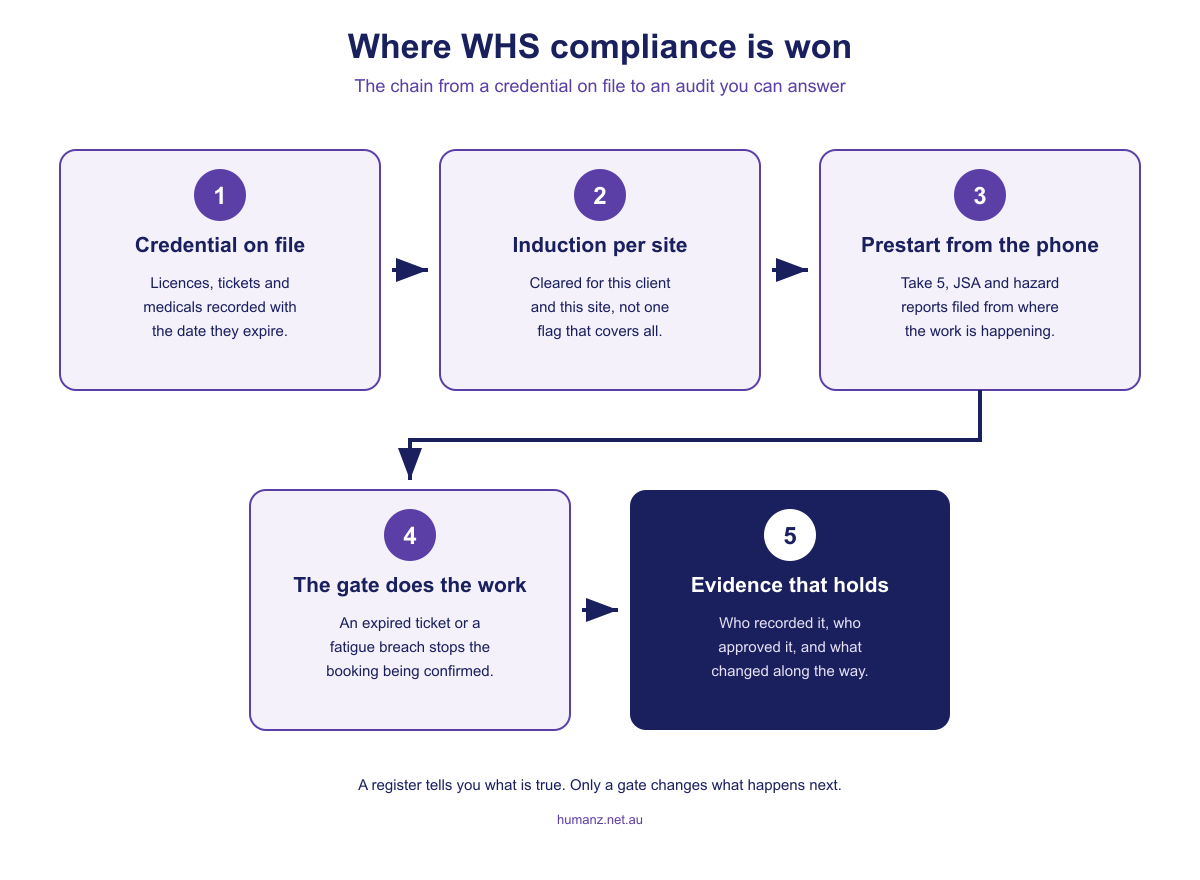
Almost nobody fails because they had no policy. The policy is usually excellent. Compliance fails in the space between the policy and the moment work is allocated.
A credential expires quietly. A high risk work licence lapsed on the weekend. The register knows. The person building Monday’s roster does not, because the register is a different system that nobody opens while rostering.
An induction was never done for this site. The worker is inducted for your business and for the client’s Karratha site, then gets sent to the client’s other site an hour up the road, which has its own induction and its own gate.
The prestart was completed, on paper, and is now in a ute. It exists. It cannot be produced. For evidentiary purposes those are close to the same thing.
Fatigue limits were breached by a combination nobody could see. No single roster looked wrong. The worker picked up shifts across two sites and two coordinators, and the total only exists if something adds it up.
The toolbox talk happened and was never recorded. Genuine consultation occurred. Six months later there is no way to demonstrate it.
Every one of those is a systems failure rather than a safety-culture failure, which is the useful part: systems failures are fixable with software, and culture problems are not.
What WHS compliance software has to do
Against those failure modes, the requirements write themselves.
A credential register that knows about dates. Every licence, ticket, induction, medical and competency, per worker, with expiry dates and alerts that fire before the lapse rather than after. Alerts need to reach the worker as well as the office, because the person who can renew a licence is usually the person who holds it.
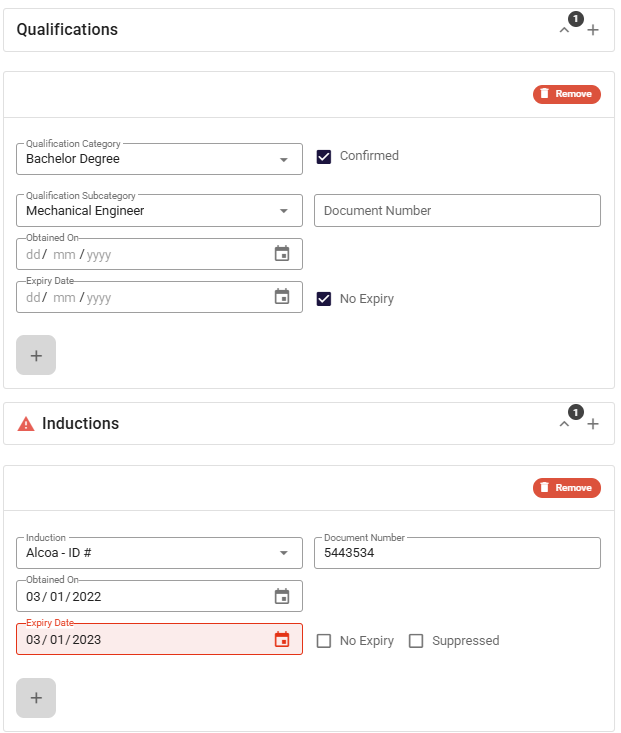
Site-specific induction tracking. Not “inducted”, but inducted for what, by whom, when, and until when. Australian field businesses routinely work across multiple clients and sites with incompatible requirements. A single flag cannot represent that.
Digital forms that come back. Prestarts, take fives, JSAs, SWMS sign-ons, hazard reports and incident reports, completed on a phone at the point of work and landing somewhere central immediately. Paper does not fail because it is paper. It fails because it stays where it was filled in.
Fatigue as a rule, not a report. Hours and patterns evaluated against a policy at the point of scheduling. Safe Work Australia treats fatigue as a hazard like any other, which means it is subject to the same identify, assess and control obligation, and a control you apply after the roster is published is not much of a control.
One record for employees and contractors. Your duty extends to workers you direct or influence, not only the ones on your payroll. If subbies live in a separate spreadsheet, you have a compliance system covering part of your workforce, which is a compliance system with a hole in it.
An evidence trail that survives someone leaving. Who recorded it, who approved it, what changed, when. Not because an inspector will definitely ask, but because the alternative is reconstructing events from memory and a WhatsApp thread. And don’t assume an official record exists somewhere else. The ABS Work-Related Injuries survey found only 31% of injured workers received workers’ compensation, and 12% never reported the injury to anyone at their workplace. Your own records are usually the only complete ones.
The question that separates real from decorative
Here is the test. Ask a vendor:
When a worker’s ticket has expired, can your system stop them being rostered onto a job that requires it? Or does it send someone an email?
The gap between those two answers is the whole category.
A register tells you what is true. A gate acts on it. Registers are useful and most products have one, because a register is a database with dates in it and is not hard to build. Gates are harder, because a gate has to live inside the scheduling workflow, which means the compliance data and the roster have to be the same system, or connected well enough to behave like it.
This is why “we integrate with your rostering tool” deserves a follow-up question. Integration that syncs overnight cannot stop a booking made at 4pm. The compliance check has to happen at the moment of allocation, or it is a report about a decision already taken.
The same logic applies to fatigue. A fatigue report tells you that someone worked 14 days straight. A fatigue gate stops the fourteenth being booked. Only one of those is a control.
What to ask a vendor
Seven questions, ordered so the disqualifying ones come first.
- Can it block an allocation, or only flag one? As above. Everything else follows.
- Does it handle site-specific inductions, not just company ones? Multi-client field work breaks single-flag models immediately.
- Are subcontractors first-class? Same profile structure, same expiry logic, same gates as employees.
- Do alerts reach the worker? Office-only alerts create an admin queue rather than a renewal.
- Do forms work with no signal? Remote sites lose coverage. Anything that requires a live connection to submit a prestart will be worked around by 7am, and a lone worker’s start-of-shift check-in is exactly the form that gets completed where there is none.
- What does the audit export look like? Ask to see one for a single worker across a date range. Vague answers here are informative.
- Where does it stop? A product that claims to do WHS, HR, payroll, project costing and fleet is describing an ambition.
If the exercise starts to feel like buying paperwork, Deloitte Access Economics modelling for Safe Work Australia is a useful corrective. It found Australia’s economy would be $28.6 billion larger each year, on average, without work-related injury and illness, with 185,500 more full-time jobs in it. Compliance spend is a small hedge against a very large number.
Where it sits next to everything else
WHS compliance is not a standalone category so much as a property of the systems you already run. The credential data is the same data your rostering needs. The induction record is part of onboarding. The prestart is a form. The fatigue policy is a rostering rule. The incident report is a document with a workflow.
Which is why buying a separate WHS product often creates the exact problem it was bought to solve: a second system, holding a second copy of the truth, that the people building rosters do not have open. If your compliance data and your scheduling live apart, someone becomes the integration, and that someone is usually a coordinator at 6am.
For construction specifically, the site-level version of this is covered in our construction site compliance checklist. For the credential side in depth, see tracking qualifications, inductions and credentials. Record-keeping obligations overlap with pay as well, and Fair Work’s requirements are more specific than most businesses expect.
How Humanz handles WHS compliance
Humanz is an Australian-built workforce management platform for field operations in construction, mechanical contracting, mining services, drilling, civil and trades. Compliance is not a module bolted to the side of it. It sits inside scheduling, which is the only place it can change an outcome.
In practice that means every worker carries a profile of licences, tickets, inductions, medicals and competencies with expiry dates attached, and alerts go to the worker and the office well before anything lapses. Site and client inductions are tracked separately, so being cleared for one site says nothing about the next. Prestarts, take fives, JSAs and hazard reports are completed on the phone at the point of work and land centrally as they are submitted. Fatigue policies evaluate every booking before it is confirmed, and a breach surfaces with the worker, the date and the amount, so a coordinator can fix it or override it with the decision on record.
Subcontractors sit in the same structure as employees, with the same expiry logic and the same gates, because a compliance system that covers half your crew is not one. And every record carries who entered it, who approved it and what changed, which is the part that matters long after everyone has forgotten the day itself.
To see it against your own credential matrix and site requirements, walk through it with our team.
Frequently asked questions
What is WHS software?
WHS software is a system for managing work health and safety records and processes in one place, including credentials and licences, inductions, safety forms, hazard and incident reports, and the audit trail behind them. It is also sold as WHS management software, WHS compliance software and, in Victoria, OHS software. The more capable products apply those records as rules when work is allocated, rather than only storing them for reporting.
Is OHS software different from WHS software?
No, they’re the same category of product under two names. Victoria never adopted the model WHS laws and still runs its own Occupational Health and Safety Act, so Victorian buyers say OHS where everyone else says WHS. What’s worth checking isn’t the label but whether the tool handles the framework your regulator enforces, since forms, duty-holder fields and exported reports should use the vocabulary your inspector does.
Is WHS software a legal requirement in Australia?
No, not on our reading of the laws. The model WHS laws and Victoria’s OHS Act set duties rather than naming tools: manage risks so far as is reasonably practicable, consult workers and keep certain records, and none of them requires those records to be kept in software. A paper system that meets the duties can comply. Software earns its place when paper and spreadsheets can no longer show who was cleared for a job on the day it was done.
Do the same WHS laws apply in every Australian state?
Not quite. Every jurisdiction except Victoria has enacted the model WHS laws, but each does so through its own Act and regulator, and Victoria operates under separate occupational health and safety legislation. The core duties are broadly consistent, while specific regulations, codes of practice and notification requirements vary, so multi-state businesses need to check each jurisdiction they work in.
What is the difference between a compliance register and a compliance gate?
A register stores credentials and their expiry dates and can report on them. A gate applies that information at the moment work is allocated, preventing a worker being rostered onto a job they are not currently cleared for. A register tells you what happened; a gate changes what happens.
Does WHS compliance software need to cover subcontractors?
Yes. Work health and safety duties extend to workers a business directs or influences, not only direct employees. If subcontractor credentials sit outside the system used to allocate work, the compliance picture is incomplete precisely where blended crews make it hardest to keep track.
Does WHS compliance software replace a safety manager?
No. It removes the manual tracking that consumes a safety manager’s week, such as chasing expiry dates and collecting paper forms, so the role can concentrate on risk assessment, consultation and site presence. The obligations remain with the business and its officers regardless of what software is used.
Related articles
Ready to see Humanz on your own roster?
Free 30-minute walkthrough, we'll use your real crews, sites and shift patterns.