
 Login
Login 

Subcontractors
The Subcontractor Onboarding Checklist: What to Collect Before Day One
By Christian Tietzel · 25 August 2026 · Updated 6 October 2026

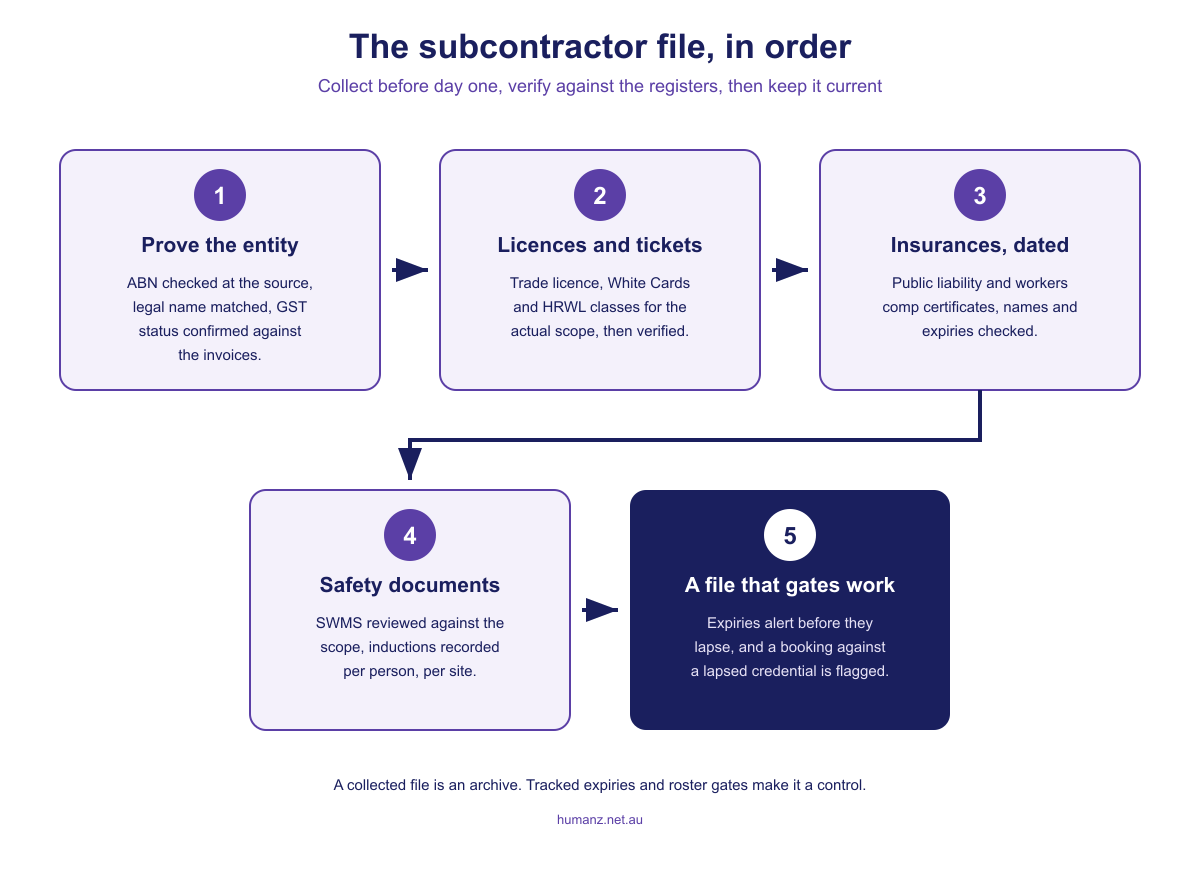
A subcontractor onboarding checklist for Australia has five parts: the entity (ABN, GST and the company behind the name), licences and tickets for the actual scope, insurances with the dates and the entity checked, the safety documents (SWMS, induction and who signed what), and the two traps that catch people after the file looks complete, starting with superannuation on labour-only contracts.
Engaging a subcontractor is a paperwork problem before it is a scheduling one. The day a subbie’s ute first rolls onto your site, your business inherits a slice of responsibility for who they are, whether they’re licensed for the work, what happens if something goes wrong, and in some cases whether you owe them superannuation. All of that is decided by documents, and the documents are far easier to collect before day one than to chase afterwards.
This is the Australian document set in the order worth collecting it, with the reason each item exists. It is written for engaging a subcontracting business. Getting an individual worker site-ready is a different process, covered in onboarding field workers.
One scope note before the list: this checklist is about the file. How to verify the licences and tickets in it, register by register and state by state, is its own job, and we’ve written it up separately in how to check a contractor licence, White Card or high risk work ticket. Collect first, verify second, and treat them as two distinct steps, because a document that was never checked against its register is a photocopy, not a control.
1. Prove the entity exists: ABN, GST and the company behind the name
Start with the business, not the tradesperson, because everything else in the file hangs off the entity you are actually contracting with.
ABN, checked at the source. Don’t file the number the subbie emailed you; look it up on ABN Lookup and file what the register says. You are checking three things: the ABN is active, the entity name matches the name on the quote and the insurance certificates, and the GST registration status matches the invoices you’re about to receive. A subbie charging GST on an ABN that isn’t GST-registered is a problem you want to find in week zero, not at BAS time.
Trading name versus legal name. The name on the ute is routinely not the name on the ABN. Contract with the legal entity, and make sure the insurances name the same entity, or the certificate of currency you’re holding may cover a business that technically isn’t the one on your site.
Company extract, where it matters. For larger engagements with a Pty Ltd, a current extract from ASIC’s registers tells you the company exists, who its directors are, and whether it is in external administration. For a one-person sole trader this is overkill. For the subcontractor carrying your structural steel package, it is cheap insurance. ASIC’s insolvency statistics say why. In 2024-25, 14,722 companies entered external administration, up 33.2% from 11,053 the year before, and construction topped the industry list in 2023-24 with 2,975 companies, 27% of all external administrations. A subbie entity failing mid-job isn’t bad luck in this sector. It’s a base rate.
2. Licences and tickets, for the actual scope
The licence question is not “do they have a licence?” but “does the licence cover this scope, in this state, right now?”
- Trade or contractor licence where the work is licensed in your state: electrical, plumbing, gas, building work above the licensing thresholds. State registers differ enormously in what they show.
- White Card for anyone doing construction work, which is national but issued per state, so how you check a White Card depends on which state issued it.
- High risk work licence for the specific class the scope needs: a dogging ticket does not cover rigging, and a basic rigging ticket does not cover advanced.
- Verification of Competency for plant, where your client or your own policy requires one. A licence says someone passed once; a VOC says they can still operate the machine you’re putting them on.
Collect copies with expiry dates into the file, then verify them against the registers. The companion guide walks every register and the traps, including the classes that don’t cover the scope they sound like they cover.
3. Insurances, with the dates and the entity checked
Three insurance questions, in descending order of how often they go wrong:
Public liability. Ask for the certificate of currency, not a photo of last year’s. Check the insured name matches the ABN entity, the expiry date is beyond your engagement, and the cover amount meets whatever your head contract or client requires, since principal contractors commonly must hold evidence of their subbies’ cover.
Workers compensation, or the sole trader gap. If the subbie has employees, they generally must hold workers compensation for them (NSW and Victoria exempt some of the very smallest employers), and you want the certificate. If they are a sole trader, in general they cannot cover themselves under a workers compensation policy, which is precisely why many principals require sole traders to hold personal accident and income protection insurance instead. Know which situation you’re looking at, because “they’ll be covered by workers comp” is often quietly untrue for the person driving the ute.
Anything scope-specific. Professional indemnity for design work, motor vehicle for plant moving on public roads, marine transit if they’re carting your gear.
Every certificate goes in the file with its expiry date recorded, because an insurance certificate is a snapshot: currency at collection proves nothing about currency in month four of the job.
4. The safety documents: SWMS, induction, and who signed what
SWMS before high risk construction work. If the scope includes any class of high risk construction work under your state’s regulations (eighteen under the model WHS Regulations, nineteen under Victoria’s own list), a safe work method statement must exist before that work starts. Safe Work Australia’s SWMS guidance covers when one is needed, and how a SWMS differs from a JSA or a Take 5 covers the forms around it. Collect it, review it against the actual scope rather than filing it unread, and keep the version you reviewed, because a generic SWMS with the wrong site name on it helps nobody in an investigation. On a construction project the principal contractor’s own duty is to take all reasonable steps to obtain it before the work starts; what a principal contractor is and what it collects covers that side of the table.
Site and company induction records. The subbie’s people need your induction and, on many jobs, the client’s site induction too. Record who was inducted, for which site, on what date, and until when. One flag saying “inducted” cannot represent a workforce that moves between clients with incompatible requirements.
The engagement terms themselves. A signed subcontract or at minimum a purchase order referencing your terms: scope, rates, insurances required, safety obligations, and what happens on variation. The best time to agree what a wet day costs is before the first one.
5. The two traps that catch people after the file looks complete
The super trap on labour-only contracts. An ABN does not switch off superannuation. Under the super guarantee rules, a contractor paid wholly or principally for their labour is treated as an employee for super purposes, even with an ABN, even with invoices. The ATO’s guidance on super for independent contractors sets out the test. If you’re engaging one person, for their labour, paid by the hour, budget for super or get advice, because discovering this at audit time means back-payments. And since the move to payday super, the cost of getting worker classification wrong surfaces faster than it used to.
Sham contracting. Engaging someone as a contractor when the reality of the arrangement is employment is unlawful, and “they have an ABN” is not a defence. The Fair Work Ombudsman’s sham contracting guidance is the reference. The checklist above assumes a genuine subcontracting business: its own entity, its own insurances, its own tools, some control over how the work is done. If what you actually want is a worker under your direction on your roster every day, engage them as one.
The checklist, in one place
In collection order:
- ABN checked on ABN Lookup: active, name match, GST status
- Legal entity name confirmed against the quote and insurances
- ASIC company extract, for engagements that warrant it
- Trade or contractor licence for the scope, this state
- White Cards for everyone coming to site
- High risk work licences for the specific classes needed
- VOCs where client or policy requires them
- Public liability certificate of currency: name, amount, expiry
- Workers comp certificate, or personal accident cover for sole traders
- Scope-specific insurances where relevant
- SWMS for any high risk construction work, reviewed not just filed
- Induction records per person, per site, with dates
- Signed subcontract or purchase order
- The super and sham-contracting questions answered honestly
Then verify the licences and tickets against their registers, record that you did, and diarise every expiry date in the file.
Where the file lives decides whether it keeps working
Collecting the file once is a fortnight of emails. Keeping it current is the part that breaks, because every document in it expires on its own schedule while the subbie keeps getting booked.
This is the argument for the file living where the booking happens rather than in a folder. When subcontractor profiles sit on the same platform that runs the roster, an expiring insurance or licence alerts you and the subbie before it lapses, and a booking against a lapsed credential gets flagged before it’s confirmed instead of discovered at the gate. The subbie’s hours then land on the same timesheets as your employees’, which is what keeps the downstream invoicing clean.
The file you collected becomes a control instead of an archive. That is the entire difference between subcontractor onboarding as a one-off admin task and subcontractor management as something your operation can rely on.
To see how subbie profiles, expiry alerts and roster gates work against your own compliance requirements, walk through it with our team.
Frequently asked questions
What documents do I need to collect from a subcontractor in Australia?
The core set is an ABN verified against the register, the legal entity name, any trade or contractor licence the scope requires, White Cards and high risk work licences for the people coming to site, a public liability certificate of currency, workers compensation or personal accident cover, a SWMS for any high risk construction work, induction records, and a signed subcontract or purchase order.
Can a subcontractor start work before their onboarding file is complete?
Not on anything the missing documents cover. A SWMS must exist before any high risk construction work starts, and letting someone on site before licences and insurances are checked hands you exactly the risk the file exists to control. If the start date can’t move, narrow the day-one scope to work the completed parts of the file support.
Is a purchase order enough, or do I need a signed subcontract?
A purchase order referencing your standard terms is the workable minimum for smaller scopes. Whichever form you use, it needs to cover scope, rates, required insurances, safety obligations and what happens on variation. For larger or higher-risk packages a signed subcontract is worth the effort, because agreeing what delays and variations cost is far cheaper before the job than mid-argument.
Do I have to pay super to a subcontractor with an ABN?
Sometimes, yes. Under the superannuation guarantee rules, a contractor paid wholly or principally for their labour is treated as an employee for super purposes regardless of holding an ABN or issuing invoices. Single-person, labour-only, hourly-paid arrangements are exactly the pattern the rule captures, so get advice before assuming the ABN settles it.
Do sole trader subcontractors need workers compensation?
Generally a sole trader cannot cover themselves under a workers compensation policy, since those policies cover a business’s workers rather than its owner. That is why many principal contractors require sole traders to hold personal accident and income protection insurance instead, and why the distinction between a sole trader and a subbie company with employees matters when collecting certificates.
How often should subcontractor documents be re-checked?
Every document with an expiry date needs re-checking at or before that date: insurances annually at renewal, licences and tickets on their own cycles, and inductions when a site or client requires refreshers. A file that was complete at onboarding decays from that day forward, which is why expiry tracking matters more than the initial collection. The entity itself deserves the same schedule. The Australian Bureau of Statistics’ Counts of Australian Businesses puts the annual business exit rate at 13.8%, with 375,331 of 2,814,778 businesses exiting in the latest count, so the ABN you verified at onboarding belongs to a population where roughly one business in seven leaves each year.
What is the difference between onboarding a subcontractor and onboarding an employee?
Onboarding a subcontractor means verifying a business: its entity, licences, insurances and safety documentation. Onboarding an employee means setting up a person: tax and super details, inductions, training and their profile in your systems. The two produce different files and different obligations, and blurring them is how sham contracting problems start.
Related articles
Ready to see Humanz on your own roster?
Free 30-minute walkthrough, we'll use your real crews, sites and shift patterns.