
 Login
Login 

Industries
FIFO, DIDO and BIBO: What Each Means and What Each Asks of a Roster
By Nanci · 22 September 2026

FIFO (fly-in fly-out) means workers fly to a remote site, work a block of consecutive shifts called a swing while living in camp, then fly home for a block of days off. DIDO (drive-in drive-out) is the same arrangement by road, in the worker’s own vehicle or a company one. BIBO (bus-in bus-out) moves the crew by company bus, either to camp for the whole swing or to site each day from a nearby town. All three exist because the work is too far from where people live to commute normally, and each one asks something different of the roster.
This guide is written for the people who run those rosters, not for someone deciding whether to take a FIFO job. It covers what each model is, where it is used, what it does to the shape of a swing, and where the fatigue risk sits in each. It is general information, not safety or employment advice.
FIFO, DIDO and BIBO at a glance
| FIFO | DIDO | BIBO | |
|---|---|---|---|
| How the crew travels | Charter or commercial flight | Drives, own vehicle or company vehicle | Company or contracted bus |
| Typical distance | Too far to drive: the Pilbara from Perth, the Bowen Basin from Brisbane | A few hours from a regional centre, or a daily commute from town | An hour or two from a regional town, or a park-and-ride |
| Where the crew sleeps | Camp for the whole swing | Camp for the swing, or at home on a daily commute | At home on a daily service, or camp on a swing service |
| What sets the roster’s edges | Flight times, and the days they land on | The drive, and whether it follows a night shift | The bus timetable, to the minute |
| Where the fatigue risk sits | Travel days and day-to-night changes | The drive home after a long shift | Early starts set by the bus, not the shift |
| Who organises the travel | The employer, seat by seat | Usually the worker, sometimes with a vehicle allowance | The employer, list by list |
The quick way to read it: FIFO turns the roster into a logistics plan, DIDO turns it into a fatigue plan, and BIBO turns it into a timetable.
What FIFO work is
Fly-in fly-out is the arrangement most people picture when they hear “mining roster”. The worker lives in a capital or a regional city, flies to a site on the first day of a swing, works consecutive shifts of ten to twelve hours, sleeps in a donga in a camp, and flies home for the days off, which the industry calls R&R. The swing pattern is written as time on and time off: 2/1 is two weeks on and one off, 8/6 is eight days on and six off, and 7/7 and 14/14 are even-time patterns with as many days home as away. Our shift roster patterns guide compares them on hours, days at home and fatigue, and the 8/6 roster has a guide of its own.
FIFO is the standard arrangement for the Pilbara iron ore operations, the remote Goldfields mines beyond Kalgoorlie’s daily reach, offshore and onshore oil and gas, Bowen Basin coal for crews based in Brisbane or the north Queensland cities, and the construction phase of almost any remote project. It has also spread well beyond the mine gate: maintenance contractors, civil crews, camp operators and drilling companies all run FIFO swings for the same reason the miners do, because the work is a long way from the people.
What FIFO asks of the roster
The swing, not the week, is the unit of planning, and everything else hangs off it. A FIFO roster has to carry three things a town roster never does.
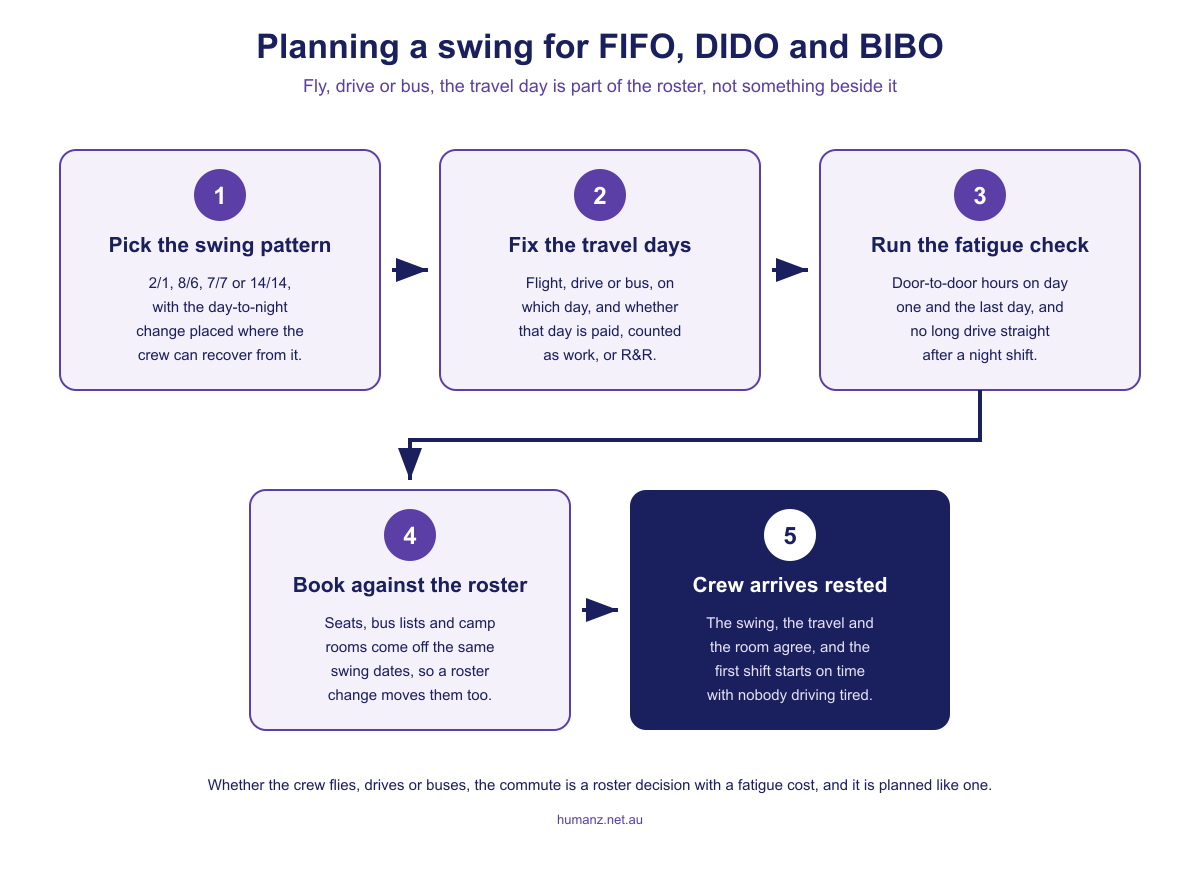
The travel day. A flight from Perth to a Pilbara site takes a couple of hours, but the travel day runs from the alarm at home to the camp check-in, often eight hours or more door to door, and the first shift can start the next morning at 5.30. Which day the flight lands on, and whether the crew flies the night before or the morning of, are roster decisions with a fatigue cost attached. The Western Australian Mental Health Commission’s 2018 report on FIFO work arrangements, by Curtin University’s Centre for Transformative Work Design, found that travelling long distances eats into the recovery time a swing is supposed to leave, and that working day shifts only was best for FIFO workers’ mental health, which is an argument for placing the day-to-night change where the crew can recover from it rather than on the day they land.
The pattern itself. The same report found that FIFO workers on even-time and shorter rosters, such as 2/2, 8/6 and 5/2, had the best mental health of any roster group, and its 18 recommendations included rosters and shift patterns that give better rest time, and permanent rooms on site. By March 2024 the WA Government’s Mental Awareness, Respect and Safety landmark study, run by the same Curtin centre and surveying 2,550 WA mine workers, reported more FIFO workers on even-time rosters and in permanent accommodation than five years earlier. The same survey found 31 per cent intended to leave their employer within twelve months and 38 per cent reported burnout, which is why pattern choice is a retention decision as much as a fatigue one.
The camp. Rooms are lived in, not just booked. The Curtin study found 60 per cent of FIFO mining workers were satisfied with their accommodation, and that while 73 per cent of men felt physically very safe in work-provided accommodation, only 53 per cent of women did. Room allocation is a roster job because the room has to match the swing: a crew change on Tuesday means rooms turning over on Tuesday, and a permanent room, where the site offers one, is a retention lever in its own right. Since 2019, Western Australia has had a code of practice on mentally healthy workplaces for FIFO workers in the resources and construction sectors, which names the lack of control over accommodation arrangements as one of the FIFO-specific factors to weigh when managing psychosocial risk.
The arithmetic underneath all of this is the headcount. To keep one position filled around the clock, a 2/1 needs 1.5 crews, an 8/6 needs 1.75 and any even-time pattern needs two. Move a site from 2/1 to 14/14 and the headcount and inductions grow by a third for the same work, and permanent rooms with them. Move it to 7/7 and the flights double as well, because the crew changes every week instead of every fortnight. Run the numbers for your own site in the crew coverage planner and compare two patterns in the swing roster comparison.
What DIDO work is
Drive-in drive-out covers two different commutes that share a name. The first is the swing version: the worker drives three or four hours from a regional centre to a camp, works the swing, and drives home for the days off. The second is the daily version: the site is an hour or two from a mining town, the worker sleeps at home and drives to site for every shift. Both are common in the Goldfields, the Hunter Valley, the Bowen Basin from Mackay and Moranbah, and on civil and construction projects within reach of a town. It is cheaper for the employer than flights and rooms, and workers on the daily version sleep in their own bed; the trade is that the fatigue exposure moves off the site and onto the road.
What DIDO asks of the roster
The drive is the hazard. WorkSafe Victoria lists commuting among the hazards that increase the risk of fatigue at a mine, alongside sleep debt, night work and extended shifts, and its mine operators carry a regulatory duty to control fatigue risk, with rosters and breaks designed to reduce it named among the measures. The Western Australian mines regulations put a similar duty on the mine operator, covered in our guide to fatigue under the WA WHS (Mines) Regulations. The roster is where the control lives: how long the shift is, what time it ends, and whether a worker is expected to drive two hours home after it.
The risk is not theoretical. When the owner of the Boddington bauxite mine axed its Mandurah bus service in 2016, the Mandurah Mail reported the next year that about 80 workers were driving round trips of up to 250 kilometres a day after their shifts. One of them put it plainly: “I’ll admit, I pull into my driveway sometimes and think how the hell have I got here.”
The last shift of the swing. On the swing version, the roster decides whether the crew drives home straight off a night shift. Ending the swing on a day shift, or holding the crew in camp for a sleep before the drive, costs a room night and saves a life every so often. A journey management rule that says nobody drives more than an hour after a night shift is a roster constraint, and it has to be checked when the roster is built, not remembered on the day.
Vehicles. Where a site pools vehicles so a swing crew drives in convoy, the departure time is a roster item too, and a roster change that moves a daily commuter from days to nights also moves them onto a dark road at the wrong end of the day.
The 7/7 even-time pattern suits DIDO better than it suits FIFO, because a weekly drive of three hours costs the worker far less of the week off than a weekly flight from Perth does.
What BIBO work is
Bus-in bus-out is the arrangement where the employer, or a bus contractor it hires, moves the crew as a group. The daily version runs from a regional town or a park-and-ride to the gate and back every shift, which is how a lot of the Bowen Basin, the Hunter Valley and the towns around the WA Goldfields get their crews to work, and what the Boddington workers lost when the Mandurah bus went. The swing version buses a crew from a regional centre to camp at the start of the swing and home at the end. Either way, the bus takes driving after a twelve-hour shift out of the equation, which is the reason safety managers like it.
What BIBO asks of the roster
The timetable is the roster. If the bus leaves the park-and-ride at 4.40 am for a 6 am start, the roster really starts at 4.40 am, and the fatigue calculation runs from there. A worker’s day on a daily BIBO service is the shift plus two bus legs, and a twelve-hour shift becomes a fourteen or fifteen-hour day away from home, which is the number a fatigue policy has to look at.
The bus list is a roster output. Every seat is a person on a shift, so the bus list has to come off the roster, not off a whiteboard. A late roster change that adds three people to night shift is also three seats on the 5 pm bus, and if the list is built separately the bus leaves without them or with empty seats the site paid for. A worker who misses the bus misses the shift, so the roster needs a confirmation step the day before, so the site knows who is on the bus before it leaves.
Overtime has a hard edge. On a daily service, a supervisor cannot ask the crew to stay an extra hour to finish a pour if the bus is the only way home. Either the timetable flexes, which costs money, or the roster has to plan the long day rather than improvise it.
Which model a site ends up with, and why
Distance decides most of it. Past a few hours’ drive, FIFO is the only workable answer, which is why the Pilbara flies and the Hunter drives. Inside that range the choice is a trade between the employer’s cost, the worker’s time at home and where the fatigue risk lands.
| Consideration | FIFO | DIDO | BIBO |
|---|---|---|---|
| Employer cost per swing | Highest: flights and rooms | Lowest: an allowance, maybe a vehicle | Middle: a contract bus |
| Workforce pool | National | Regional | Regional town, one bus radius |
| Community effect | Money leaves the region | Workers live in the region | Workers live in the region |
| Best-fit patterns | 2/1, 8/6, 14/14 | 7/7, daily shifts | Daily shifts, short swings |
Most large sites run a mix. A Pilbara mine flies its Perth crews, buses its Newman or Tom Price crews from town, and has contractors driving in from wherever the contract started, so the swing pattern, the travel method and the accommodation need to sit on the same roster line for every worker, whichever of the three applies.
Travel days, pay and the roster record
Whether a travel day is paid, paid at a flat rate, counted as ordinary hours or treated as part of R&R depends on the enterprise agreement or award that covers the worker, and this guide does not interpret those. What the roster has to do is record which it was. A travel day that is worked, in the sense that the worker was under the employer’s direction from the bus stop to the camp, needs to appear on the roster and in the timesheet as what it was, so that fatigue checks count it and payroll pays it the way the agreement says. A travel day that is genuinely rest needs to be recorded as rest for the same reason. The mistake is leaving it off the roster altogether, which is how a twelve-hour shift that started with a 4 am flight passes a fatigue check it should have failed.
How Humanz fits
Humanz treats the swing as the unit of planning and attaches the travel to it. Swing templates carry their travel days, so a 2/1 that starts with a Tuesday flight rolls out with the flight on it; flights, vehicles and camp rooms are scheduled beside the crew on the same roster, so a swing change moves them together; and the fatigue rules built into the roster see the travel day as well as the shift. It works the same whether the crew flies, drives or buses, and whether they are employees, labour hire or subcontractors. The mining workforce management page covers how rosters connect to mobilisation, credentials and timesheets, and the FIFO rostering software guide goes deeper on what the software has to do.
Humanz does not decide whether your travel day is paid, book the flights with the airline or write your fatigue policy. It holds the roster those decisions land on, and shows the whole crew, their travel and their rooms in one place. To see it against your own swing, book a walkthrough and bring the roster.
Frequently asked questions
What does FIFO mean?
FIFO stands for fly-in fly-out. Workers fly to a remote site, work a block of consecutive shifts called a swing while living in camp accommodation, then fly home for a block of days off. It is the standard arrangement for sites too far from a city or town to commute to, such as Pilbara iron ore mines and remote construction projects.
What is DIDO work?
DIDO stands for drive-in drive-out. The worker drives to site instead of flying, either commuting daily from a nearby town or driving a few hours to a camp for the whole swing. It costs the employer less than FIFO, but the drive itself is a fatigue hazard, so rosters have to control shift lengths, finish times and driving after night shifts.
What does BIBO stand for?
BIBO stands for bus-in bus-out. The employer or a bus contractor moves the crew by bus, either daily from a regional town or park-and-ride, or to camp at the start and end of a swing. It removes driving after a long shift, and the bus timetable effectively sets the roster’s start and finish times.
What is a FIFO roster?
A FIFO roster is a swing pattern: a block of consecutive shifts on site followed by a block of days off at home, written as time on and time off. Common patterns are 2/1 (two weeks on, one off), 8/6 (eight days on, six off), and the even-time 7/7 and 14/14. The pattern sets the flights, the rooms and the number of crews needed to keep the site covered.
Is FIFO or DIDO better?
Neither is better in general; the distance usually decides. FIFO is the only practical option beyond a few hours’ drive, and it puts the fatigue risk on travel days and shift changes. DIDO suits sites within reach of a regional centre and lets workers sleep at home on daily commutes, but it moves the fatigue risk onto the road after the shift, which the roster has to manage.
Do travel days count as work?
It depends on the enterprise agreement or award that covers the worker, which sets whether a travel day is paid, paid at a flat rate, counted as ordinary hours or treated as rest. Whatever the answer, the travel day should be recorded on the roster and in the timesheet as what it was, so that fatigue checks count the time and payroll pays it correctly.
Related articles
Ready to see Humanz on your own roster?
Free 30-minute walkthrough, we'll use your real crews, sites and shift patterns.