
 Login
Login 

Safety Systems & Forms
TRIFR and LTIFR: The Formulas, a Worked Example and a Free Calculator
By Christian Tietzel · 22 September 2026

TRIFR is the number of recordable injuries per million hours worked, and LTIFR is the number of lost time injuries per million hours worked. Both use the same sum: injuries in the period, multiplied by 1,000,000, divided by the hours everyone worked in that period. A crew that worked 264,960 hours with one lost time injury has an LTIFR of 3.8. Add two restricted work injuries and three medical treatment injuries and its TRIFR is 22.6.
That is the whole formula. What trips contractors up is everything around it: which injuries count, whose hours go in the bottom line, what a client means by “lost time”, and what number to write on a prequalification form when the last twelve months had one rolled ankle. This guide covers each, works one example end to end, and links the free TRIFR and LTIFR calculator on our tools page. It is general information, not safety or legal advice. Client questionnaires and regulators define these terms slightly differently, so use the definition on the form in front of you.
The formulas
LTIFR = (fatalities + lost time injuries) × 1,000,000 ÷ hours worked
TRIFR = (fatalities + lost time injuries + restricted work injuries + medical treatment injuries) × 1,000,000 ÷ hours worked
The million is not arbitrary. Australia’s workplace injury recording standard, AS 1885.1, defines the frequency rate as the number of occurrences of injury or disease for each one million hours worked, and that convention runs through Australian tenders, prequalification schemes and regulator reports. The US basis is different: OSHA rates use 200,000 hours, roughly 100 full-time workers for a year, so the same injuries on the same hours give a number five times smaller. If a client or a multinational parent reports on the 200,000-hour basis, say so beside the figure. A TRIFR of 22.6 and a TRIR of 4.5 are the same crew.
Frequency rates exist because counts mislead. Three lost time injuries in a 40-person crew and three in a 400-person crew are very different years, and dividing by hours worked is what makes them comparable, within one business over time and, with care, between businesses of different sizes.
What counts as a recordable injury
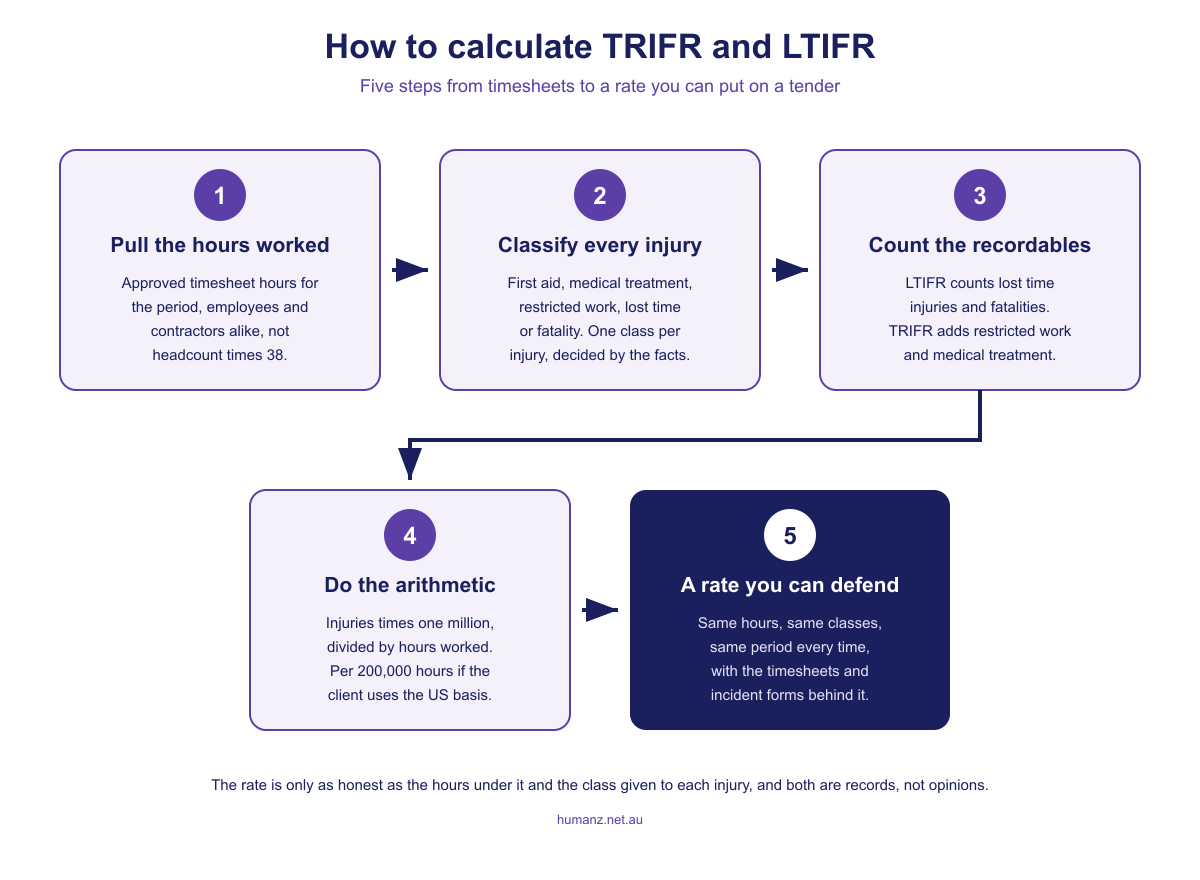
Every work injury gets one class, decided by what happened to the worker afterwards, and the class decides which rate it moves.
| Class | What it means | Counts toward LTIFR | Counts toward TRIFR |
|---|---|---|---|
| Fatality | A death from a work injury | Yes | Yes |
| Lost time injury (LTI) | The worker cannot work at least one full day or shift after the day of injury, or is left with a permanent impairment | Yes | Yes |
| Restricted work injury (RWI) | The worker is back, but on alternate or restricted duties, or reduced hours | No | Yes |
| Medical treatment injury (MTI) | Treated by a doctor or other medical practitioner beyond first aid, with no shift lost | No | Yes |
| First aid injury (FAI) | Treated on site with first aid, normal duties continue | No | No |
The lost time threshold is the one most often argued over. Safe Work Australia’s claims data counts a lost time claim as one that resulted in one day or shift or more away from work, a fatality or a permanent impairment, and it treats three hours of time lost as a day or shift, on the basis of typical minimum shift lengths. Most Australian client definitions follow the same shape: a full shift lost at any point after the day of injury. Under most definitions the day of the injury itself does not count, so a worker sent to the doctor at 2 pm who is back on the tools the next morning is an MTI, not an LTI.
Two habits keep the classification honest. The first is one class per injury, the most serious that applies, so an injury that starts as an MTI and costs a shift a week later becomes an LTI in the month it happened, and the rate for that month moves. The second is a register with dates: the injury, the treatment, the first shift lost and the return, because a prequalification reviewer may ask for the register behind the number, and “we think it was an MTI” is not an answer.
A first aid injury does not count in either rate, which is exactly why a creeping first aid count is worth watching. It is the earliest signal in the data, and the one the headline rates cannot see.
Hours worked: the denominator nobody checks
Ask a contractor for its TRIFR and it will usually have the injury count right and the hours wrong. Hours worked means hours actually worked in the period: ordinary hours plus overtime, minus leave, RDOs and any other paid hours nobody was on the job for. Headcount multiplied by 38 and 52 is a guess, and a guess in the denominator moves the rate as much as a mistake in the numerator. A crew that really worked 46 hours a week has a rate about 17 per cent lower than the 38-hour estimate suggests.
The real figure is sitting in approved timesheets. If the crew submits digital timesheets that are reviewed and approved through a proper approval workflow, the period total is a report, not a reconstruction, and it survives the question “how did you get that number”.
Contractor and labour hire hours are the second trap. Some questionnaires want employee hours only, some want everyone under your control on the site, and some want the two reported separately. Read the form, and state on it which you used. On sites where subcontractors work most of the hours, reporting employee hours only can halve the denominator and double the rate without a single extra injury.
Safe Work Australia itself estimates the hours behind its national frequency rates from labour force data, because it has no timesheets to work from. You do, which is the one advantage a contractor has over the national statistics.
A worked example: a 120-person civil crew
Take a civil contractor with 120 people on the books across employees and subbies, an average of 46 hours a week each, and 48 working weeks in the year.
| Input | Figure |
|---|---|
| Hours worked | 120 × 46 × 48 = 264,960 |
| Fatalities | 0 |
| Lost time injuries | 1 (a rolled ankle in a trench, three shifts lost) |
| Restricted work injuries | 2 (a back strain and a hand laceration, both on light duties) |
| Medical treatment injuries | 3 (stitches twice, a foreign body in an eye) |
| First aid injuries | 9 (not counted) |
LTIFR = 1 × 1,000,000 ÷ 264,960 = 3.8
TRIFR = (0 + 1 + 2 + 3) × 1,000,000 ÷ 264,960 = 22.6
On the 200,000-hour basis the same year reads 0.8 and 4.5. Now watch what one more lost time injury does. A second LTI in the same year takes the LTIFR from 3.8 to 7.5, a doubling caused by one incident, and that is the arithmetic of small numbers, not a collapse in safety performance. Safe Work Australia’s advice for smaller organisations is to calculate rates over a longer window, five years rather than one, to take the volatility out. A contractor answering a questionnaire that asks for three years should give the three-year rate and the three-year hours, and, where the form allows, the counts underneath, so a reviewer can see one injury for what it is.
Rolling twelve months is the other useful frame. A financial year rate resets to zero every July and tells you nothing in August. A rolling twelve-month rate, recalculated each month with the oldest month dropped, moves as the year does and is the number a safety committee can act on. Run the numbers in the calculator, then run them again with one injury added to see how much room the figure has.
What a good TRIFR is, and why nobody can tell you
There is no official Australian TRIFR benchmark. Safe Work Australia does not publish TRIFR or medical treatment injury frequency rates, and in May 2025 it retired its long-running lost time injury frequency rate calculator in favour of a dashboard of workers’ compensation injury frequency rates, which count accepted claims per million hours worked rather than injuries. The national serious claims frequency rate, for claims involving a week or more off work, was 6.8 per million hours in 2023-24 across 146,700 claims, with a median of 7.4 weeks lost (the 2022-23 median, the latest finalised year), according to the Key Work Health and Safety Statistics Australia 2025. By occupation it was 23.1 for labourers, 12.1 for machinery operators and drivers and 8.1 for technicians and trades workers.
Those figures are not a TRIFR and they are not an LTIFR, and putting your 22.6 beside the national 6.8 proves nothing either way. Claims are a subset of injuries: the ABS work-related injuries survey for 2021-22 found only 30.5 per cent of injured workers received workers’ compensation, most often because a claim was not thought necessary for a minor injury. A serious claim also needs a week off, where an LTI needs one shift. The claims rate sits below any honest LTIFR by construction.
The most useful external reference for construction is the Federal Safety Commissioner’s scheme, which tracks medically treated injury and lost time injury frequency rates for accredited companies and reports both trending down, with LTIFR improving the longer a company has been accredited. Accreditation also meets the WHS prequalification requirements of seven states and territories. But the scheme publishes trends for its members, not a pass mark for everyone else.
So the comparison that matters is with yourself: this year against the last three, this project against the last one, on the same definitions and the same hours basis. Safe Work Australia’s own guidance on WHS reporting says not to rely on any single indicator like an injury rate, because a rate can be flat while the safety culture underneath it is not.
Where the rate gets used: tenders and prequalification
Prequalification questionnaires and tender schedules ask for LTIFR and TRIFR for one to three years, usually with the hours worked and the counts beside them, and sometimes with the number of fatalities and notifiable incidents on the same page. A few things make the answer defensible rather than just filled in.
- State the basis. Per million hours, or per 200,000. Employee hours only, or everyone on site.
- State the period. Financial year, calendar year or rolling twelve months, and the same period for every year in the table.
- Keep the three records behind it. The timesheet totals for the period, the injury register with classes and dates, and the incident reports each injury came from. A reviewer who asks for one of them and gets it in an afternoon rarely asks for the other two.
- Explain a zero. A small contractor with no lost time injuries in 190,000 hours has an LTIFR of zero, and the hours are what make it credible. Without them, zero looks like nobody counted.
The same discipline answers the regulator. Mines in Western Australia and Queensland report injury data to their inspectorates on a schedule, and the safety systems that produce a clean quarterly return are the same ones that produce a clean tender figure.
The lead indicators the rate cannot see
TRIFR and LTIFR are lag indicators. They count harm that already happened, and on a crew of 120 they move in steps of 3.8 at a time, which makes them a poor way to notice a site going wrong. The signals that move first are the ones nobody has to get hurt for: near misses reported and closed out, prestarts and JSAs done before the task rather than after, toolbox talks held with the crew that was actually there, inspections and their actions, and the first aid count that the headline rates ignore.
A safety report that leads with the rate and follows with those numbers reads as a system. One that has only the rate reads as a scorecard, and a scorecard invites the one behaviour every safety manager dreads: the injury that goes unreported so the number stays clean. That is why the incident reporting culture, and the reasons near misses go unreported, matter more to the rate than any formula.
How Humanz fits
Humanz does not classify injuries and does not calculate the rate, and it would be a strange thing for a rostering platform to claim. What it does is hold the two records the rate is built on. Hours worked come off approved digital timesheets, for employees and subcontractors through the same submission and approval flow, so the period total is a report rather than a reconstruction. Incident, hazard and near-miss reports are captured on phones as custom forms against the job, with the injury class recorded by the safety team when it is known, so the register and the incident reports are the same record. Both live inside the workforce management platform the crew already uses for the roster.
The arithmetic is on our tools page. The TRIFR and LTIFR calculator takes hours worked and the four injury counts, gives both rates on the million-hour or 200,000-hour basis, and shows what one more lost time injury would do to the figure.
Frequently asked questions
What is TRIFR?
TRIFR, the total recordable injury frequency rate, is the number of recordable work injuries per million hours worked. Recordable injuries are fatalities, lost time injuries, restricted work injuries and medical treatment injuries; first aid injuries are excluded. The formula is recordable injuries multiplied by 1,000,000, divided by the hours worked in the same period.
How do you calculate LTIFR?
Multiply the number of lost time injuries in the period by 1,000,000 and divide by the total hours worked in that period. A lost time injury is one where the worker cannot work at least one full day or shift after the day of the injury, and fatalities are counted with them. One lost time injury across 264,960 hours gives an LTIFR of 3.8.
What is a good TRIFR in Australia?
There is no official benchmark. Safe Work Australia publishes workers’ compensation claims rates rather than TRIFR, and its national serious claims frequency rate of 6.8 per million hours in 2023-24 counts accepted claims with a week or more off work, so it is not comparable with a contractor’s injury-based rate. The useful comparison is your own rate over the last three to five years on the same definitions and hours basis.
What is the difference between TRIFR and LTIFR?
LTIFR counts only injuries that cost at least one full shift, plus fatalities. TRIFR also counts restricted work injuries and medical treatment injuries, where the worker was hurt badly enough to need a doctor or alternate duties but lost no shift. TRIFR is always equal to or higher than LTIFR for the same period, and it is harder to keep low by managing people back to work early.
Do contractor hours count in TRIFR?
It depends on what the client or scheme asks for. Some want employee hours and injuries only, some want everyone working under your control on the site, and some want the two reported separately. Use the definition on the form, state which one you used, and keep contractor hours in the same timesheet records as employee hours so either answer is available.
Related articles
Ready to see Humanz on your own roster?
Free 30-minute walkthrough, we'll use your real crews, sites and shift patterns.