
 Login
Login 

Timesheets & Payroll
Payday Super Just Moved Your Timesheet Deadline
By Heather · 24 August 2026 · Updated 3 September 2026

For as long as anyone reading this has run a payroll, superannuation worked on a comfortable quarterly rhythm. Pay wages weekly, sweep the super up four times a year, breathe. That rhythm is gone. From 1 July 2026, payday super means the super guarantee travels with every pay run, and the clock is short.
The rule, in one sentence. When you pay an employee qualifying earnings, their super contribution must be received by their fund, allocated and complete, within 7 business days of that payday. Not sent within seven days. Received. The ATO’s payday super guidance is blunt that clearing house processing time is your problem, which is why its stated best practice is paying super with the pay run itself.
Most of the coverage treats this as a payroll story. For businesses running field crews, it’s mostly not. It’s a timesheet story, because the pay run can only move as fast as the slowest approved timesheet, and the slack that used to hide slow approvals has been removed.
What actually changed on 1 July
Four mechanics worth having precisely right, straight from the ATO’s payment deadline rules.
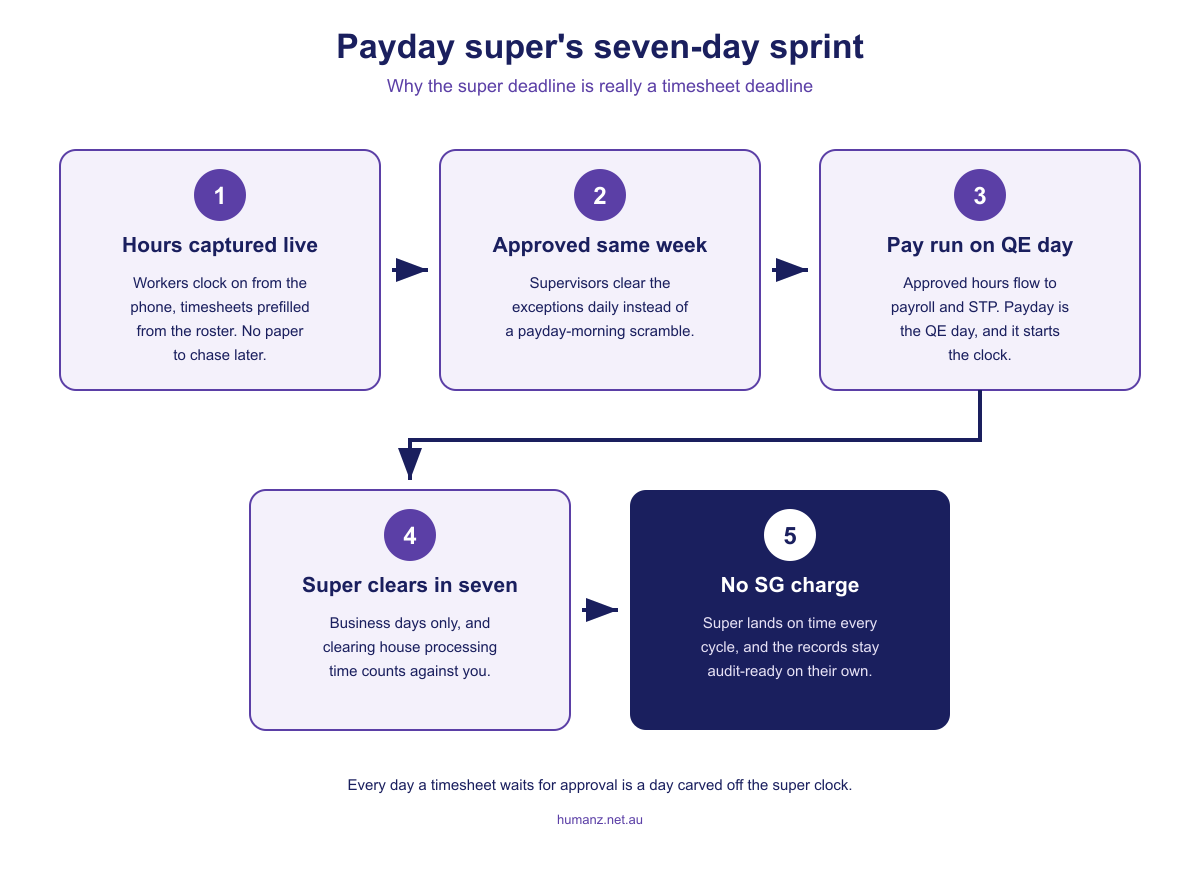
The QE day starts the clock. The day you pay qualifying earnings, your regular payday for most purposes, is the qualifying earnings day. The 7 business days count from there, whatever day you keyed the run into the system.
Business days exclude more than weekends. A day that’s a public holiday across an entire state or territory doesn’t count as a business day, even if your business isn’t in that state. A run that straddles a holiday cluster has a genuinely shorter window than it appears.
Received means received. The contribution has to land in the fund with the data needed to allocate it to the member. A payment bounced for a mismatched member number hasn’t been made. If you use a clearing house, its processing days eat your seven.
Late now means the super guarantee charge, every cycle. Miss the window and you’re into SG charge territory. On the ATO’s current settings, that means the unpaid super plus interest at the general interest charge rate compounding daily, plus an administrative uplift that starts at 60% of the shortfall and interest. The uplift drops 20 points for a clean two-year history and up to 40 points more for fast voluntary disclosure, which can take it all the way to 0%, so owning a miss quickly is worth real money. A separate 25% choice loading, capped at $1,200 per notice period, applies where an employee’s choice of fund gets ignored. Under the quarterly regime a late payment surfaced four times a year at most. Under payday super, a weekly payroll gives you 52 chances a year to get it wrong, and a systemic delay compounds weekly instead of quarterly.
It also helps to know why the ATO built the regime this hard. Its estimate of the net super guarantee gap for 2022-23 is around $6.2 billion, or 6% of the theoretical liability. And when the ATO randomly reviewed employers, 41% needed their super contributions adjusted, with a median increase of about $8,000. Read that second number again. This was never just dodgy operators. It was ordinary businesses with ordinary process gaps, and the new regime is designed to surface them within days instead of years.
The quarterly due dates still apply to earnings paid up to 30 June 2026, so the two systems overlap in your records this year, and both sets sit inside the same seven-year record-keeping obligation. Everything paid from 1 July follows the new clock.
Why this lands on the timesheet, not the payroll system
Payroll software vendors sorted their side quickly. Xero, MYOB and the rest can trigger super with each pay run. The bottleneck isn’t the button. It’s everything that has to be true before anyone dares press it.
A field business pays from approved hours. Before payday super, the sequence had slack built in. Chase paper timesheets on Monday, decode ute-dashboard handwriting Tuesday, query the weird ones Wednesday, run pay Thursday, and if approvals dragged into next week, well, the super sweep was weeks away anyway. Late approvals were an annoyance, not a compliance event.
Now walk the same sequence against a 7 business day fence that starts at payday. Every day spent chasing a missing timesheet is a day carved off the super window. An unapproved timesheet that forces a supplementary pay run creates its own fresh QE day and its own fresh super deadline. Adjustments and corrections multiply pay events, and every pay event carries super obligations on the clock. The businesses that felt this hardest in July were exactly the ones where timesheet errors and slow approvals were already chronic, because payday super doesn’t create that disease. It just removes the months of quiet in which it used to hide.
The cash flow half of the story
The compliance clock gets the headlines, but the working capital change deserves equal attention, because it’s permanent.
Under quarterly super, the accrued guarantee sat in your operating account for up to three months. On a $2 million annual payroll, that float regularly held $50,000 to $60,000 of super between sweeps, and plenty of businesses quietly used it as working capital. That buffer is gone. Super now leaves with every run, which smooths the outflow but removes the float, and businesses that were leaning on it are discovering the fact one tight week at a time.
The adjustment is straightforward if it’s deliberate. Reprice the super component into your weekly cash forecast rather than a quarterly line, check invoice payment terms against the new rhythm, and if progress claims lag 30 or 45 days behind the labour that earned them, the gap that quarterly super used to paper over is now visible every payday. Better to renegotiate terms than to meet the SG charge through cash starvation.
There’s a second wrinkle for businesses using contractors. The super guarantee has never been limited to employees. A contractor engaged under a contract wholly or principally for their labour can be owed super too, and payday super moves that obligation onto the same per-payment clock. If your subbie arrangements have been running on the assumption that an ABN ends the question, this is a sensible moment to get specific advice, because the question now recurs every pay cycle instead of every quarter.
The pattern that survives payday super
The businesses comfortable under the new regime share one operational shape. Hours are captured digitally at the shift, approvals happen on a cadence measured in hours, and the pay run starts from data nobody has to chase.
In practice that means a few specific things.
Capture at the source, prefilled from the roster. When a worker clocks on through their phone against a rostered shift, the timesheet is born matching the plan, and only exceptions need human attention. Our guide to digital timesheets for tradies covers what that looks like on a real crew.
Approve on a same-week rhythm. Supervisors approving daily or every couple of days turn payday from a scramble into a formality. The timesheet approval workflow matters more than any single feature, because approval latency is now super latency.
Feed payroll structured data, not paper. Approved hours flowing straight into the payroll system, the pattern in our Xero rostering and timesheets integration, removes the retyping step where both errors and days disappear. Pay on time, and the super instruction goes with it, with maximum runway for clearing.
Watch the laggards, not the averages. The metric that predicts a payday super breach is simple. How old is your oldest unapproved timesheet on payday morning? If the answer is regularly “last week’s”, the seven days are being spent before the clock even starts.
None of this is exotic. It’s the operating model that a workforce management platform built for field crews exists to run, roster, capture, approve and hand off in one motion. What payday super changed is the cost of not having it. You can put a number on your own gap in about three minutes with the timesheet cost calculator, and the number is usually persuasive before the SG charge is even counted.
The pay events people forget
Regular payday is the easy case. The breaches waiting to happen live in the irregular payments, because each one is its own QE day with its own seven-day fence.
Back pay lands when a timesheet dispute finally resolves. That payment carries super, on the clock, even though the hours are six weeks old. An out-of-cycle top-up because someone’s overtime got missed is a fresh pay event, not a correction to the old one. Termination pays go out on their own timeline, usually in a hurry, and their super rides along. Even an annual bonus run in December is a QE day like any other.
The operational answer isn’t to memorise the categories. It’s to stop treating off-cycle payments as exceptions handled by hand. If every payment, scheduled or not, flows through the same pipeline that triggers super with it, the categories stop mattering. If off-cycle payments get processed through a side door, each one is a small bet that somebody remembered the clock, taken 30 or 40 times a year.
That’s one more argument for killing the disputes at the source. Most back pay in field businesses starts life as a timesheet nobody could agree on. Fewer disputed hours means fewer out-of-cycle payments, which means fewer deadlines running on nobody’s calendar.
Worth doing this month
If your super still runs on habits formed under the quarterly regime, a short audit now beats a charge statement later.
- Map your real sequence from shift worked to super paid, with honest day counts on each step
- Find the slowest step. In field businesses it’s almost always timesheet collection or approval, not banking
- Check your clearing arrangement’s processing time and subtract it from seven. That’s your actual window
- Set a payday-morning report on unapproved timesheets, and treat anything on it as today’s problem
- If steps 1 to 4 exposed a chase-and-retype process, fix the capture layer first. Everything downstream inherits it
The quarterly sweep is gone and it isn’t coming back. The businesses that treat payday super as a payroll setting will keep finding surprises. The ones that treat it as a timesheet discipline will barely notice it’s there.
Frequently asked questions
When did payday super start?
Payday super applies to qualifying earnings paid from 1 July 2026. Earnings paid up to 30 June 2026 stay under the old quarterly super guarantee rules, so the 2026-27 year is the first fully on the new system.
What is the deadline for paying super under payday super?
Super guarantee contributions must be received by the employee’s fund, with the information needed to allocate them, within 7 business days of the day qualifying earnings are paid. Business days exclude weekends and any public holiday that applies to a whole state or territory. Time taken by a clearing house counts against the window.
What happens if super is paid late under payday super?
A contribution that lands after the deadline exposes the employer to the super guarantee charge, which includes the shortfall, an interest component and an administrative charge. Because the obligation now attaches to every pay run rather than every quarter, a recurring delay compounds with each payroll cycle.
Why does payday super matter for timesheets?
Because the pay run can only happen once hours are approved, and the super clock starts at the pay run. Slow timesheet collection and approval now consume the same seven business days that the super payment needs to clear. Fast digital capture and same-week approvals are what keep the window workable.
Does payday super apply to payments to contractors?
It can. The super guarantee has never been limited to employees, and a contractor engaged under a contract wholly or principally for their labour can be owed super, now on the same per-payment clock as everyone else. If your subbie arrangements assume an ABN settles the question, it’s worth getting specific advice, because the question now recurs every pay cycle instead of every quarter.
Do bonuses, back pay and termination payments have their own super deadline?
Yes. Every payment of qualifying earnings is its own qualifying earnings day, so a December bonus run, a resolved back pay claim or a termination payment each starts a fresh 7 business day window for the super riding with it. Off-cycle payments handled outside the normal payroll pipeline are where the likeliest breaches sit.
Does payday super change how much super is paid?
No. The rate and the earnings base are unchanged by the reform. What changes is timing, super moves with each payment of qualifying earnings instead of accumulating for a quarterly payment, and the compliance consequences of running late.
Related articles
Ready to see Humanz on your own roster?
Free 30-minute walkthrough, we'll use your real crews, sites and shift patterns.