
 Login
Login 

Compliance, Fatigue & Safety
Chain of Responsibility: What the Heavy Vehicle National Law Asks of Contractors Who Run Trucks
By Christian Tietzel · 23 September 2026

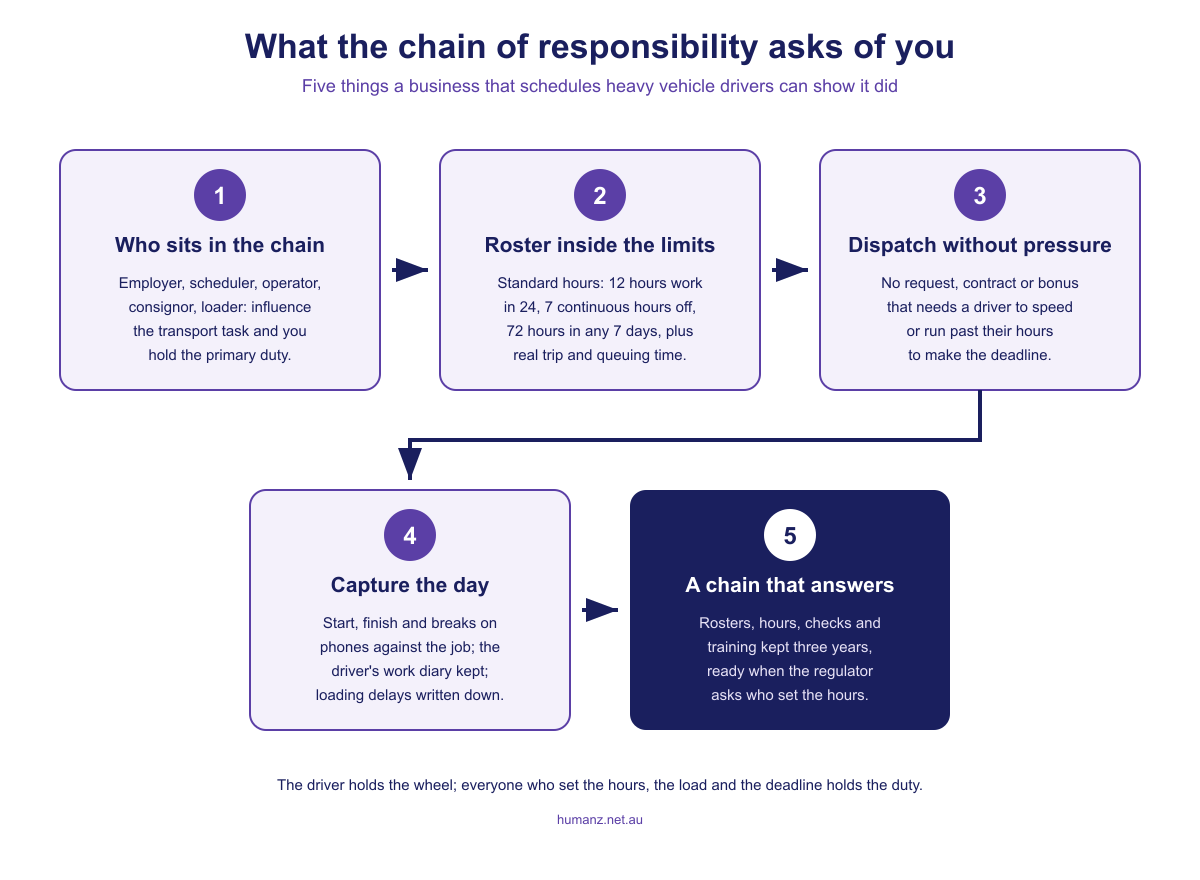
The chain of responsibility is the part of the Heavy Vehicle National Law (HVNL) that makes every business influencing a heavy vehicle’s journey responsible for its safety, not just the driver. Employ, schedule or direct the driver of a vehicle over 4.5 tonnes, consign or receive its load, or run the yard it loads at, and you are in the chain, whatever your industry. A mining, civil or labour hire business that rosters truck drivers is a scheduler under that law.
This guide is for the businesses the ranking explainers skip: the civil contractor with tippers, floats and a water cart, the mining contractor whose crew bus and service trucks leave the gate, and the labour hire provider whose drivers work someone else’s roster. It covers who is in the chain, where the law reaches and where it stops, the duties in the words that matter after the 1 August 2026 amendments, how to schedule inside the limits, what the record keeper has to hold, and what enforcement has looked like. It is general information, not legal advice. It is not about electronic work diaries.
Who is in the chain
The National Heavy Vehicle Regulator (NHVR) defines the chain of responsibility as the part of the HVNL that makes parties other than drivers responsible for the safety of heavy vehicles on the road. There are ten functions that put a business in the chain: employer of a driver, prime contractor engaging a self-employed driver under a contract for services, operator, scheduler, consignor, consignee, packer, loading manager, loader and unloader. A scheduler is anyone who schedules the transport of goods or passengers by the vehicle, or the driver’s work and rest times. A loading manager runs premises where heavy vehicles are regularly loaded or unloaded, which the NHVR puts at five or more a day, and that catches most quarries, batch plants and laydown yards.
Three rules follow from the NHVR’s own wording. You are a party because of a function you perform, not because of a title, a job description or the words of a contract. Performing several functions does not multiply the duty; the duty is always the same. And driving is not one of the functions: drivers are not parties in the chain, they carry their own obligations under the HVNL and the road rules, including a personal duty under section 228 not to drive while impaired by fatigue, which since 1 August 2026 reaches every heavy vehicle over 4.5 tonnes and now includes being unfit to drive.
So a civil contractor that owns three tippers and rosters their drivers is an employer, an operator and a scheduler. A mining contractor that books a subcontractor’s float to move an excavator between sites is a prime contractor and a consignor. A labour hire provider that employs a driver and places them with a host is the employer; the host that decides which truck the driver takes and when the shift starts and ends is the operator and the scheduler. The NHVR says the primary duty cannot be transferred or delegated, and that a party remains in the chain when its transport activities are contracted or subcontracted to someone else. Safe Work Australia says the same of the WHS duties that sit beside it: labour hire and host businesses cannot contract out of or transfer their duties to each other. Our guide to labour hire host obligations covers the WHS side; the point here is that the host’s roster is a scheduling decision under the HVNL, whoever issues the payslip.
Where the law reaches, and where it stops
The HVNL applies in New South Wales, Queensland, Victoria, South Australia, Tasmania and the ACT, where it commenced on 10 February 2014. Western Australia and the Northern Territory have not adopted it, but the NHVR notes that it applies to their vehicles the moment they cross into a participating state, so a Pilbara contractor sending a float into South Australia is in the chain for that trip.
A heavy vehicle is one with a gross vehicle mass or aggregate trailer mass over 4.5 tonnes, or a combination that includes one. That is the chain of responsibility threshold. The work and rest hours, and the work diary, apply to a narrower class: a fatigue-regulated heavy vehicle is one over 12 tonnes, a combination over 12 tonnes, or a bus over 4.5 tonnes built or fitted to carry more than 12 adults including the driver. A 4.5 to 12 tonne service truck is inside the chain and under the unfit-to-drive duty, but its driver is not counting hours in a diary. A crew bus with 13 or more seats, counting the driver’s, is fatigue-regulated; a 12-seater is not.
The other boundary is the gate. The HVNL defines a road as an area open to or used by the public and developed for driving, and defines transport activities as the business practices and decisions associated with using a heavy vehicle on a road, including contracting, directing or employing a person. Reasoning from those definitions, a gated haul road inside a mine is not a road, and the haul trucks, dozers and water carts that never leave the pit sit under the site’s WHS and mining safety law rather than the HVNL. The registered water cart that runs 40 kilometres of highway between two pits, the tipper hauling to a council job, the crew bus from the camp to the gate and the float carrying the excavator are all on a road, and everything the driver did with that vehicle on site that day, from pre-start and loading to driving it inside the fence, counts as work time when the hours are added up. A stint on a dozer or an excavator does not, although the NHVR is blunt that it still adds to the driver’s fatigue.
Western Australia runs its own chain of responsibility under state road law, introduced in 2015 and administered by Main Roads, and it manages commercial vehicle driver fatigue through WorkSafe WA under Part 4.10 of the WHS (General) Regulations 2022. The WA limits differ from the national ones: a solo driver may work up to 17 hours in a period bounded by seven continuous hours off before and after, must have at least 27 hours of non-work time in any 72, and takes at least 20 minutes of breaks from driving in every five hours of work time, with a fatigue management plan and three years of records held by the responsible person. The Northern Territory has declined to adopt the HVNL fatigue provisions until they are shown to work in remote Australia, manages driver fatigue under its WHS Act, and recognises both the national and the WA schemes for operators crossing its borders. Our guide to WA mines fatigue regulations covers the site side of that state.
The duties, in the words that matter
The core of the chain is section 26C: each party in the chain of responsibility for a heavy vehicle must ensure, so far as is reasonably practicable, the safety of the party’s transport activities relating to the vehicle. The section goes on: the party must eliminate public risks or, where that is not reasonably practicable, minimise them, and must ensure its conduct does not directly or indirectly cause or encourage the driver to contravene the law or to exceed a speed limit. The NHVR’s scope guidance adds that the duty relates only to what you can influence and control, and that you cannot lessen it by contract.
Section 26D puts a due diligence duty on executives, which the NHVR reads to include an executive officer, a manager or another person who takes part in managing the business, as well as directors and partners. Due diligence means getting and keeping knowledge about carrying out transport activities safely, understanding the business’s transport hazards and risks, providing the resources to eliminate or minimise them, having and using processes that do the same, and making sure information about hazards, risks and incidents is received, considered and responded to quickly. An executive who fails in it faces the same penalty as an individual who breached the primary duty.
Section 26E is the one a scheduler meets most often. Nobody may ask, direct or require, directly or indirectly, a driver or a party in the chain to do or not do something the person knows or ought reasonably to know would cause the driver to speed, to drive while impaired by fatigue or unfit to drive, or to breach their work and rest hours; nor may anyone enter a contract that would have that effect. Each offence carries a statutory maximum of $20,000 in the amended text, before the indexation that lifts every HVNL penalty each July. A booking that the scheduler knows, or ought reasonably to know, cannot be completed inside the driver’s hours is a prohibited request whether or not anyone said the words.
The primary duty offences run in three categories. Category 1 is reckless conduct, without reasonable excuse, that exposes a person to a risk of death or serious injury or illness; Category 2 is a breach that exposes a person to that risk; Category 3 is any other contravention. The statutory base penalties are $300,000 or five years’ imprisonment or both for an individual and $3 million for a corporation at Category 1, $150,000 and $1.5 million at Category 2, and $50,000 and $500,000 at Category 3. The NHVR indexes them on 1 July each year, and its 2026–27 schedule puts the Category 1 maximum at $4,230,550 for a corporation and $436,850 for an individual. Vendor pages quoting $3 million are quoting the un-indexed figure printed in the Act.
The amendments that commenced on 1 August 2026 changed four things a scheduler needs to know. Every driver of a heavy vehicle over 4.5 tonnes now holds a personal duty not to drive while impaired by fatigue or unfit to drive, where unfit covers illness, injury and mental health, and chain parties must ensure their business practices do not cause or encourage it. Basic and Advanced Fatigue Management were closed to new entrants and replaced by Alternative Compliance Accreditation for fatigue, under which an operator holding General Safety Accreditation applies to the NHVR for Alternative Compliance Hours; existing BFM and AFM accreditations remain valid until they expire or are cancelled. The accreditation scheme itself became the tiered Heavy Vehicle Accreditation scheme, with General Safety Accreditation as the entry tier and Alternative Compliance Accreditation for fatigue and mass above it. And some written work diary entries became optional. The 2026 Master Code, registered on 21 January 2026, is now activity-based, covers off-road parties, and may be used as evidence of what a party knew or ought to have known if it is charged; it creates no new obligation and there is no offence for skipping one of its controls.
Scheduling inside the limits
For a solo driver on standard hours, the outer limits are 12 hours of work in any 24, with seven continuous hours of stationary rest; 72 hours of work in any seven days, with 24 continuous hours of rest; and 144 hours in any 14 days with four night rest breaks, two of them on consecutive nights. Shorter windows carry their own minimums, starting at 15 continuous minutes of rest in any five and a half hours. Work time is not just driving: loading and unloading, checking the load, inspecting, servicing, cleaning and refuelling the vehicle and filling in the diary all count. Our guide to maximum hours in a row sets those numbers beside the award and WHS limits; the free fatigue checker tests a fortnight of shifts against limits you enter, but it does not model the NHVR’s counting rules and is no substitute for them.
The NHVR’s compliance guidance lists what a business can point to: rosters and schedules that do not require drivers to exceed driving hours or speed limits, booking systems that are flexible and allow for unexpected delays without penalty, drivers paid by the hour rather than per trip, a driver never required to drive while fatigued or at risk of fatigue, and records of drivers’ actual hours. Its time slot advice names the failure pattern a mine gate or batch plant reproduces daily: the demand to meet a slot leaves drivers feeling pressured to drive fatigued or speed, queued trucks spill onto the road, and contracts should allow time to absorb delays rather than penalise a driver for being late. Its fitness-to-drive advice asks for rosters that consider fatigue risk, journey plans with rest every two hours, contractual disclosure of second jobs, and fatigue days a driver can call in instead of calling in sick.
For a contractor, the arithmetic is the whole job. A 12-hour shift driving the truck is legal on its own. Add an hour of loading and pre-start before it and a two-hour run back to the depot in the same truck after it, and the driver has done 15 hours of work in 24 on a fatigue-regulated vehicle, a breach the roster caused. If the driver instead drives home in a ute, the HVNL counts that trip as rest time, but the fatigue is the same, and the roster has still failed the WHS duty and, since 1 August 2026, the duty not to cause or encourage a driver to drive while impaired by fatigue. Queensland’s mines regulator has warned since 2017 about driving more than two hours, or 150 kilometres, after a series of night shifts and told sites to review labour hire contract arrangements for commute distance and breaks between rostered time. Inside the fence that is a WHS duty under Safe Work Australia’s fatigue guidance; at the gate it becomes a work and rest limit with a number on it.
The records that show it
Every fatigue-regulated driver has a record keeper: the employer for an employed driver, the accredited operator for a driver working under BFM, AFM or Alternative Compliance Accreditation, or the driver themselves if self-employed. A driver on standard hours working within 100 kilometres of base does not need a work diary, which is most mine and civil haul runs, but the hours limits still apply and the driver records work and rest in a local area record and hands it to the record keeper. The record keeper holds the driver’s name, contact details and licence number, the driver’s rosters and trip schedules, payment records including timesheets, and the work and rest records, for three years after they are created, at a place an authorised officer can reach.
That is the statutory floor. The due diligence duty asks for more, and a client’s prequalification asks for it before the regulator does: a fatigue policy and the training records behind it, the scheduling procedure and evidence it was followed, the pre-start and fitness-for-duty records, the override and incident records, and, since January, a map of the business’s activities against the Master Code. Prequalification platforms now run a dedicated chain of responsibility review across fatigue, loading, speed, mass and dimension, and maintenance, and an auditor wants to see that the controls were applied, not that a policy exists. The fatigue management plan guide covers the document; this article is about the trail the roster leaves behind it.
What enforcement has looked like
The regulator prosecutes off-road parties. In December 2022 the NSW Supreme Court fined a transport company $180,000 for a Category 2 offence and its managing director and its scheduler $15,000 each for Category 3 offences over speed and fatigue failures, and the NHVR said schedulers have the responsibility to ensure they are compliant with their primary duty. In November 2023, after the Eastern Freeway crash that killed four Victoria Police officers, a NSW company was fined $2.31 million for a Category 1 offence and its managing director $22,000 for failing his due diligence duty. In July 2024 a Melbourne scrap metal business that loaded and ran its own trucks pleaded guilty to a Category 1 offence and was fined $180,000 over 69 mass breaches found across two years, and its three directors between $7,000 and $8,500 each for failing their due diligence duty. And in June 2026 a $1.2 million Category 2 fine against a Sydney earthmoving company was confirmed after an appeal, with $75,000 in costs and a 12-month supervisory intervention order, over a November 2021 fatal crash involving a driver who needed 24-hour oxygen support; the company had backdated its safety manuals. That last one is this article’s audience.
The numbers behind the prosecutions are not improving. The NHVR found almost 5,000 fatigue offences in 2025, more than 23 per cent of every breach it detected, and the results of that March 2026 operation, published in August 2026, showed false and misleading record offences up more than 42 per cent on the November 2025 operation. The Bureau of Infrastructure and Transport Research Economics counted 213 deaths in crashes involving heavy vehicles in the 12 months to June 2026, 4.9 per cent more than the year before. Transport for NSW put 78 fatigue-related deaths on that state’s roads in 2024, up from 53, with heavy vehicle drivers about 26 per cent of them.
Five things people get wrong
- “It only applies to trucking companies.” It applies to any business performing one of the ten functions. A builder who books a heavy vehicle delivery is a consignee; a mine that sets the departure time is a scheduler.
- “Only the driver cops it.” Drivers are not parties in the chain. The chain exists to reach the people who set the hours, the load and the deadline, and the prosecutions above landed on schedulers, managing directors and company directors, not the drivers.
- “Our trucks never leave site, so we are exempt.” Inside a gated site, largely yes: that is WHS and mining law. But the water cart, tipper, float and crew bus that use a public road are in, and the hours spent on those vehicles inside the fence count toward the driver’s limit that day.
- “Utes and light trucks are covered too.” Not under the HVNL, which starts at 4.5 tonnes. Between 4.5 and 12 tonnes the chain and the unfit-to-drive duty apply but the work and rest hours do not; below 4.5 tonnes it is a WHS fatigue matter.
- “The labour hire company is responsible for its own drivers.” The provider is the employer. The host that rosters the driver is the scheduler and usually the operator, and neither can contract the duty to the other.
How Humanz fits
Humanz checks fatigue limits as shifts are placed and flags a booking that would breach them before it is confirmed, with the evidence kept automatically. The limits live in the rule engine as layered policies, business default, then client, then site, with the strictest applicable policy winning: maximum shift lengths, minimum breaks between shifts and after nights, consecutive day and night caps, start-time limits, and rolling hour ceilings across 7, 14 and 28 days. Rather than hard-blocking, it shows the coordinator the exact breach and lets an authorised person continue when there is a genuine reason, and every override is recorded, so the trail shows who accepted which risk and when. Start and finish times are captured on phones at site as the day happens, and plant is allocated beside its operator on the same board, so the hours a driver spent loading and pre-starting are on the same record as the hours they drove. Employees, labour hire and subcontracted owner-drivers sit on one roster with the same gates, which is what the fatigue management software page is about.
Humanz is not an electronic work diary, does not hold or apply for NHVR accreditation, does not track a vehicle’s location, and does not decide whether a driver is fit to drive. It holds the roster, the hours and the plant allocation that the record keeper and the due diligence duty depend on, and produces them when a client, an auditor or an authorised officer asks who set the hours. The work diary records the day; the roster is what decided it. If your schedulers are still doing the arithmetic in their heads, book a walkthrough and bring last month’s roster.
Frequently asked questions
What is the chain of responsibility?
The chain of responsibility is the part of Australia’s Heavy Vehicle National Law that makes every business that influences the use of a heavy vehicle over 4.5 tonnes responsible for its safety, not just the driver. Each party must ensure the safety of its transport activities so far as is reasonably practicable, must not cause or encourage a driver to speed, drive fatigued or breach their hours, and cannot transfer the duty by contract. It applies in every state and territory except Western Australia and the Northern Territory, which run their own arrangements.
Who are the parties in the chain of responsibility?
There are ten functions: employer of a driver, prime contractor engaging a self-employed driver, operator, scheduler, consignor, consignee, packer, loading manager, loader and unloader. A business is a party because of the function it performs, not its title or contract, and performing several functions does not multiply the duty. Drivers are not parties; they hold separate duties, including a personal duty since 1 August 2026 not to drive while impaired by fatigue or unfit.
Does the chain of responsibility apply on a mine site?
Not on a gated haul road that the public cannot use, because the law applies to transport activities on a road, which it defines as an area open to or used by the public. Haul trucks and plant that never leave the pit are governed by WHS and mining safety law instead. A registered water cart, tipper, float or crew bus that uses a public road is in the chain, and the driver’s on-site work with that vehicle that day counts toward their work and rest limits. Time operating other plant does not count under the HVNL, although it is fatigue the WHS duty must manage.
Is a labour hire host in the chain of responsibility?
Yes, if it schedules the driver’s shifts or directs the use of the vehicle, which makes it a scheduler and usually an operator. The labour hire provider is the driver’s employer and is in the chain too. The primary duty cannot be transferred or delegated by contract, so both hold it at the same time, in the same way that labour hire and host businesses cannot contract out of their WHS duties.
What changed in the Heavy Vehicle National Law on 1 August 2026?
Four things changed for a scheduler: a personal unfit-to-drive duty for every driver of a heavy vehicle over 4.5 tonnes, the closure of BFM and AFM to new entrants, a tiered accreditation scheme, and optional written work diary entries. The driver’s duty is not to drive while impaired by fatigue or unfit to drive, and chain parties must not cause or encourage it. Basic and Advanced Fatigue Management were closed to new entrants and replaced by Alternative Compliance Accreditation for fatigue, with existing accreditations valid until they expire. The accreditation scheme became the tiered Heavy Vehicle Accreditation scheme, with General Safety Accreditation as the entry point, and some written work diary entries became optional.
Is Humanz an electronic work diary?
No. An electronic work diary is an NHVR-approved device or system that replaces the written diary a fatigue-regulated driver keeps, and Humanz is not one. Humanz is the roster: it checks fatigue limits as shifts are placed, flags a breach before the booking confirms, records overrides, and captures start and finish times on phones, which gives the record keeper the rosters and timesheets the law requires. The diary records the day; the roster is what decided it.
Related articles
Ready to see Humanz on your own roster?
Free 30-minute walkthrough, we'll use your real crews, sites and shift patterns.