
 Login
Login 

Workplace Rules
Time in Lieu on Site: The Agreement, the Record and the Roster
By Heather · 14 September 2026

Time in lieu (time off in lieu, or TOIL) is paid time off an employee takes instead of being paid for overtime already worked. The option comes from some modern awards and registered agreements, not the National Employment Standards. The construction, mining and road transport awards require a written agreement, and payment for hours not taken within six months.
On paper that’s tidy. On site, overtime from a shutdown or a long swing is easy to bank with a nod at smoko and no note of which pay period it came from, and nobody thinks about the bank again until someone resigns. ABS working arrangements figures for August 2025 show 31% of employed people usually worked extra hours or overtime.
This guide sticks to hours, agreements and records. Pay rates belong to your award and your payroll system.
Where the time in lieu rules come from
The Fair Work Ombudsman’s overtime pay guidance defines overtime as work performed outside the ordinary hours listed in an award or agreement, and says some awards and registered agreements allow an employee to take paid time off instead of being paid overtime. So the footing is a clause in the award or agreement, not a general right. Time in lieu isn’t one of the National Employment Standards, which set minimums such as maximum weekly hours, leave and notice, so there’s no national default underneath it.
So start with the instrument that covers the worker. Under a modern award, the rules are whatever its time-off clause says, and the construction, mining and road transport awards put that clause inside the overtime clause. If your award has no time-off clause, get advice before offering time off instead of overtime pay.
A crew on an enterprise agreement works to the agreement’s own terms, and time off may not sit in its overtime clause. The Ombudsman notes that the details of when overtime applies differ under each award and registered agreement, so don’t assume the award’s version carried across.
A few jobs and industries sit outside both. The Ombudsman says award and agreement free employees don’t get a higher pay rate for overtime unless their employment contract says so, which leaves the employment contract to say whether extra hours earn more pay or time off.
Time in lieu also isn’t a rostered day off, which runs under separate award clauses covered in how rostered days off work.
How time in lieu works under the award clause
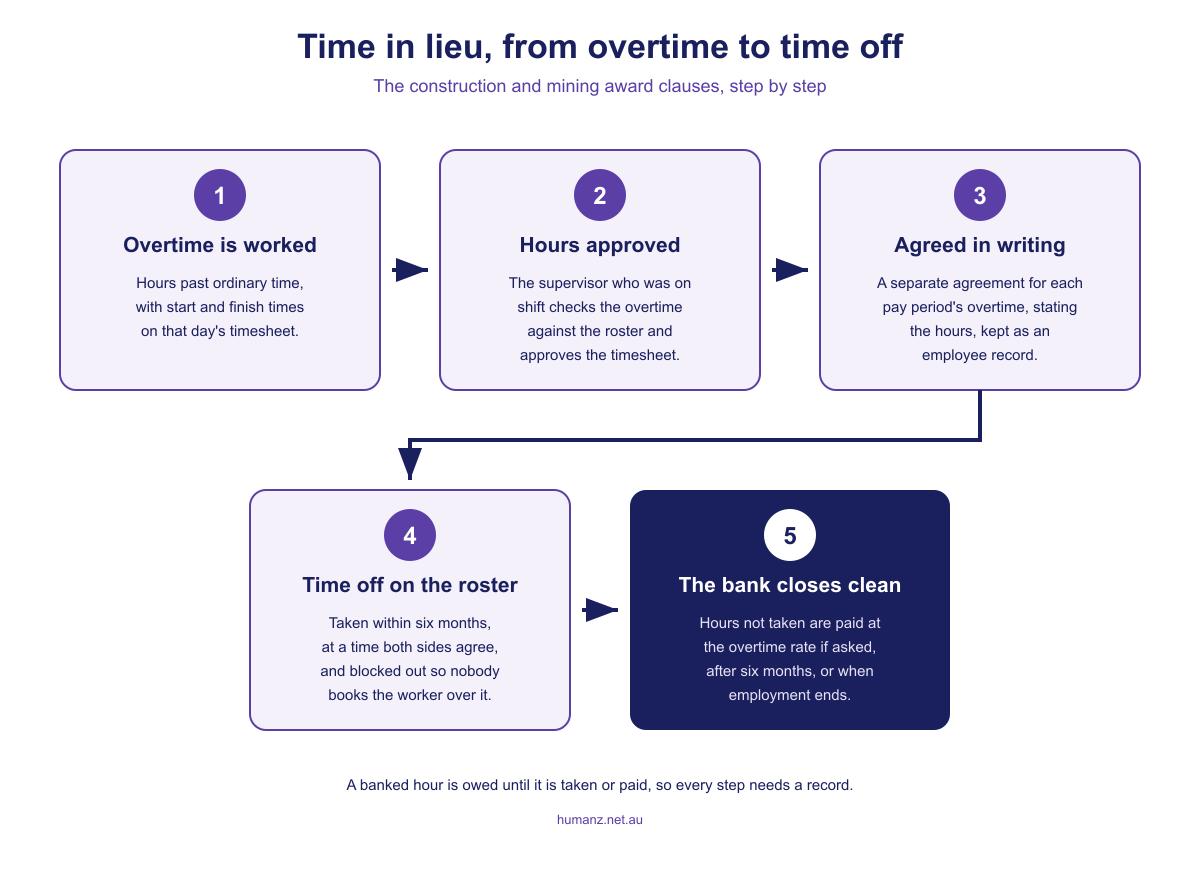
The Building and Construction General On-site Award and the Mining Industry Award use near-identical time-off clauses, which makes them a good baseline. The Road Transport and Distribution Award departs from it in ways the next section covers.
A written agreement for each pay period’s overtime
Under the construction and mining awards, the employee and employer agree in writing that the employee will take time off instead of being paid for a particular amount of overtime already worked. Overtime from each pay period needs its own separate agreement, which rules out a single blanket agreement signed on day one. Each agreement has to state:
- the number of overtime hours it covers, and when they were worked
- that both parties agree the employee may take time off instead of being paid
- that if the employee asks at any time, the employer must pay for hours not taken as time off, at the overtime rate that applied when they were worked
- that any such payment is made in the next pay period after the request
The paperwork is lighter than it sounds. Both awards include a sample form, say there’s no requirement to use it, and confirm an exchange of emails or other electronic means will do.
Hour for hour, taken within six months
Under the construction and mining awards, the time off equals the number of overtime hours worked, so two hours of overtime becomes two hours off. It has to be taken within six months after the overtime is worked, at a time or times the employee and employer agree. The six months runs from when the overtime is worked, not from when the agreement is signed, so one pay period’s agreement can carry more than one expiry date, and a bank built over several pay periods carries several.
When banked hours must be paid out
Under all three awards, the employer must pay for banked hours, at the overtime rate that applied when they were worked, in three situations:
- the employee asks to be paid, at any time, with payment in the next pay period after the request
- six months pass without the time being taken, with payment in the next pay period after those six months
- employment ends while time is still owed
The third is the one nobody budgets for.
No pressure, and the worker can ask first
All three awards say an employer must not exert undue influence or undue pressure on an employee’s decision to make, or not make, a time-off agreement. A worker can also raise it first. If they’re eligible to request flexible working arrangements under section 65 of the Fair Work Act (broadly, 12 months with the employer plus a circumstance such as caring for a child of school age or younger, disability, pregnancy or being 55 or older), each award notes the employer may only refuse on reasonable business grounds. Under the construction and mining awards, an agreed request still needs a separate written agreement for each pay period’s overtime.
How the construction, mining and road transport awards differ
Here’s how the time-off clauses compare in the Building and Construction General On-site Award, the Mining Industry Award and the Road Transport and Distribution Award, each as consolidated to 1 July 2026. An enterprise agreement covering the crew can set different terms.
| Construction (MA000020) | Mining (MA000011) | Road transport (MA000038) | |
|---|---|---|---|
| Time-off clause | 29.13 | 20.5 | 21.5 |
| Employees the clause excludes | Daily hire and casual employees | None stated | None stated |
| Written agreement | A separate one for each pay period’s overtime | A separate one for each pay period’s overtime | In writing |
| Time off banked | The overtime hours worked | The overtime hours worked | Equivalent to the overtime payment |
| Taken within | Six months | Six months | Six months |
| Paid out | On request, after six months or at termination | On request, after six months or at termination | On request, after six months or at termination |
| Agreement kept | As an employee record | As an employee record | As a time and wages record (clause 7.2(b)) |
Construction shuts out daily hire and casuals. Clause 29.13 opens by saying it doesn’t apply to daily hire employees or casual employees, so a daily hire labourer or a casual on a building job can’t bank overtime under the award at all.
Road transport banks the value, not the hours. Clause 21.5 makes the time off equivalent to the overtime payment that would have been made, and the clause’s own worked example gives more hours off than overtime hours worked. A bank tracked hour for hour short-changes the driver. The clause doesn’t require a separate agreement for each pay period, but the award’s facilitative provisions (clause 7.2(b)) still require the agreement to be recorded in writing and kept as a time and wages record.
Mining and road transport casuals need advice first. Neither of those time-off clauses excludes casuals on its face, but each award’s casual clause says a casual who works overtime must be paid the overtime rates. The two sit uneasily together, so get advice before offering a casual time off instead.
Time in lieu on remote sites, swings and shutdowns
The award text is the same for a suburban slab pour and a Pilbara shutdown. The rosters aren’t.
Six months is shorter in swings
On a 2/1 roster (two weeks on, one off), six months holds only eight full cycles, so there are eight or nine R&R breaks to land the time off at a time both sides agree. Mid-swing, a few banked hours are an afternoon in a camp room nobody asked for. Tacked onto R&R, they move a flight. Either way the roster planner needs the expiry dates as much as payroll does.
Shutdowns multiply the paperwork
Under the construction and mining awards, a three-week shutdown on weekly pay can produce three separate agreements per worker, one for each pay period’s overtime. Writing them up from memory at the end is how the agreements stop matching the timesheets.
Banked overtime is still worked overtime
Banking 12 hours doesn’t give back the rest those hours used up. The Mining Industry Award (clause 14.3) and the Road Transport and Distribution Award (clause 21.4) require overtime to be arranged, wherever reasonably practicable, so there are at least 10 consecutive hours off between work on successive days, or 8 for mining shiftworkers. The construction award’s clause 29.8 requires a worker who hasn’t had 10 consecutive hours off after overtime to be released until they have. The wider limits are in our guide to how many hours you can legally work in a row.
Who approves what
Three decisions get made about banked overtime, often by three different people.
- The supervisor who was on shift confirms the overtime happened, through the normal timesheet approval workflow.
- Someone who can commit the employer signs the agreement with the worker. The award sample forms have a line for the employer representative’s signature, and “the leading hand said it was fine” isn’t a written agreement.
- Whoever owns the roster books the time off inside six months, so nobody rosters the worker over it.
What the timesheet, the agreement and the roster need to record
Each record proves something different, and a bank missing one of them is hard to defend.
| Record | What it should show | Why it’s needed |
|---|---|---|
| Timesheet | Overtime hours worked each day, and when the overtime started and finished | The record-keeping rules require one or the other, and the agreement needs both |
| Written agreement | Hours covered, when they were worked, the agreement to take time off and the right to be paid on request | The award, which also requires it to be kept |
| Leave taken | Dates and hours of time off, against the agreement they draw down | Shows the time was used inside six months |
| Roster | The agreed time off, blocked out | Stops the worker being booked over it |
| Payroll | The balance still owed, and any payout | The system that calculates pay |
The timesheet row isn’t optional. Where a penalty rate or loading must be paid for overtime, the Fair Work Regulations require a record of either the number of overtime hours worked each day or when the overtime started and finished. Record both: a construction or mining agreement has to state the hours and when they were worked anyway, and the Ombudsman’s best practice tip is to keep hours records for all employees. Time and wages records are kept for seven years and can’t be changed except to correct an error. The full list is in our guide to the employee records you must keep.
The sample form in the construction and mining awards shows what a usable agreement contains: the employee’s and employer’s names, the date and time the overtime started and ended, the amount worked in hours and minutes, the employer’s agreement to pay for hours not taken as time off if the employee asks, and signatures and dates from the employee and an employer representative.
Records are also where enforcement lands. Fair Work Inspectors handed out 743 infringement notices for record-keeping or pay slip breaches in 2024-25, with $838,000 in penalties paid, according to the Fair Work Ombudsman’s annual report release. The Ombudsman also warns that, in some cases, an employer who hasn’t kept records may have to prove to a court it didn’t underpay an employee, and a bank with no agreement behind it gives you nothing to prove it with.
How Humanz keeps the hours, the leave and the roster together
Humanz doesn’t calculate pay, interpret your award or hold the time in lieu balance. It keeps the records above consistent, so the balance payroll holds is built on hours someone approved.
Overtime gets captured where it’s worked. Timesheets prefill from the roster, get submitted from the phone at site and reach a supervisor for approval, with planned versus worked visible per job. Edited entries carry a warning marker and every approval is stamped to a user and a time, so the hours a time-off agreement covers are hours someone actually checked.
Approved time off goes on the roster. The worker requests leave in the app, the manager approves or declines it with a dated record, and approved leave shows on the roster so nobody books over it. It’s the same thinking as keeping leave inside the roster.
Approved hours then flow to payroll without re-keying, including through the two-way Xero integration, and time and wages records with start, finish and approval trails stay retrievable for seven years. That’s what rostering software built for field crews should do with time in lieu: keep one record from rostered shift to approved hours, so the bank in payroll matches what happened on site.
If you run time in lieu now, spend an hour this week checking that every banked lot has a written agreement, the date the overtime was worked and the date its six months runs out. Fix the lots missing any of those first.
Frequently asked questions
What is time in lieu?
Time in lieu, also called time off in lieu or TOIL, is paid time off an employee takes instead of being paid for overtime already worked. It comes from some modern awards and registered agreements rather than the National Employment Standards. The construction, mining and road transport awards all require a written agreement for it.
How does time in lieu work?
Under the construction and mining awards, the employee and employer agree in writing, separately for each pay period’s overtime, that the hours will be taken as time off. The time off equals the overtime hours worked and must be taken within six months at a time both agree. Hours still owed after six months, on request or at termination must be paid at the overtime rate that applied when they were worked.
Does time in lieu need a written agreement?
Yes, under the Building and Construction General On-site Award, the Mining Industry Award and the Road Transport and Distribution Award, which all require the agreement to be in writing. The construction and mining awards also require a separate agreement for each pay period’s overtime, stating the hours covered and when they were worked, and accept an exchange of emails. The employer must keep the agreement with the employee’s records.
Is time in lieu hour for hour?
Under the construction and mining awards, yes, because the time off equals the number of overtime hours worked. The Road Transport and Distribution Award instead makes the time off equivalent to the overtime payment that would have been made, and its worked example gives more hours off than overtime hours worked. An enterprise agreement can set its own terms.
How long do you have to take time in lieu?
Under the construction, mining and road transport awards, time in lieu must be taken within six months after the overtime is worked, at a time the employee and employer agree. If it isn’t taken by then, the employer must pay for the overtime in the next pay period after the six months, at the overtime rate that applied when it was worked.
Is unused time in lieu paid out when employment ends?
Yes, under the construction, mining and road transport awards, which require time in lieu still owed when employment ends to be paid at the overtime rate that applied when the hours were worked. An employee can also ask to be paid out at any time, with payment due in the next pay period after the request.
Can casual employees take time in lieu?
It depends on the award. The Building and Construction General On-site Award’s time-off clause excludes casual and daily hire employees, while the mining and road transport awards don’t exclude casuals but do require them to be paid the overtime rates for overtime they work. Get advice on the specific award or agreement before offering a casual time off instead of overtime pay.
Related articles
Ready to see Humanz on your own roster?
Free 30-minute walkthrough, we'll use your real crews, sites and shift patterns.