
 Login
Login 

Timesheets & Payroll
Time and attendance software: what it does, and how to digitise records the Fair Work way
By Heather · 20 July 2026 · Updated 6 October 2026

Time and attendance software records when each worker starts, finishes and takes breaks, usually from a phone or a site kiosk, and turns those times into the timesheets payroll pays from and the records a Fair Work inspector can ask for. A time and attendance system is the same thing with the hardware included.
Time and attendance sounds like the most boring system in the business, right up until it isn’t. An underpayment claim or a Fair Work audit turns years of casual record-keeping into an urgent evidence problem. The Fair Work Ombudsman’s 2024-25 annual report counts 25,608 anonymous reports received in a single year, up 50% from the 17,021 the year before. Any worker with a phone can start the records request. If your records live on paper timesheets in an archive box, or in a spreadsheet someone edits after the fact, you don’t really have records. You have a liability.
Australian employers must keep employee time and wage records for seven years, in a form that is legible, accessible and not altered after the fact. The Fair Work Ombudsman’s record-keeping requirements spell out what must be captured, including hours worked for casuals and irregular part-timers, overtime, and penalty entitlements. That casual clause covers more people than it sounds. The ABS counted 2.4 million casual employees in August 2025, 19% of all Australian employees, and casuals paid by the hour are the workers the hours rules treat most strictly. Time and attendance software exists to make meeting that standard the default by-product of running the business, rather than a separate compliance project.
Why paper and spreadsheets fail the audit test
The case against manual time capture is evidentiary, not administrative:
- Backfilled data. Timesheets completed at week’s end are reconstructions, not records. Under scrutiny, “close enough” start times become systematic underpayment exposure.
- No integrity trail. A spreadsheet cell edited three weeks later leaves no trace. Auditors and courts treat alterable records accordingly.
- Illegible, missing, lost. Paper gets wet, skipped and thrown out. A gap in required records is itself a contravention that can attract penalties, and the ceiling lifted when intentional underpayment became a criminal offence on 1 January 2025. The Fair Work Ombudsman’s criminal prosecution guidance puts the maximums at 10 years in prison for an individual, or a fine of the higher of 3 times the underpayment or $1.82 million, and for a company the higher of 3 times the underpayment or $9.1 million. Complete records are the difference between an error and an allegation of intent.
- Reverse onus. In underpayment disputes, an employer who failed to keep proper records may have to disprove an employee’s claim about hours worked. Without records, you argue from nothing.
We’ve covered the operational side in how to reduce timesheet errors. The compliance side is what turns it from a nice-to-have into a requirement.

What digitised time and attendance looks like
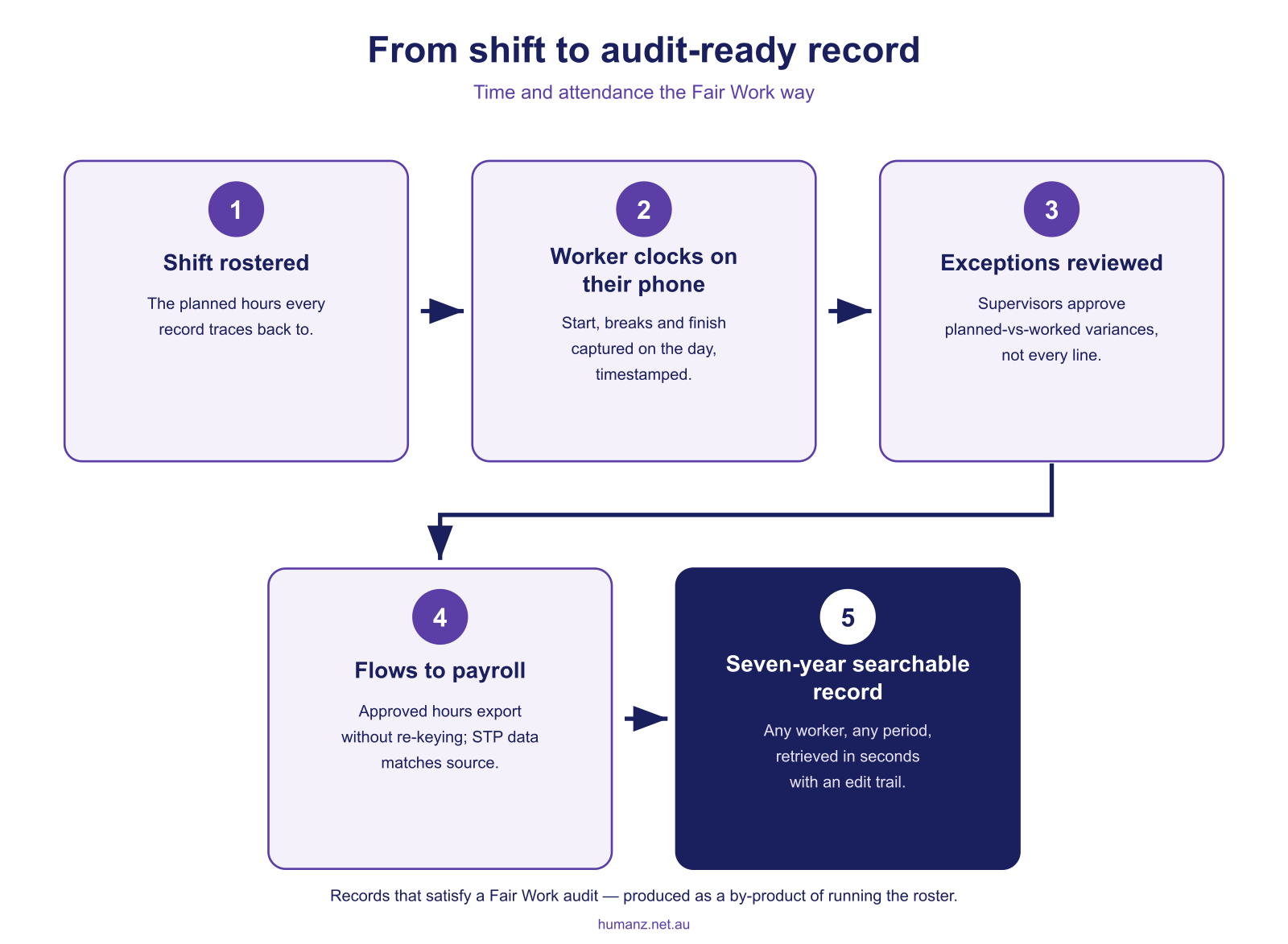
1. Time captured at the point of work
Workers record start, break and finish times on their phone, on the day, against the shift they were rostered. Not from memory on Friday. Timestamps and submission records give every entry provenance. That’s the foundation digital timesheets provide, and it’s what separates a record from a recollection.
2. Roster-connected, exception-based review
When timesheets are generated from the roster and adjusted for actual attendance, supervisors review exceptions (the late start, the extended shift) instead of re-keying every line. That only holds while the roster is true, which is why shift swaps need to run through the system rather than around it. Planned versus worked is visible per shift, which is precisely the data an award-compliance check needs. The approval step is recorded as well, so you can see who approved what and when.
3. Award-relevant data captured, not inferred
Overtime, penalties, allowances and loadings all hinge on when hours were worked, not just how many. Time and attendance software that stamps actual times lets pay be calculated against the applicable award, and defended later if a figure is questioned. The Fair Work Ombudsman’s pay calculator is the reference point for checking entitlements. Your records are what prove you applied them. For shift-heavy businesses, our guide to Fair Work compliance for shift workers covers the obligations in detail.
4. A clean handoff to payroll
Approved time flows to payroll without re-keying, which is the step where most manual-process errors creep in. With Single Touch Payroll reporting pay data to the ATO every pay run, the gap between what your timesheets say and what your payroll reports is not a gap you want. Payroll integration closes it.
5. Seven years of retrieval, in seconds
The record-keeping obligation is at heart a retrieval obligation. Produce this worker’s hours for that fortnight three years ago. Digital records make that a search rather than an archaeology dig through archive boxes, and access controls plus edit trails preserve the integrity that makes them count as evidence.
Making the switch without the drama
Businesses moving off paper usually worry about worker adoption. The transition holds up when three things are true: the app is faster than paper (prefilled from the roster, a few taps to submit), supervisors approve on their phone the same day, and pay queries drop because the data is right. Run the first pay cycle in parallel with paper, fix the gaps, then cut over. Most field teams are fully switched inside a month. The same platform then extends into workforce analytics. Once actual hours are clean, overtime trends and labour costs per site fall out for free. And if you’re weighing up whether the switch is worth it, the free cost calculator estimates what manual roster and timesheet admin is costing you each week.
How Humanz handles time and attendance
Humanz is workforce management software for Australian field crews where time and attendance is wired into the roster:
- Mobile time capture against rostered shifts, with timestamps and full audit trails
- Prefilled timesheets from roster data, so workers confirm and adjust rather than re-enter
- Exception-based approvals with planned-vs-worked visible per shift
- Award-relevant detail covering actual start, finish and break times, not just totals
- Payroll-ready exports that move approved time through without re-keying
- Searchable history for any worker and any period, retrievable in seconds
See how Humanz handles time and attendance →
Frequently asked questions
What is time and attendance software? Time and attendance software records when employees actually start, take breaks and finish work, captured at the time rather than reconstructed later. For Australian employers its real job is making Fair Work record-keeping a by-product of running the business, with hours stored in a form that is accurate, retrievable and not altered after the fact.
Are timesheets a legal requirement in Australia? Time and wage records are. Employers must keep records of hours worked (particularly for casuals and employees paid by the hour), overtime, and pay for seven years. Timesheets are how most businesses generate those records. The obligation is that the records exist, are accurate and aren’t altered after the fact.
What’s the best way to digitise time and attendance records for Fair Work audits? Capture time digitally at the point of work, connect it to the roster so planned-vs-worked is visible, approve with a recorded trail, and store centrally with search. The audit answer is then an export, not a reconstruction.
How is time and attendance different from rostering? A roster is the plan and time and attendance is the record of what actually happened. The two earn their keep when connected, because timesheets generated from rostered shifts let supervisors review exceptions rather than every line, with planned versus worked visible per shift. That gap between planned and worked is exactly the data an award-compliance check needs.
Does this replace payroll software? No, it feeds it. Time and attendance produces approved, award-relevant hours. Payroll applies rates and pays. The integration removes the re-keying step where errors breed.
How long does implementation take? For a field business already rostering in Humanz, time capture is switched on per team. Most run one parallel pay cycle and then cut over, typically inside a month.
Can workers still fudge start times in an app? An app records when the entry was made as well as what it claims, and supervisors approve against the rostered shift. Compared with a Friday-afternoon paper timesheet, the honesty gradient runs strongly in your favour.
What about workers without smartphones? Supervisor-entered time on behalf of a worker is supported. It’s still timestamped against the roster and still auditable. In practice smartphone coverage on Australian field crews is near-universal.
Related articles
Ready to see Humanz on your own roster?
Free 30-minute walkthrough, we'll use your real crews, sites and shift patterns.